The Pain And Promise Of Indian IT Stocks: Is The Worst Over? | Open Interest

The performance of Indian IT companies over the last two years has been closely tied to global macroeconomic events. With a majority of their revenues dependent on international markets, these firms have been hit by successive global shocks — the Russia–Ukraine war that created uncertainty for European clients, the US Fed's rate pause, which dampened discretionary spending, and now the Trump tariffs, which have further clouded business sentiment.
Despite sitting on a multi-year high order book, the sector has struggled to execute projects as clients continue to defer spending decisions in an uncertain global environment.
In recent months, the US has managed to strike tariff agreements with several key partners — the EU, UK, Japan, and select ASEAN nations. However, Washington imposed an additional 25% secondary tariff on India effective on August 27, raising the effective tariff to 50%. This has weighed heavily on investor sentiment, which is currently at a low point.
Foreign portfolio investors have been particularly volatile in their approach to Indian IT. NSDL data shows that FPI assets under custody in the sector rose sharply from Rs 4.98 lakh crore ($60.54 billion) as of August 15, 2023, to Rs 6.90 lakh crore ($82.40 billion) by August 2024. Since then, however, global headwinds have taken their toll — FPI holdings fell back to Rs 5.30 lakh crore ($60.63 billion) by August 15, 2025. In fact, in just the first fortnight of August, FPIs sold $1.6 billion worth of Indian IT stocks.
Amidst this volatility, it appears that the sector may have already bottomed out. Much of the negative news is reflected in stock prices and valuations. While the industry revenue grew 5% in dollar terms in FY25, growth is expected to slow to about 3% this fiscal year. Analysts are already looking ahead, modelling for a recovery in FY27, with June 2027 valuations being factored in.
US Corporate Earnings and IT Spend Outlook
US-based BFSI and other corporates reported better-than-expected earnings last quarter, often exceeding muted street expectations. While tech spending was subdued in the first half of the year, it is expected to pick up in the second half. Overall, 2025 IT spending may remain below 2024 levels, but order flows are likely to bunch up in 2026.
The pandemic was the last major catalyst for global IT infrastructure upgrades, and companies are again expected to refresh systems — this time with AI-driven solutions and efficiency-focused initiatives. According to a recent HSBC report, Indian IT firms now account for nearly 20% of global IT spends and 35–40% of volumes, underscoring their importance in global tech services.
In the UK and Europe, muted corporate earnings are offset by easing tariff risks and progress on Russia–Ukraine peace talks, setting the stage for a revival in IT spending. In Asia, however, tariff uncertainty continues to cloud the outlook.
The threat posed by Global Capability Centres (GCCs) appears to have peaked. While they may dent long-term order flows for large IT companies, GCCs are here to stay and will continue chipping away at spending.
Meanwhile, the Fed's latest commentary suggests a rate cut in September to support the labour market. A dovish Fed stance could revive discretionary spending towards the year-end, with early client discussions already underway. This could provide a short-term boost to Indian IT order flows.
Adding to the optimism, cash-rich Indian IT majors such as Infosys and Wipro have used the current environment to diversify their offerings through strategic acquisitions, enhancing their long-term competitiveness. There is also a factor that street seems to have ignored, for the last four quarters, IT companies has emphasised on reskilling their existing workforce for future deals. This will cushion them from future margin pressure as clients seek to maintain their guidance to the street and their margins.
Valuations
The Nifty IT Index has fallen nearly 15% over the past 12 months, even as the benchmark index gained just over 1%.
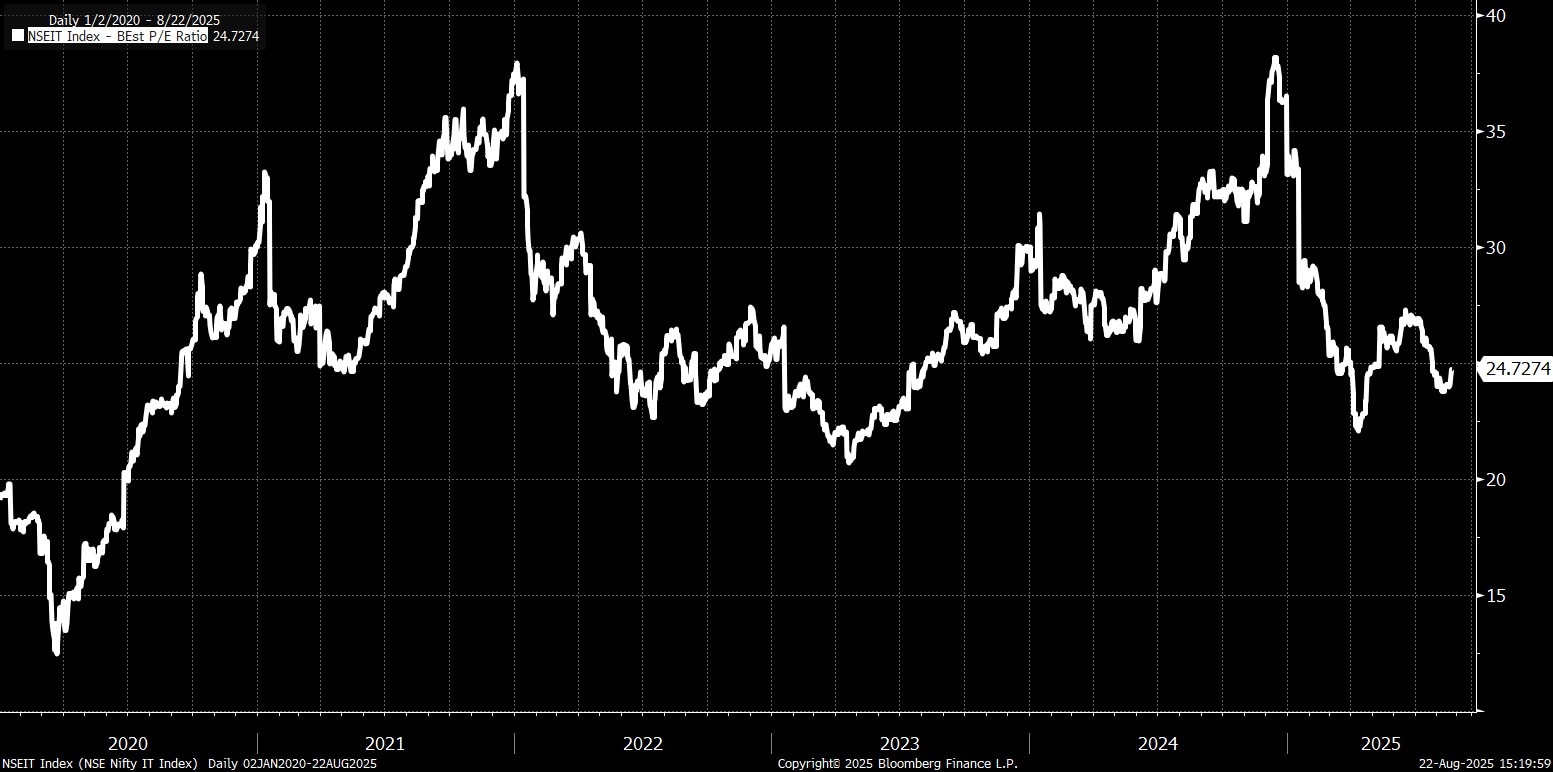
Many IT stocks are down 25–30% from their 52-week highs. The index is currently trading at a forward P/E of 24.7x — the same level as in 2023, from where it later expanded to around 38x, going by historical trends.
Is the worst over? It seems so. But investors should note that FY26 is likely to remain a muted year. The real recovery is expected in FY27 — and as always, markets tend to move ahead of the cycle.

-
India's Troika Of Good Luck | Joining The Dots

A weaker Trump, a cooling AI trade and resilient earnings have put Indian markets back in favour. Rising inflation could spoil the party.
-
Talking Points This Week: Leadership Shock At Nvidia, Earnings Strength, And The Fog Over Hormuz
The Anthropic IPO pricing and first trading day, Nvidia's upcoming earnings, and any fresh signals from Iran will set the tone for the following week.
-
Signature Play: The Classic Cocktail Is Dead. Or Is It?
Classic cocktails are disappearing from India's cocktail menus. But they're still being ordered, taught to bartenders and borrowed from. So, who's really having the last drink?
-
A New Samvat Wishlist: Inclusive Prosperity And Human Development
India has strengthened its economic foundations through infrastructure, digital access and enterprise. Its next growth chapter must deepen productivity, create better livelihoods and widen participation in prosperity.
-
Love, Sex Aur Dhokha: The Audacious Plot To Spy On Jensen Huang
A Taipei dinner, a Singapore chip buyer and a suspected Chinese asset: inside the alleged spy operation that got close to NVIDIA's Jensen Huang.
-
Ten Things I Learnt This Samvat
Patience can be a trap. Cheap stocks can stay cheap. Leverage can wipe you out. What did Samvat 2082 teach us? Niraj Shah writes on 10 lessons from the year gone by.
-
Talking Points This Week: Tech Nerves, FII Buying, And A Faraway Banking Shock
The global markets are not shining this Diwali. The exception in the large markets is, India.
-
Midterm Rally Lasted A Day. The Hard Reality Of A Divided US May Last Two Years | Opinion
Between a contested AI boom, a debt ceiling that arrives in 2027 and a president with every incentive to act alone, the next two years may prove more volatile than the first day's rally suggests.
-
Blue Wave Will Derail the AI Trade but Won't Dismantle the AI Era | Unhedged Position
The Democrats' sweep of the US Congress will see politics collide with economic forces both over the long and short term.
-
It's Time To Take The GST Council's Bet On Trust Global
Payment records can prove India's services exports, and clear, proportionate rules can bring foreign digital sellers into the tax net.









