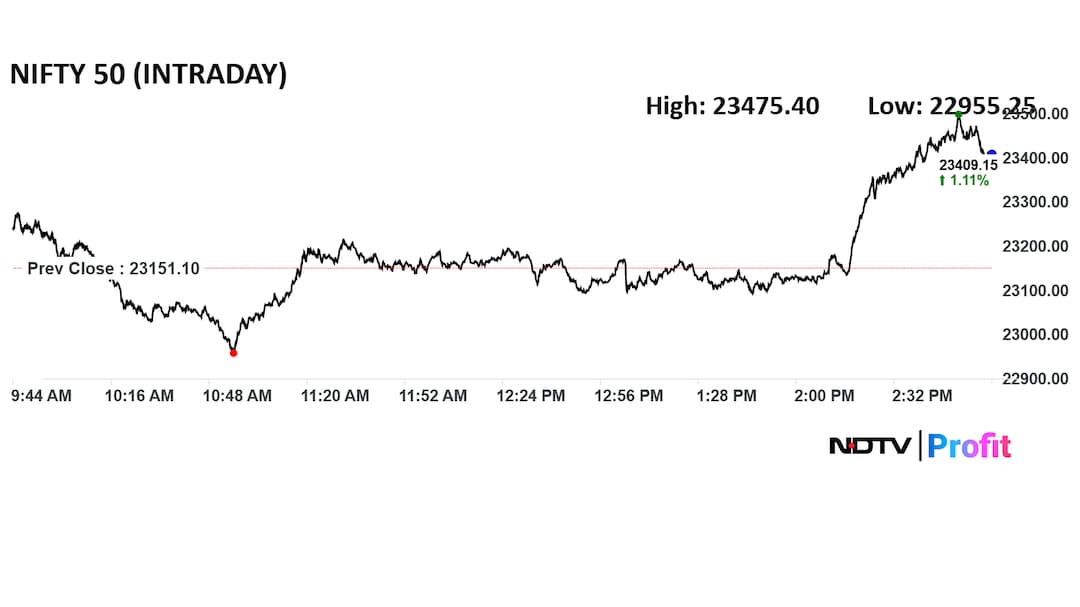
India's benchmark Nifty 50 and BSE Sensex indices saw a sharp rebound from session lows to surge over 1% in the final hour of trade on Monday. The Nifty swung 547 points from the session low to its high. To be sure, there were no weekly derivatives expiry for either of the indices.
Dalal Street suffered its worst weekly drop in years last week — wiping out billions in market value. A sharp surge in international crude oil prices linked to the ongoing conflict in the Gulf, weak global cues, persistent foreign institutional selling, a depreciating rupee and rising volatility as measured by the India VIX have driven Indian equities lower.
Here are the key reasons behind the rise in Nifty and Sensex.
US Trade Deal Hopes
The recovery in the stock market came after a senior trade official said India and the United States will formally sign a trade deal after there is clarity on the legal nature of tariffs, dismissing claims of any "standoff". The US is India's largest export destination. The two countries agreed to a trade pact early February, but implementation has been stalled due to a US Supreme Court verdict invalidating the Trump tariffs.
Data released after noon showed India's trade deficit narrowed and exports remained resilient.
Domestic Buying
Domestic institutional investors have been lapping up shares dumped by foreign funds for a while now. Over the last one month, while FPIs have offloaded stocks worth Rs 69,000 crore, DIIs have pumped in Rs 1 lakh crore.
Last week, even as the Nifty and Sensex lost over 5% in value, DIIs bought shares worth Rs 44,711 crore. FPIs sold Rs 41,000 crore during the period.
Gulf Oil Supply
External Affairs Minister S Jaishankar hailed the direct talks with Iran and said it was the most effective way to resume shipping through the Strait of Hormuz. In an interview with Financial Times, Jaishankar said that his talks with Iranian officials have yielded results, adding that the communication continues. "If it is yielding results for me, I would naturally continue to look at it," he said, noting that “many more” Indian-flagged ships are yet to cross the strait.
India imports roughly half of its crude oil from the Gulf region, a source scuttled due to the virtual blockade of the Strait of Hormuz by Iran.
Essential Business Intelligence, Continuous LIVE TV, Sharp Market Insights, Practical Personal Finance Advice and Latest Stories — On NDTV Profit.