India's IPO Mania: Here's All You Need To Know In Charts
India's primary market has grabbed headlines this week, following the rising frenzy in the initial public offerings of small and medium companies along with a change in overseas investors' outlook towards fresh issues.
There is more to it. Listing of small companies remains very lucrative despite the increasing probe by the markets regulator. Most public issues consist of offer for sale with very limited proceeds locked for capital expansion. Equity markets have become costly, and so foreign investors have targeted the primary market.
NDTV Profit breaks down the layers to help understand the dynamics in Asia's third-largest primary and secondary market.
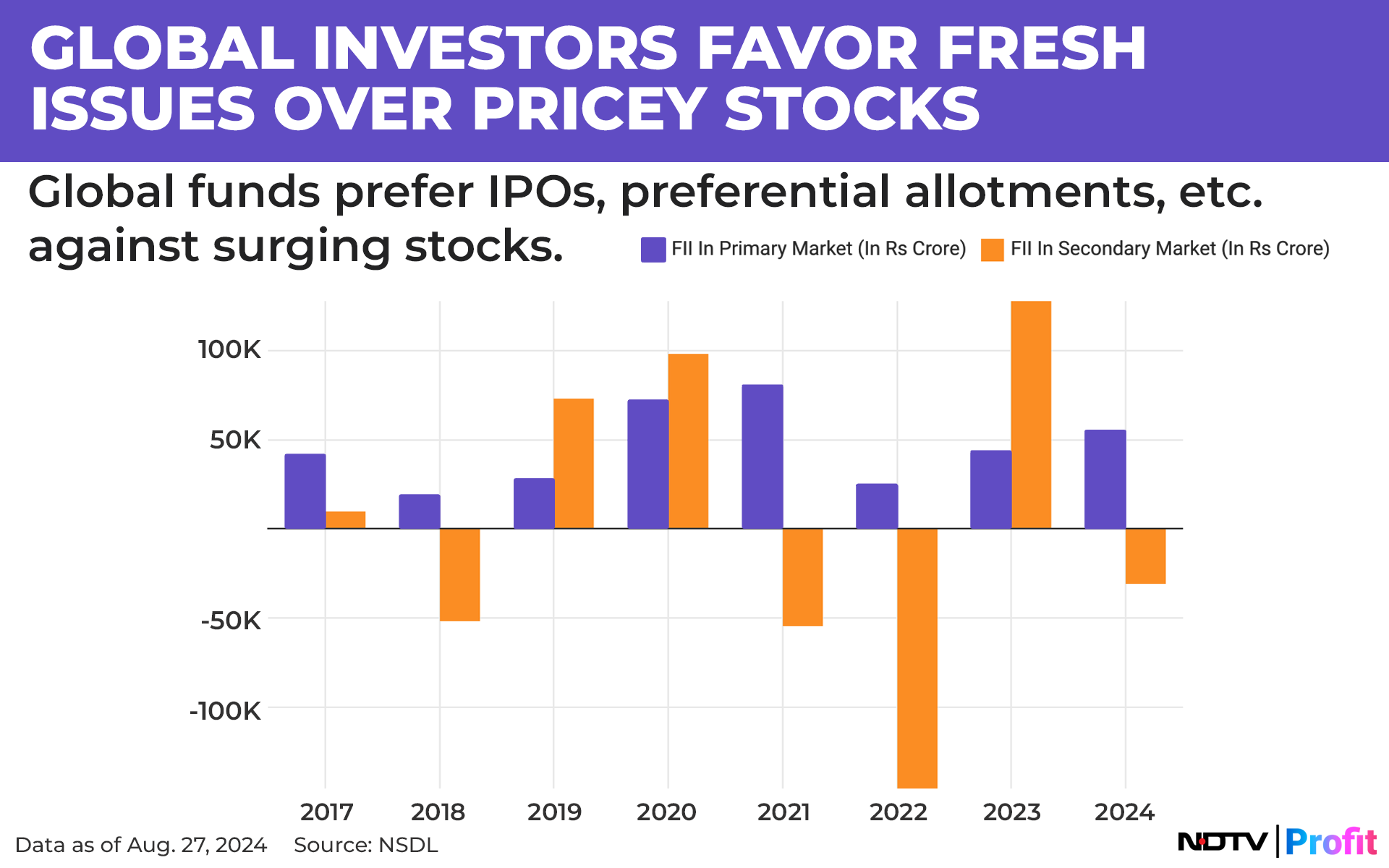
Foreign investors have changed focus from secondary to primary markets as stocks have become costlier across the board. So far this year, overseas funds have bought shares worth Rs 54,782.4 crore in the primary market which consists of initial public offerings, preferential allotments and sales to large investors. Meanwhile, they have sold stocks worth Rs 30,670.3 crore in the secondary market.
.png)
India's benchmark indices—the NSE Nifty 50 and the S&P BSE Sensex—have risen 15% and 13.2% respectively so far this year, making them the fifth and seventh best-performing Asian indices.
The mid-cap benchmark is valued over Nifty 50 and the small-cap stocks, continue to gain more despite froth concerns. The price-to-equity ratio of the Nifty is valued at 24.4, while that of the small-cap and the mid-cap index is at 33.6 and 45.8, respectively.
The foreign inflows in the primary marker have hit the highest since 2021 while they have sold in the secondary market after pocketing in the previous year.
There's a surge in IPOs as companies line up to go public in 2024 as a confluence of factors has boosted India's primary market, according to Pantomath Capital Advisors Pvt. "The biggest reason is India's strong macro environment, which has raised investor confidence."
The healthy performance of several new stocks in the last couple of years has also drawn investors to new IPOs, Pantomath Capital said.
In another interesting trend, two-thirds of IPOs this year have been offer for sale from private equity investors and promoters. Of the remaining one-third, only 20% of the proceeds are intended for capex, said Ashish Gupta, chief investment officer of Axis Asset Management, in a report.
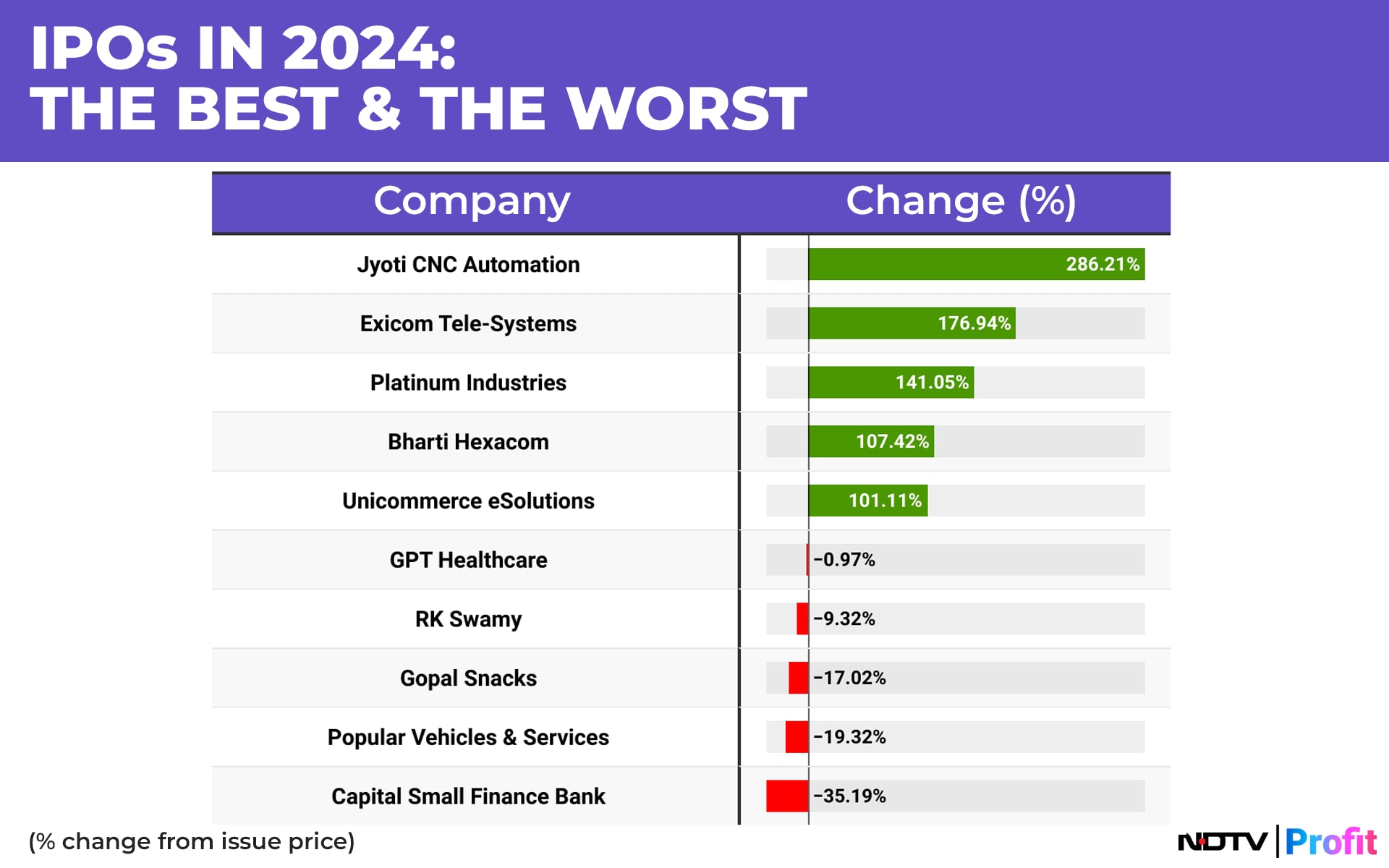
Among the companies that have debuted this year in the mainboard space, Jyoti CNC Automation Ltd.—with over 280% returns—has been the top performer. Exicom Tele-Systems Ltd., Platinum Industries Ltd., Bharti Hexacom and Unicommerce eSolutions are the other top IPOs with over 100% gains.
Capital Small Finance Bank, Popular Vehicles & Services Ltd. and Gopal Snacks Ltd. have been the loss-making IPOs so far this year.
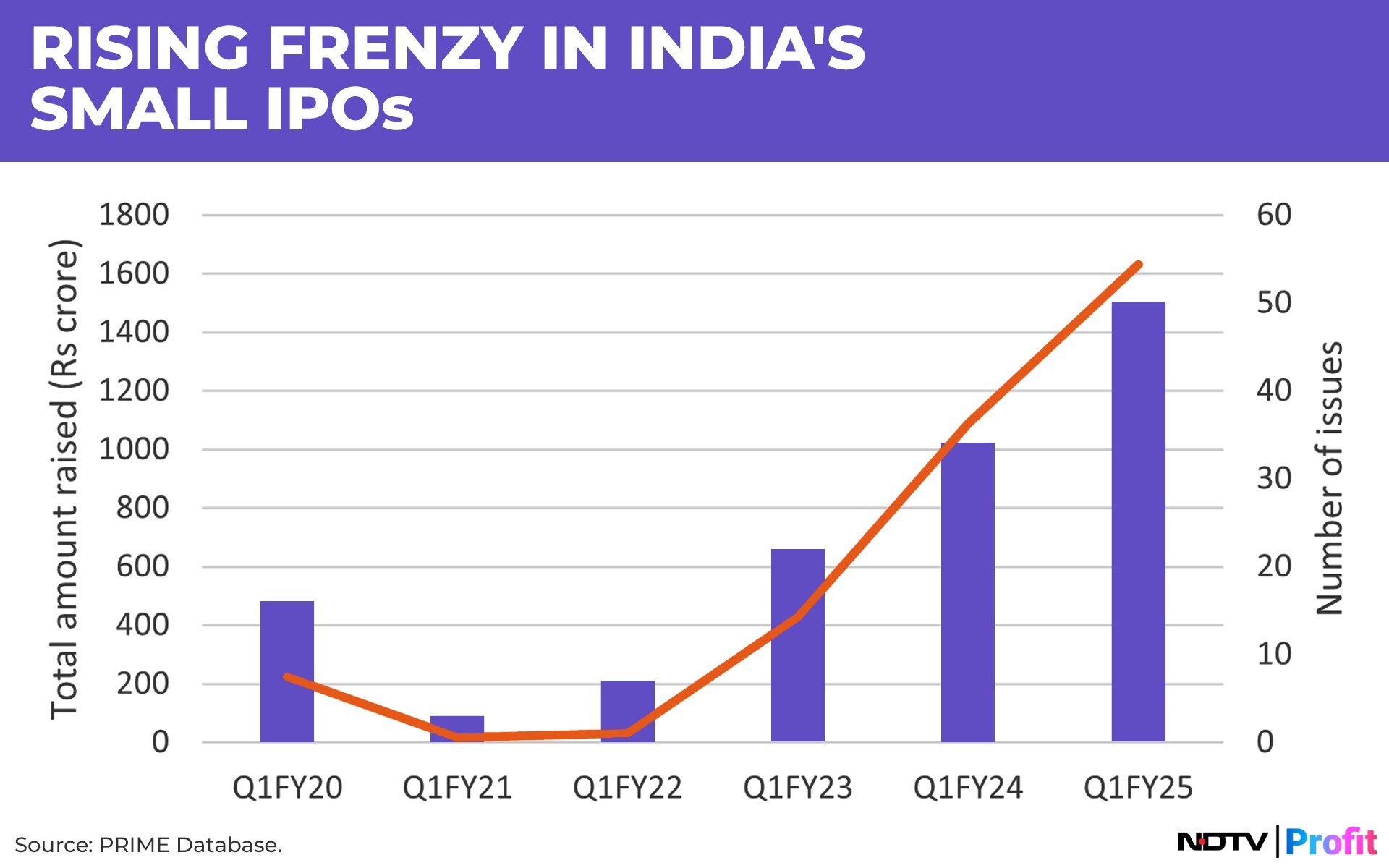
The focus now shifts to the rising mania in the country's SME issues and listings. The total amount raised via the initial public offering in the SME space doubled in the first six months, compared to the same period last year with 117 companies participating, a surge of over 60%.
In terms of the number and total funds raised, the first quarter of the current financial year is the highest in the last five years, with 50 companies raising Rs 1,632.3 crore, according to data from Prime Database.
Despite regulatory scrutiny looming over the debut price, SME IPOs have been one of the easiest ways to quickly double investors' wealth since July—when the 90% cap for listing was set. About 15 of the 33 listings, or nearly one in two companies, doubled in value on the day of the debut.
Liquidity, FOMO Effect and retail participation are the key drivers for the recent surge in SME stocks and strong listings gains, according to Vaibhav Porwal, co-founder, Dezerv.
The frenzy in this space is only limited to listing days, as shares tend to drop right after their debut. Many of the SME companies listed this year were trading below their listing day price, according to exchange data.
SMEs contribute substantially to India's GDP and employment generation and access to the capital market is a development and has to be encouraged, said V K Vijayakumar, chief investment strategist, Geojit Financial Services Ltd. "But recent developments indicate excesses...Experience tells us that speculative excesses lead to tears."
.png)

-
Rs 50-Lakh Gold In Bank Locker, Rs 3 Lakh Of Protection: The Gap Most Families Don't Know About

The RBI ties a bank's liability to the annual locker rent and families who want to insure their jewellery face a separate question about how to prove what was inside.
-
The More Food Turns Into Fuel, The Harder It Is To Read Agricultural Markets | The Reason Why
A policy designed to reduce dependence on imported fuel can create new pressures elsewhere in the food economy.
-
Your iPhone Costs 12 Grams Of Gold, A Car About 100. What Does Your Life Weigh?
Measured in rupees, almost everything looks more expensive than it did a generation ago. Measured in grams of gold, a lot of it has become cheaper.
-
Gold Is Rs 22,000 Cheaper Than A Month Ago. Should You Buy Amid The Wedding Season?
Gold's potential slide to $3,500 could save around Rs 4,700 per 10 grams, but a soft inflation print could just as easily push prices back up. One way to split the risk is to buy in parts, some now and the rest after the Fed's Dec. 9 decision.
-
AI Agents Are Gaining Power. Who Governs Them?
Artificial intelligence agents promise to transform productivity by moving machines from assisting decisions to executing them. But as organisations delegate greater authority to these AI-agents, they must first establish who controls that authority and who remains accountable when things go wrong.
-
Why Swapping Your Old Gold Can Trigger A Rs 5 Lakh Tax Bill, And How You Can Avoid It Legally
Swapping old gold for new is taxed as a sale and a fresh purchase. Getting your own gold remade can cut most of that bill, though it has its own costs.
-
The AI Trade is Done. The Real Opportunity for Investors Starts in 2027 | Unhedged Position
As pureplay AI stocks plunge and circular, capex-led financing unwinds, 2027 is set to be a year of reckoning for AI companies. Yet the bust clears the way for a better opportunity for investors in 2027 -- shifting the spotlight from AI builders to the companies using AI.
-
Leadership As Mission: Why The Age Of AI Demands More Human Leadership
Debjani Ghosh examines how AI is changing leadership, arguing that its success must be measured by its impact on people and the accountability of those guiding its use.
-
We May Need Another Tukaram Mundhe To Fight Air Pollution | The Reason Why
Developers may install basic measures such as sprinklers and green nets, resume work, and continue violating rules when this equipment stops working.
-
Extracting Value From Battery Scrap Could Be Challenging For India | The Reason Why
A discarded lithium-ion battery still contains valuable materials such as lithium, nickel and cobalt. These can be recovered and reused. When such batteries are crushed and shredded, they produce a dark powder called black mass.









