RBI Monetary Policy Committee: What We Know About The New External Members
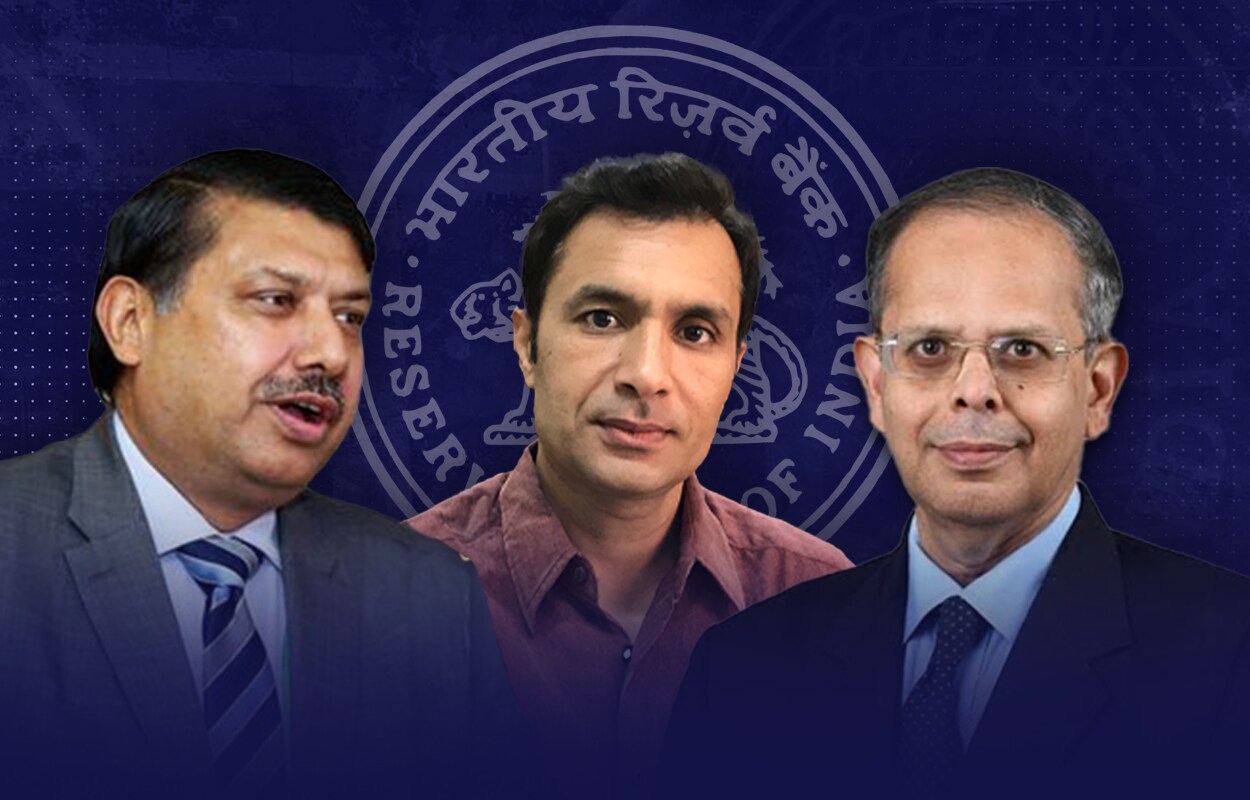
The government on Tuesday appointed three new external members, including Ram Singh, Saugata Bhattacharya, and Nagesh Kumar, to the Reserve Bank of India's monetary policy committee. The reconstitution of the panel has come ahead of the crucial policy meeting on interest rate decisions, slated between Oct. 7-9.
These new members are replacing Mumbai professor Ashima Goyal, IIM-Ahmedabad professor Jayanth Varma, and New Delhi senior adviser Shashanka Bhide, whose tenure ends on Friday. The other members of the committee include Governor Shaktikanta Das, Deputy Governor Michael Patra, and Executive Director Rajiv Ranjan.
Ram Singh
Ram Singh is the director of the prestigious Delhi School of Economics, with a Ph.D. (JNU, New Delhi) and Post-Doctorate (Harvard) degrees in law and economics, as per the research portal Ideas For India. His areas of research interests are contract theory, public economics, and public private partnerships.
He is a recipient of Fulbright, Commonwealth, Erasmus Mundus Fellowship in economics and Ronald Coase Fellowship in economics. His publications can be found on the Economic and Political Weekly. One of his publications— 'The Efficiency of Comparative Causation' (with Francesco Parisi)—is in the Review of Law and Economics, 2011.
Apart from DSE, he has taught at Brown University, University of Hamburg, Jawaharlal Nehru University, and has been Commonwealth Fellow at the London School of Economics.
Saugata Bhattacharya
Saugata Bhattacharya is ex-chief economist at Axis Bank Ltd., with over 30 years of experience in economic and financial markets analysis, policy advocacy, infrastructure and project finance, consumer behaviour and analytics.
He is also a senior fellow at Centre for Policy Research. According to the CPR portal, Bhattacharya plays a lead role in the ongoing work with the Government of Andhra Pradesh—supporting its Data Analytics Unit. He also pursues his research interests in macro-financial forecasting, reviewing global and domestic developments, the MSME sector, digital public infrastructure in banking, financial and insurance sectors, and urbanisation.
Earlier, at IDFC, he worked as a specialist with the Policy Advisory Group and participated in several key committees of Government of India, including the Prime Minister's Task Force on Infrastructure.
Nagesh Kumar
Nagesh Kumar is the director and chief executive of the Institute for Studies in Industrial Development. Prior to taking up this role in May 2021, Kumar served as director at the United Nations Economic and Social Commission of Asia and the Pacific, holding several senior management roles during 2009-21, including as chief economist, director of macroeconomic policy and financing for development division and social development division at the UNESCAP headquarters in Bangkok. He was also head of the South and South-West Asia Office located in New Delhi, that he had established.
Kumar is a non-resident senior fellow of the Boston University Global Development Policy Center. Holding a PhD in Economics from the Delhi School of Economics, Kumar was recipient of the Exim Bank's first International Trade Research Award in 1990, and GDN's Research Medal awarded by the World Bank and the Japanese Government in Tokyo in 2000.

-
Where You Live Shapes How You Get To Work | The Reason Why

Two-wheelers are the most popular way to get to work in India, accounting for nearly 43% of workplace commutes.
-
High US Salaries, No Green Card Certainty: The Financial Calculation Facing Indian H-1B Families
The suspension of PERM processing at eight technology employers does not cancel existing H-1B visas. What it does is force a question many Indian families have been avoiding: is the US salary worth tying your career and family plans to one employer?
-
Unhedged Position: Can India See An Indonesia-Style Time Correction?
The Nifty is trading below levels it first clocked in 2024. Is there, then, as I have suggested in the headline, potential that the current time correction drags on painfully for the next three-five, even ten years?
-
Navigating Friction And Energy Realities: An Analysis Of Marco Rubio's October Visit To India
Occurring at a critical juncture marked by stalled trade negotiations and escalating geopolitical pressures over global energy supplies, the visit offers a profound window into modern US-India relations.
-
India Exports Capital. Why Not Export Trusteeship?
The big question, then, is whether India can build an institution that global borrowers, investors, banks, and lawyers can trust, even without an Indian connection.
-
France's Economy & Politics Are In Crisis | The Reason Why
Let's look at how the French economy and politics evolved under Nicolas Sarkozy, Franois Hollande and Emmanuel Macron.
-
You May Inherit The Business. You Must Earn Its Credibility.
Succession tests the founder's ability to share authority as much as it tests the next generation's readiness to assume it.
-
Signing Deals Is One Thing; Making Them Work Is Another | The Week In Whys
Sometimes, things don't turn out as planned. Indian companies have lost some bids to rivals, some projects won't produce until 2030.
-
FOMC Wall, PERM Suspension, Hospital Stocks | Talking Points This Week
A PERM suspension would directly affect green-card sponsorship rather than H-1B visas, so the near-term earnings impact could remain relatively limited. The key question is whether this marks a new phase in US scrutiny of Indian IT.
-
Everything, Everywhere, All At Once: Dalal Street's Week To Forget | Joining The Dots
Visa curbs, a Starlink spat and cancer drug caps: what connects this week's shocks for Indian markets









