Navigating Energy Crossroads: S Jaishankar's Call For Diversified Supply Chains At G20 Ministerial Meeting
As geopolitical fault lines continue to test maritime trade routes and commodity flows, Jaishankar's message remains pertinent: true economic resilience requires open markets, protected transit lines, and a genuine commitment to multilateral cooperation rather than coercion.
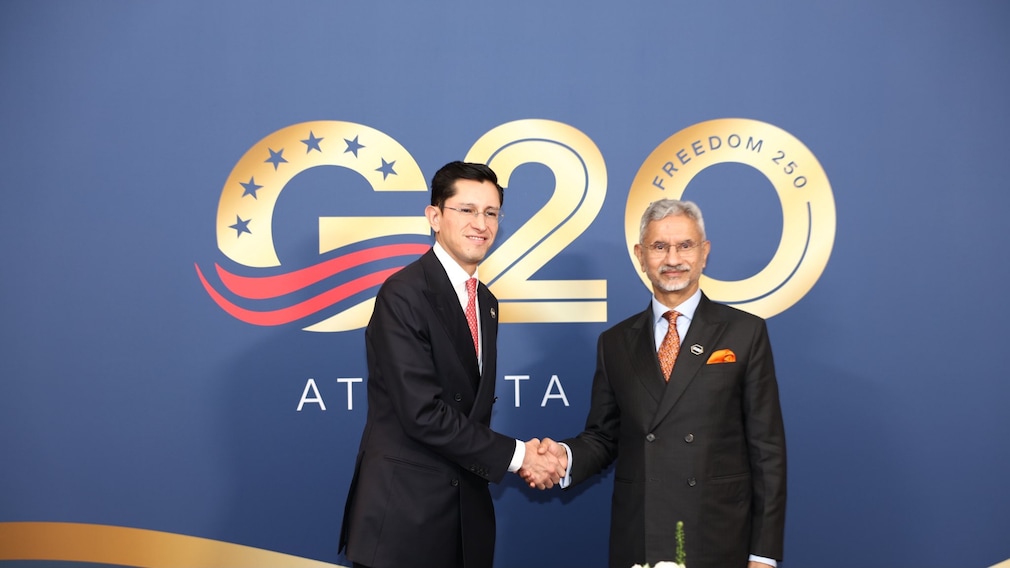
The contemporary global order faces a structural paradox: while interconnectedness defines modern commerce, geopolitical fragmentation increasingly weaponises those very connections. This tension formed the centerpiece of Indian External Affairs Minister S Jaishankar's address at the G20 Foreign Ministers' Meeting in Atlanta, United States, convened by US Secretary of State Marco Rubio on October 29-31, 2026.
Amid volatile markets, Middle Eastern conflicts, and transit chokepoints, Jaishankar articulated a clear vision for global energy security-one that challenges the politicisation of resources and champions diversified, predictable, and equitable supply chains. His address serves as both a critique of unilateral market distortions and a blueprint for global economic equity, particularly for low-income and developing nations.
The Diagnosis: An Artificial Crisis of Predictability
Jaishankar framed the global energy dilemma not strictly as a crisis of physical production, but as a crisis of unpredictability, disruption, and access. In his remarks at the G20 plenary, he underscored that deliberate interference-through unilateral sanctions, maritime chokepoints, and targeted disruptions of energy infrastructure-functions as a calculated strategy to hold global prices hostage.
For major emerging economies like India, which remains among the world's largest importers of oil, liquefied natural gas and fertilisers, these market distortions carry immediate domestic consequences. Jaishankar pointed out that continuous market manipulation displays little regard for the economic survival of low-income and developing nations. Furthermore, he criticized the habit of drawing convenient, selective distinctions between oil and gas, noting that selective carve-outs distort fair competition and stability.
Diversification and De-Risking as Strategic Imperatives
At the heart of Jaishankar's Atlanta address was a straightforward prescription: diversification and de-risking. As global trade routes face heightened risks-ranging from conflict around the Strait of Hormuz to systemic shocks-relying on concentrated, linear supply chains is no longer viable.
Jaishankar urged the G20 to work collectively toward the depoliticisation of energy markets, arguing that global commerce requires insulation from zero-sum geopolitical rivalries. For India, a country heavily reliant on crude oil, liquefied natural gas and fertiliser imports, energy security is directly tied to national development. In the short term, this means securing reliable, predictable liquid petroleum gas supplies for domestic clean cooking initiatives.
In the long term, it demands a robust framework for critical minerals, which are indispensable to the renewable energy transition. Highlighting India's National Mission on critical minerals-stretching from exploration to recycling-Jaishankar proposed a "G20 Critical Minerals Circularity Initiative" to prevent a new era of resource monopolisation.
The Broader Geopolitical Context
Jaishankar's intervention in Atlanta did not happen in a vacuum. It coincided with parallel deliberations, including a Quad Foreign Ministers' meeting on the sidelines and broader US-led foci on maritime security, sea lanes, and economic resilience. While Western powers often frame supply chain resilience through the lens of strategic competition, Jaishankar's stance injected the perspective of the Global South-insisting on the right to industrialise, resist predatory commercial practices, and prevent the weaponisation of trade.
Jaishankar pointedly noted that the deliberate weaponisation of energy trade and calculated attacks on infrastructure are being used to hold global energy prices hostage. In a globalised economy, these continuous distortions-manifesting as sanctions, geopolitical obstacles, and selective carve-outs between oil and gas-reverberate far beyond their intended targets. Jaishankar's sharp critique exposed the hypocrisy of wealthy nations drawing convenient distinctions in energy policies, which ultimately leave the Global South to bear the brunt of unaffordable costs and compromised access.
Conclusion
S Jaishankar's address at the Atlanta G20 ministerial serves as a wake-up call against the geoeconomic fragmentation of energy and resource flows. By tying market predictability directly to the welfare of developing populations, India positioned energy security not as a narrow national metric, but as a collective global public good.
As geopolitical fault lines continue to test maritime trade routes and commodity flows, Jaishankar's message remains pertinent: true economic resilience requires open markets, protected transit lines, and a genuine commitment to multilateral cooperation rather than coercion.
Ultimately, the Atlanta address reinforces India's role as a pragmatic, balancing power in an unsettled world. By engaging in extensive bilateral diplomacy on the margins of the G20-meeting with counterparts from Latin America, Europe, and East Asia to secure lithium, technology, and manufacturing partnerships-India is actively practicing the diversification it preaches.
Jaishankar's call to action is a reminder to the G20 that keeping energy markets open and predictable requires genuine multilateral leadership, wider access to green financing, and advanced collaboration in technologies like green hydrogen and small modular reactors. Only by de-politicising energy flows can the international community build a resilient economic architecture that protects the vulnerable and fuels global growth equitably.
Disclaimer: The views expressed in this article are solely those of the author and do not necessarily reflect the opinion of NDTV Profit or its affiliates. Readers are advised to conduct their own research or consult a qualified professional before making any investment or business decisions. NDTV Profit does not guarantee the accuracy, completeness, or reliability of the information presented in this article.
-
Indians Are Travelling, But Not Every Journey Is A Holiday | The Week In Whys

Pilgrims, patients and working women are the real travellers, and the system hasn't quite caught up with them.
-
Getting To Work Costs Women More | The Reason Why
It is not just about women paying more than men. It is about women paying much more in cities than in villages.
-
AI Bias In Investing Cannot Be Eliminated, But It Can Be Governed
Framing is a particularly important example as identical financial information presented in terms of gains rather than losses can lead an LLM to reach a different assessment.
-
Joining The Dots | Dark Skies, Steady Diya: Why Hope Holds This Diwali
With war, a weak rupee and foreign outflows weighing on sentiment, policymakers at the NDTV World Summit and market veterans at NDTV Profit Ignite: Diwali Edition offered the same advice: stay invested and filter out the noise.
-
The Curious Case of Equitas Small Finance Bank And A CEO Who Quit For Stock
PN Vasudevan believes persistent investor concerns over a perceived conflict of interest had become a governance overhang on Equitas Small Finance Bank's stock, even as the lender improved profitability and asset quality.
-
Talking Points This Week: AI Cash Burn, A Tiger Comeback And An India That Still Finds Its Own Path
India is not immune to higher oil or tighter global liquidity, yet its earnings base is broader, its domestic policy levers are still available.
-
Foreign Investors Own Half Of HDFC Bank and ICICI Bank. An LTCG Cut Could Matter Most Here
Foreign portfolio investors have US$115 billion parked in HDFC Bank, ICICI Bank. If the government cuts long-term capital gains tax, Jefferies says returning foreign money could land here first.
-
'Never Seen This Level Of Negativity': Sandeep Tandon Says The Next Rally May Be Closer Than You Think
Veteran investor Sandeep Tandon says foreign selling is easing, large-caps are due a comeback and mid-caps are crowded, while he turns positive on gold, power and pharma this Diwali.
-
Indians Stay With Family, Not In Hotels | The Reason Why
India still lacks enough clean, reliable and affordable hotels for budget-conscious travellers.
-
The Economic Imperative: Analysing The Material Driving Force Behind India-Canada Strategic Reset
This economic complementarity is further reinforced by deep institutional investment ties and talent mobility, which form the bedrock of the bilateral framework.










