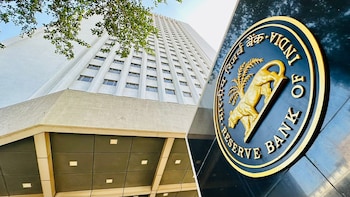
The Reserve Bank of India (RBI) is likely to keep interest rates on hold this week, analysts and economists said.
The central bank is due to review monetary policy on Friday, having said in October that the likelihood of another hike in rates was "relatively low".
Falling investments by the private sector, a lower than expected GDP growth and a negative fall in IIP for October have raised hopes for a rate hike pause by RBI.
Predictions of a softening of the bank's hawkish stance have grown amid fears that meeting even the government's revised growth target of 7.5 per cent this year may be optimistic in the current economic climate.
Industry lobby groups like Federation of Indian Chamber of Commerce and Industries or FICCI and Confederation of Indian Industries (CII) have called for a cut in rates. CARE, a credit rating agency, expects cash reserve ratio or CRR to be cut to inject money into the system ahead of the advance tax payment deadline of 15 December for corporates and individuals. CRR is the minimum percentage of deposit banks have to hold with RBI.
Output shrank 5.1 per cent year-on-year in October, with the slump felt in key sectors such as manufacturing production, mining and capital goods.
"The industrial slowdown is taking very serious dimensions and there is an urgent need to improve sentiments if the downward trend has to be checked," said CII director-general Chandrajit Banerjee.
A cut in rates is not the only way RBI could inject short-term liquidity. It could use other tools to boost short-term liquidity like open market operations, where it buys government securities and injects liquidity into the system.
At 6 per cent, CRR is way below the peak of 9 per cent reached in October 2008.
Most bankers and analysts expects RBI to keep rates unchanged.
State Bank of India (SBI) chairman Pratip Chaudhry expects RBI to hold interest rates at current levels during its mid-term review meet on Friday.
"They will hold the rate steady on Friday," said DK Joshi, chief economist at analysts Crisil. "They will give a dovish guidance on the economy... I think the tone will change," he said.
Chairman of Prime Minister's Economic Advisory Council C Rangarajan said a pause in rate increases "is something that's likely to happen".
“This is a difficult time for the RBI. They have to maintain a tight stance with inflation lingering. They need to keep the policy rates where they are to see a sustained downtrend in inflation. The weakness in the exchange rate will not help cut rates at the moment," Leif Eskesen, Chief Economist for India & ASEAN, HSBC Global Research said.
Headline inflation for November eased to 9.11 per cent against 9.73 per cent in October. That was less than what analysts expected.
The RBI would also have to factor in the eurozone debt crisis, which is hitting growth around the world and has prompted other central banks to ease their monetary policy stance, analysts said
The RBI's repo rate, at which it lends to commercial banks, is at a near three-year high of 8.50 per cent. The reverse repo rate that it pays banks for deposits is at 7.50 per cent -- its highest in more than a decade. Governor Duvvuri Subbarao maintains that the succession of 13 rises since March last year was designed to tame spiralling inflation running at nearly 10 per cent, even if it means that short-term growth takes a hit.
(With agency inputs)
Essential Business Intelligence, Continuous LIVE TV, Sharp Market Insights, Practical Personal Finance Advice and Latest Stories — On NDTV Profit.