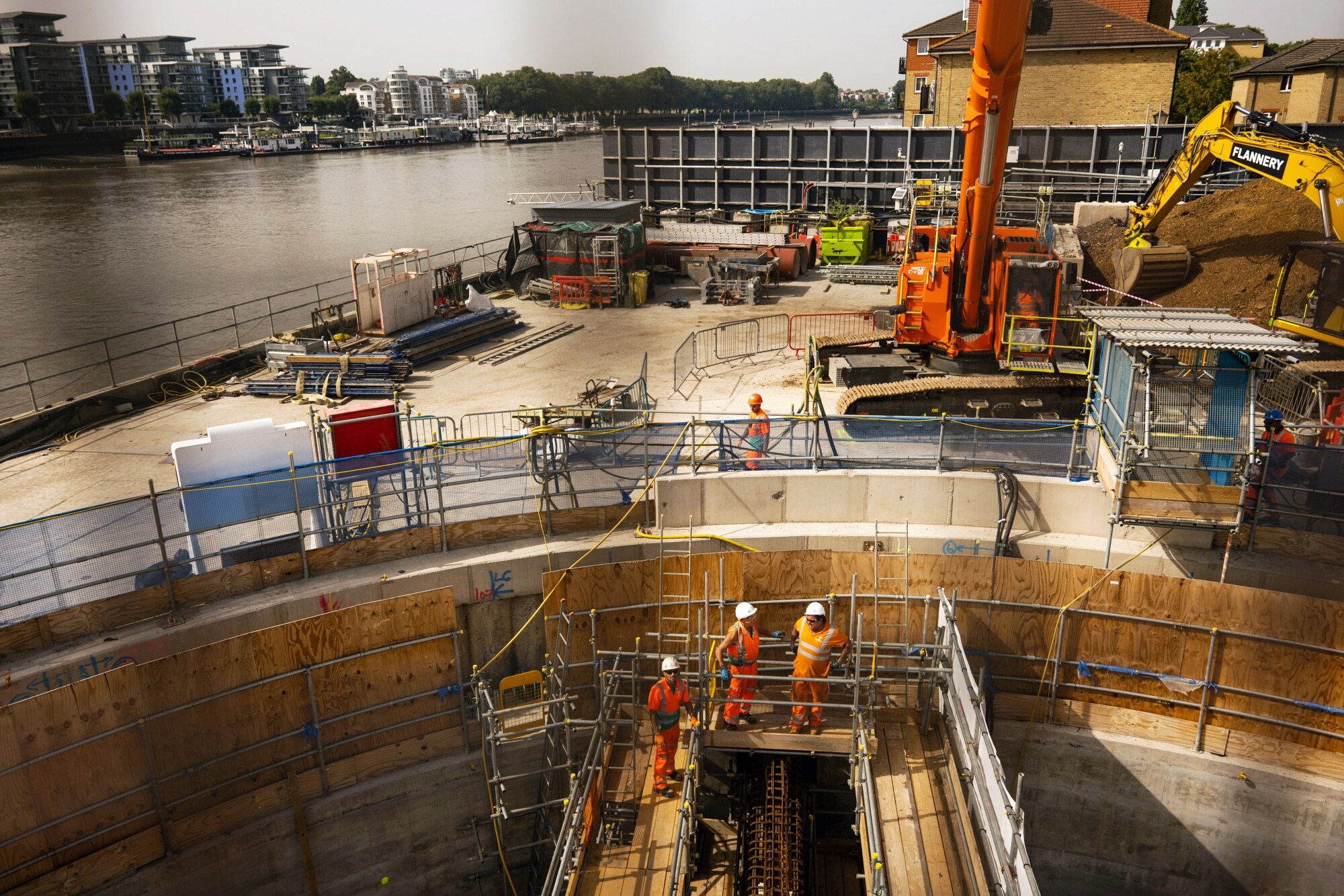
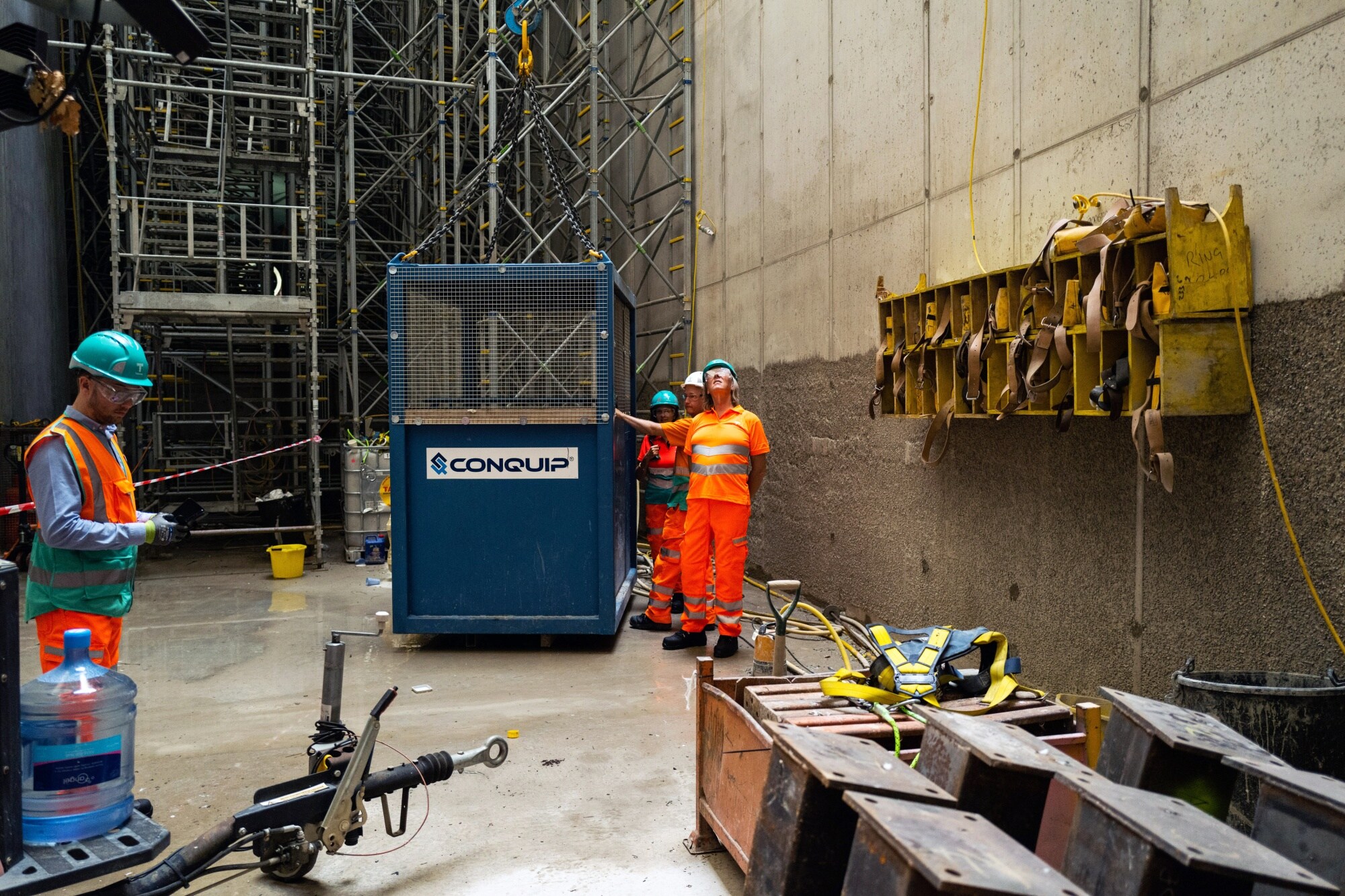
(Bloomberg) -- The journey into London's new sewer system begins with a safety briefing and a wardrobe change — a hard hat, goggles and gloves, steel-toe boots, high-visibility orange trousers and matching shirt. Then comes the 40-meter (131-foot) descent in what looks like a shark-diving cage dangling from a crane beside the yawning hole next to the River Thames.
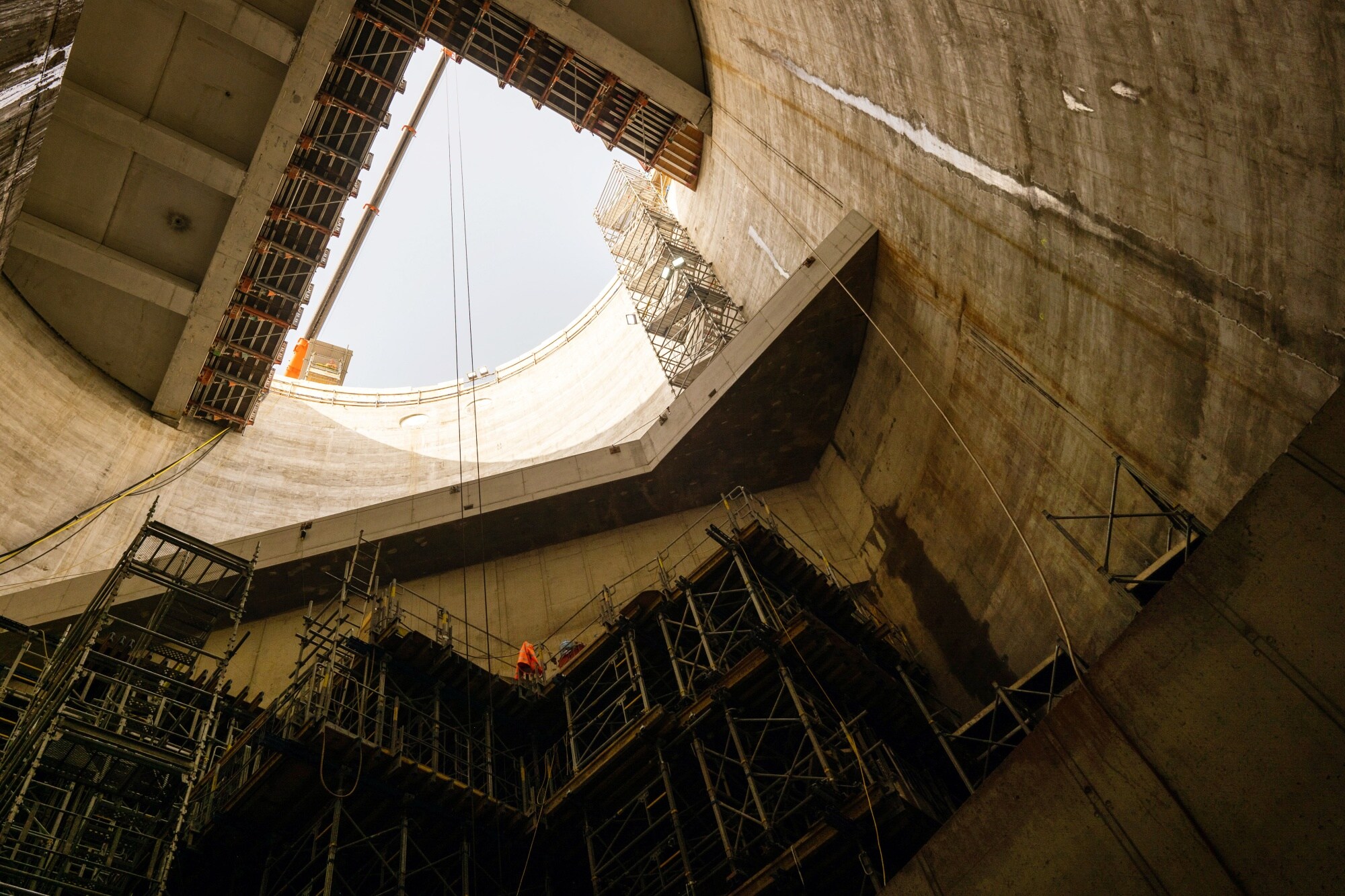
“When you get to the bottom, it looks like Gotham City,” Scott Hughes, the section manager at the worksite, tells a group of three community leaders touring the almost-finished Thames Tideway Tunnel project below.
Project manager Ryan Moor is more blunt: “It's essentially a massive toilet.”
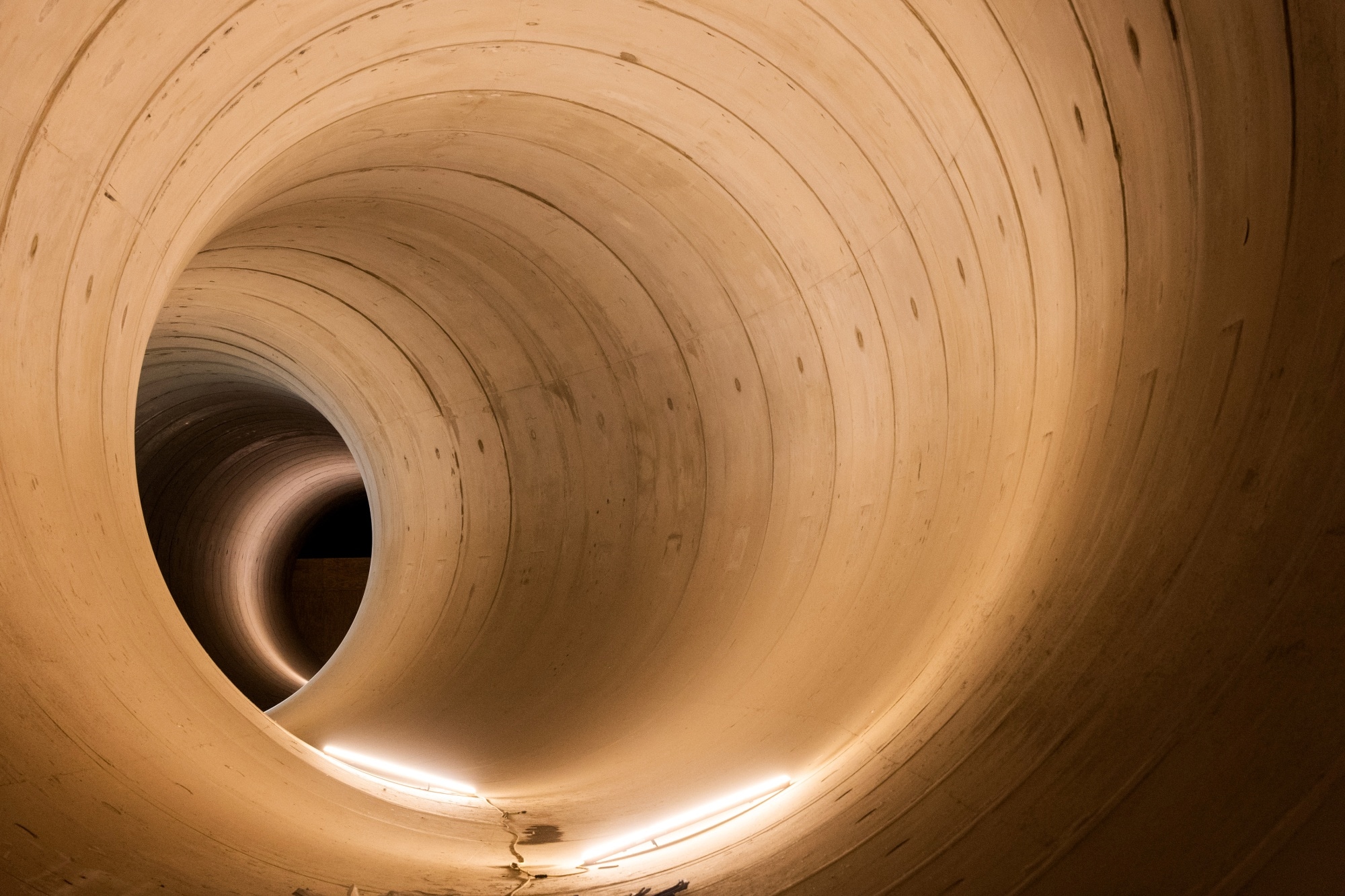
Turns out they're both right on the scale and function. Once on the floor of the underground passage — wide enough for two double-decker buses — a worker lets out a yelp to demonstrate how far it echoes. The tunnel itself, musty and cool, slopes gradually deeper toward a junction near Battersea Park, ensuring the effluent it's built to carry will literally flow downhill.
After eight years of work and the excavation of 5.6 million tons of earth, the £4.5 billion ($5.5 billion) Tideway Tunnel is about 90% complete. The super sewer consists of 15 miles of concrete caverns that will redirect raw sewage and runoff to treatment plants when heavy downpours overflow London's 150-year-old wastewater network. Crews are now preparing to cap at ground level several shafts the size of missile silos like the one visited in early September at the Carnwath Road Riverside site. They'll be sealed off to humans for a decade or perhaps longer — future maintenance to inspect for fatbergs and other subterranean problems will be done via drones. Left on the surface will be seven new public spaces, the first of which opened this month.
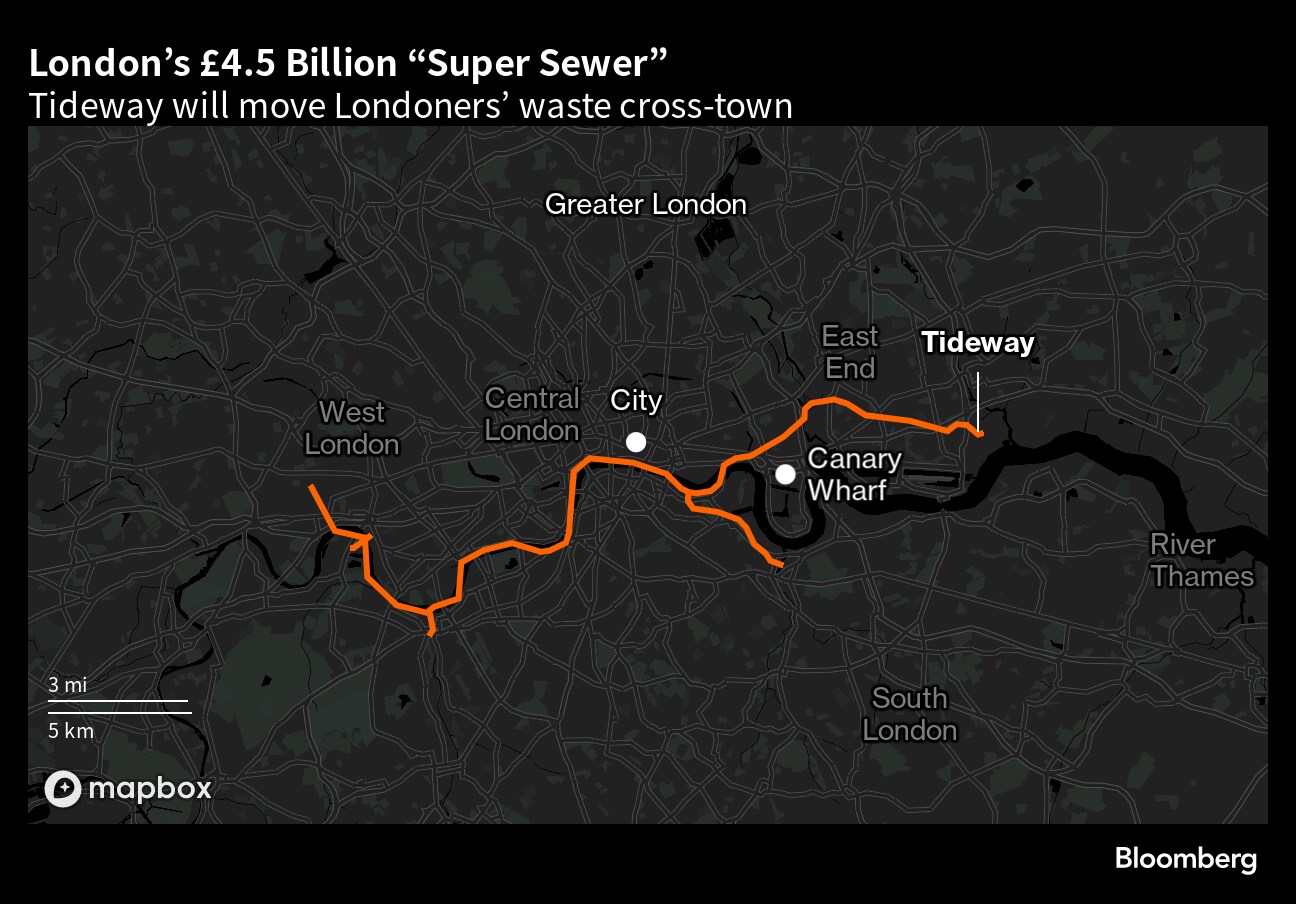
Tideway's construction is on track to be finished by next summer and the system fully operational in 2025, coming in about £1 billion over a 2015 cost estimate of £3.5 billion. One of the UK's biggest green infrastructure projects, the Tideway project is nearing completion largely unnoticed by residents who don't live near the 24 work sites.
But once in service, the megaproject stands to bring a dramatic improvement to water quality in the metropolitan region. Like many older cities, London has a combined sewer, built to handle a mix of urban runoff and human waste; in a city synonymous with rain, 40 million tons of untreated raw sewage gets dumped into the river on an average year — enough to fill almost 15,000 Olympic swimming pools. Thames Water Ltd., the private utility that will operate Tideway when the work is finished, says it expects all but a few of the more than 50 sewage discharges into the river each year will stop.
In other words, London's centuries-old problem of a river fouled with poop will be largely resolved. Just in time for another era of water runoff challenges.
“The Thames will have to be cleaner and healthier in order to tackle the most acute effects of climate change, including floods and droughts,” says Chris Coode, the CEO of Thames21, an environmental charity. But Tideway isn't a cure-all, he adds. “All efforts need to be made by river stakeholders to invest in sustainable drainage solutions such as rain gardens or wetlands that help to capture rainwater before entering into the sewerage system.”
A Flood of Financial Woes
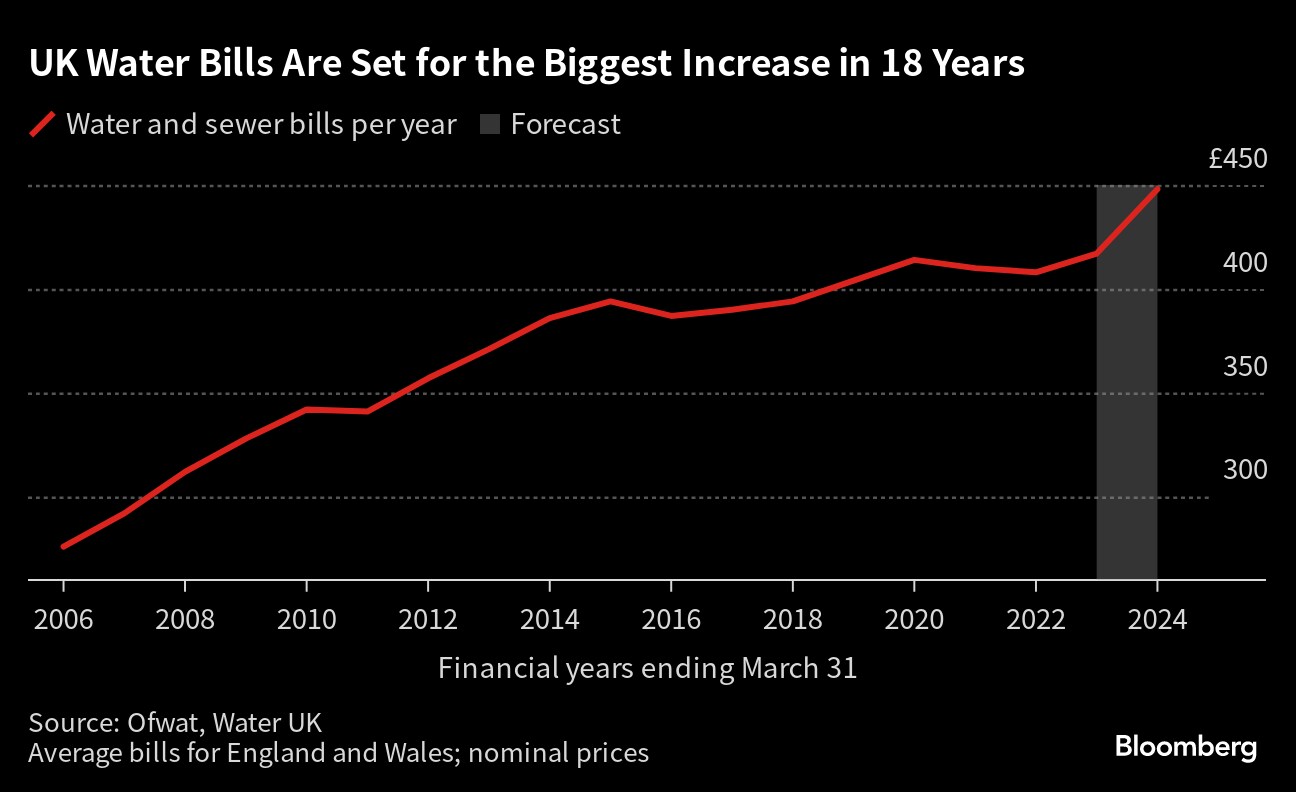
The timing of Tideway's completion is tricky for a couple of reasons, not least of which is economic. Bearing part of the cost of the upgrades are about 15 million customers who pay a higher surcharge on their water and sewage bills — an increase Thames Water insists has remained no more than £25 a year when adjusted for inflation. Still, the average annual tab in the current financial year for water and sewer is projected to be £448, a 7.4% increase from a year earlier, according to water regulator Ofwat. That's the biggest jump in records going back to 2006.
Financial markets have posed other strains on Thames Water. The UK's largest water and wastewater company struggled this year to manage its debt as interest rates increased, which led the UK government to draw up contingency plans including a temporary nationalization, Bloomberg reported in June. That prospect receded after shareholders agreed to put up £750 million of equity. Prioritizing payments to shareholders instead of making critical investments has been a sore spot with many in the public.
“There's a general feeling that they failed to invest and, as a result, we've now got problems,” says Mike Jones, acting chair of the Crossness Engines Trust, a group of volunteers who are restoring the southern outfall of the Victorian sewage system and creating a museum downstream of the City. “If the system was ultra-efficient and delivered, then an increase in cost perhaps would be acceptable, but against the backdrop of what's been happening to Thames Water over the past few months, I would guess that the public's perception is they shouldn't pay for it.”
So a big challenge for Tideway's operators and consortium of its equity investors will be convincing the public that there's more to their higher water bills than pipes they'll never see.
One of the legacies beyond the environmental cleanup will be Tideway's financial model, says Andrew Cox, the co-head of infrastructure at Allianz Capital Partners. It's an asset manager that's part of Munich-based Allianz Group, which is Tideway's biggest private investor.
To get the project funded by long-term institutional capital, the UK government provided a kind of “scaffolding,” Cox says, to protect against risks like cost overruns and to cap equity investors' potential exposure to the unknowns of digging such deep tunnels under the city. Equity investors get a fixed return of about 2.5% through to 2030 and will be subject to the normal UK water regulatory framework beyond that, providing protection against inflation and interest-rate volatility. Upon completion, Thames Water will operate the tunnel but Tideway's assets will remain the holdings of a separate licensed entity that's effectively isolated from Thames Water's credit risk.
“We took a certain amount of overrun risk, but ultimately if things would have gone really badly then the government would've stepped in,” Cox says. “It set the benchmark for future large-scale greenfield project procurement in the UK and we are very hopeful that it will be used, or that at least parts of the model will be used for future procurements.”
From Eyesore to Attraction
To history buffs like Jones, Tideway represents something else: the biggest upgrade to London's sewers since 1865.
That's when the Crossness Pumping Station opened. Its four massive steam engines — named Victoria, Prince Consort, Albert-Edward and Alexandra, after the royal family — inaugurated London's epic effort to tackle a public health crisis. In the mid-19th century, it was estimated that 20% of the river was raw sewage; cholera outbreaks linked to contaminated drinking water killed thousands.
Public disgust boiled over in 1858 when a heat wave and low water levels created a stench so foul it was dubbed the “Great Stink,” forcing Parliament to fund a massive fix. Civil engineer Joseph Bazalgette devised the solution, a network of canals, tunnels and pumping stations that would steer the waste of London's burgeoning population — it grew from 1 million people in 1800 to almost 6 million in 1900 – downstream. It was a monumental two-decade undertaking involving 1,100 miles of drains and 82 miles of sewers lined with 318 million bricks, according to the Museum of London.
Bazalgette's system remains in use, now undersized for a city approaching 9 million people, but additional capacity from Tideway should allow it to serve for another 120 years, planners say. Workers at the Blackfriars Bridge site are thinking even longer term: They buried a time capsule for future excavators to find in their shaft 60 meters below ground, containing a few souvenirs of modern life: a Covid-19 mask, a smartphone, maps and a sample of the river water.
Jones of the Crossness Trust laments the lack of credit that this Victorian-era infrastructure receives today. “Nobody thinks about Bazalgette's system when they flush the toilet and I suspect the same will apply to the Tideway Tunnel,” he said. “It much depends on what Thames Water make of it in terms of publicity and explaining to people what's happening.”
Indeed, the utility's PR campaign is about to shift gears as the construction-site eyesores give way to riverside parks. The first of seven new public spaces built atop the tunnel recently opened at Putney Embankment. While Paris is aiming to make the Seine clean enough for swimming, it's unlikely London authorities will push for these new public spaces to become swimming holes: Tides can rise and fall by 20 feet on the Thames, making the current too dangerous for recreational bathers. But officials are eager to have residents spend more time along the city's soon-to-be-cleaner signature waterway.
“People are going to embrace the completion of it and the fact that we're going to have more parks,” said Amanda Lloyd-Harris, a councillor in the Borough of Hammersmith & Fulham who toured the tunnel at Carnwath Road. “The Thames is for everyone — it's not for the few — so we need to open the land up that we have on the river.”
--With assistance from Demetrios Pogkas.
More stories like this are available on bloomberg.com
©2023 Bloomberg L.P.
Essential Business Intelligence, Continuous LIVE TV, Sharp Market Insights, Practical Personal Finance Advice and Latest Stories — On NDTV Profit.