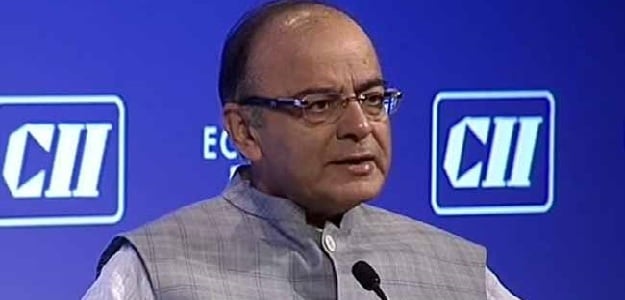
New Delhi: Finance Minister Arun Jaitley on Wednesday said the government in the next few days will list out the exemptions to be phased out as part of its plans to gradually bring down corporate tax rate to 25 per cent, the first tranche of which will be announced in the Budget in February.
"I have announced a roadmap for direct taxation... (to) bring corporate tax down to 25 per cent by phasing out some of those exemptions. We are going to put in public domain in the next few days some of those exemptions that we intend to phase out in the first round," he said while addressing corporate leaders here.
"The first tranche of reduction of corporate tax... I hope to do it in the near future whenever the new Finance Bill comes up."
Mr Jaitley made these comments while participating in an interactive session at the 'National Strategy Day in India' organised by the World Economic Forum (WEF) and the Confederation of Indian Industry (CII).
The minister in his Budget in February had announced the government's intention to reduce corporate tax from 30 per cent to 25 per cent over the next four years.
Mr Jaitley also said the government has been able to address various tax legacy issues, including those pertaining to retrospective tax amendment, though two-three problems remain.
"Systematically, one by one, we have been resolving (taxation issues)... That fear of retrospective taxation has gone. Two-three of those problems remain and they remain because of legal reasons. I have publicly announced that we are looking for processes by which we can resolve some of these," Mr Jaitley said.
Observing that his table was "full of problems" when he took over as the Finance Minister, Mr Jaitley said he had worked consistently to "remove the fear of highly adversarial and an oppressive tax structure".
Retrospective taxation and other legacy issues were a drag on the economy, the Finance Minister said, adding that some of the demands were exaggerated while in other cases it was not possible to resolve the issues through executive action as assessment orders were already issued.
"I had a table full of those problems and those were not easy problems. Particularly when assessment orders have been passed, you have no executive powers to set them aside. They can only be set aside either by change in law or by judicial or quasi judicial order."
"I must say with a sense of satisfaction that a large number of those issues have been put to rest," he added.
The Finance Ministry has also been making efforts to make the taxation laws and processes simpler, Mr Jaitley said, adding that over the last 17 months, "the confidence of both domestic and international investors in Indian economy has been restored".
On the Goods and Services Tax (GST), Mr Jaitley said, "It is only a question of time, since obstruction won't continue indefinitely. As and when it is put to vote, I see GST becoming a reality."
Support legislations and the IT backbone to roll out GST are ready, the Finance Minister further said. "The moment the Upper House passes it, we can get 50 per cent of states to ratify it and be in a position to put it in motion."
GST has made "considerable headway", Mr Jaitley said, adding that the parliamentary standing committee had recommended it and the lower house had passed it by a two-third majority.
"Almost all state governments are on board. And I must say even the state governments of the Congress party have supported it," he further said.
He, however, added: "I say with a sense of regret that there was a policy somersault as far as the Congress is concerned and regrettably, it was led by the people who had moved the GST Bill. This policy somersault was not for any policy reason, it was for political reason because the policy seems to be obstructive."
The minister said he has been discussing the issue of passage of the GST Bill with leaders of the Congress party and other political parties.
He added that the composition of the Rajya Sabha would change in coming months and would make it easier for the government to function.
Mr Jaitley is of the view that the public opinion is in favour of economic reforms and against those who obstruct them. "Temporarily, they may be able to halt certain measures. But I think once the direction is set, the movement for that change will go on," he said.
Global investors, Mr Jaitley said, have shown interest in India at a time when the world economy is passing through a "very challenging moment".
"We set a direction for the Indian economy... consistently with every measure, we are moving in that direction and we are not allowing any policy change which is in contrarian direction. I think India has become highly aspirational," he said.
On growth prospects, Mr Jaitley said the increased indirect tax collections suggest economic recovery.
"I can now see trickles of growth. One of the greatest positives is a huge increase in indirect tax revenues," he said, adding that the collection grew 36.5 per cent during the first seven months of the current fiscal year (April-October).
After discounting additional tax measures, the growth works out to 13.5 per cent.
"Excise duty, Customs, service tax... on a year-on-year basis increased 13.5 per cent. With additional revenue measures, it is much more. This is a real increase. This actually indicates that manufacturing itself is picking up," he said.
Referring to challenges on account of global problems like devaluation of the Chinese currency and possibility of a rate hike by the Federal Reserve, Mr Jaitley said, "There are some crises which impact us much lesser, some impact us much directly. Our strategy has been to strengthen the basis of our economy so that impact of (the crisis) is transient and temporary."
The minister spoke of an improvement in the macroeconomic data going forward, which will enhance the country's ability to deal with global problems.
He added that "impact (of Fed rate hike) certainly would be there".
"I think rather than actual change, it's suspense which has been impacting us for the last few years."
To queries on power sector reforms, Mr Jaitley said, "In the next couple of days, we are likely to announce some major policy decisions in that regard to take the sector out of stress. Once that happens, I am quite sure the private sector will also start participating."
"That is an infrastructure issue, which we are going to be addressing literally in the next couple of days, if not in the next couple of hours itself."
The effort, he said, would be to address the financial problems of the distribution companies which had to suffer on account of reluctance of state governments to raise tariff.
On the bankruptcy law, which will make it easier for companies to exit businesses, Mr Jaitley said the endeavour would be to introduce the Bill in the next session of Parliament.
The committee, which was assigned the task of drafting the bankruptcy law, will be submitting its report in the next couple of days.
The government, he added, is also working on updating certain other legislations, especially the Specific Relief Act.
Besides, the government has come out with an ordinance to fast-track dispute resolution through arbitration.
On relaxation of the land acquisition law, Mr Jaitley said states will be encouraged to come up with their own laws which will be ratified by the Centre.
"There is a change in strategy that let the states bring about any change... The first state has already sent its proposal to the Centre, we have accepted it and they have notified it," Mr Jaitley said.
On quota reforms of the International Monetary Fund (IMF), which has been held up for the past several years, Mr Jaitley said, "The ball is in the US court. The Treasury Secretary has been saying he is very keen to give effect to it."
The quota reforms are aimed at giving more voting rights to emerging economies.
Essential Business Intelligence, Continuous LIVE TV, Sharp Market Insights, Practical Personal Finance Advice and Latest Stories — On NDTV Profit.