Yellen Calls For World Bank Overhaul Including Scaled-Up Lending
(Bloomberg) --
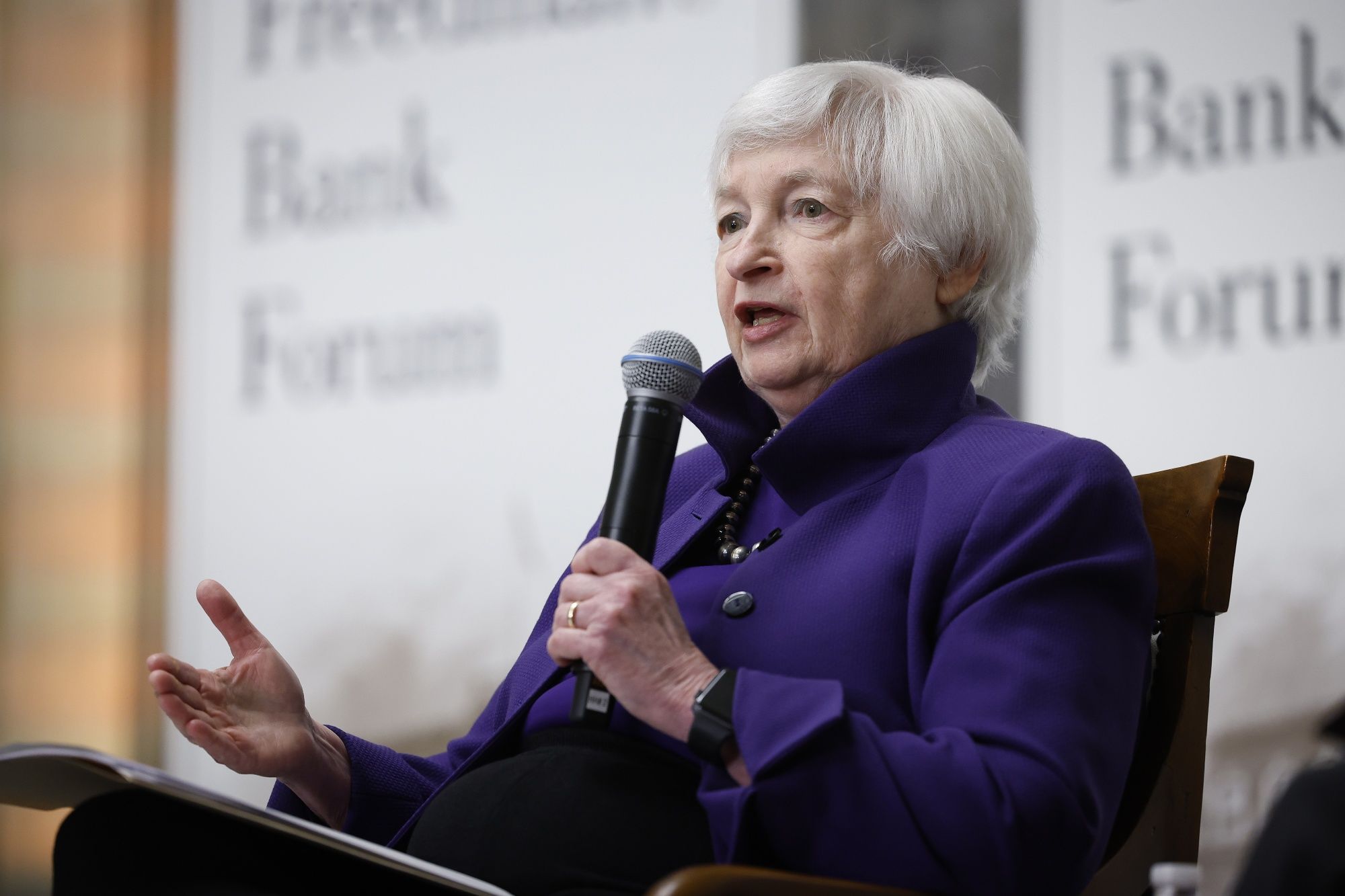
Treasury Secretary Janet Yellen proposed changes for the World Bank and regional development banks Thursday, pushing them to move beyond country-specific loans to address global threats and speed the flow of private capital to poor and emerging economies.
“The evolution of these banks will require changes to incentives, operating models and uses of the banks' financial resources,” Yellen said in remarks prepared for delivery to the Center for Global Development think tank in Washington.
The Treasury chief endorsed the notion that multilateral development banks can substantially increase their lending without significantly increasing risk. The additional capacity at the World Bank, however, would be in the tens of billions of dollars, according to a senior Treasury official, not in the hundreds of billions suggested by a recent study commissioned by the Group of 20 largest economies.
Yellen's comments, while lacking details on how reform goals would be achieved, add a powerful voice to those who believe the World Bank should be doing more -- generally, to support low- and middle-income countries struggling to develop, and, specifically, to confront global challenges like climate change. The changes should represent additional goals and shouldn't detract from the bank's traditional poverty-reduction agenda, the official said.
Her remarks come days before policy makers from across the world gather in the US capital for annual meetings of the World Bank and International Monetary Fund.
Yellen in gatherings next week will seek support for her proposals from other key shareholders in the World Bank, according to the official, who asked to not to be identified because the plans were not public. The US is the largest shareholder in the Bretton Woods institutions.
Read more: Gore Calls for World Bank Leader Shake-Up on Climate Concern
In the speech, Yellen pointed out that the development banks have traditionally focused on single-country project finance -- lending money, say, for a large infrastructure project. In such cases, the borrowing country bears the costs and accrues the benefits of the project.
But when it comes to closing fossil-fuel-burning power plants in favor of clean energy projects, single countries are still being asked to bear the cost for projects that will confer benefits well beyond their borders. In such cases, the Treasury official said, countries should be offered a lower cost of finance in order to incentivize the project.
“The whole thrust of directing the bank to think about how to support collective action on things like climate change is essential at this point,” said Nancy Lee, a senior policy fellow at the Center for Global Development. “It's a very different world than in the last century, when there were very few global crises driven by factors beyond the control of most poor countries.”
Doug Rediker, a former IMF executive board member, called the proposals a “laudable effort,” but worried the Biden adminstration has not shown enough interest in the international financial institutions to bring about the changes very easily.
Influence Question
“It's unclear to me whether the administration has taken the necessary steps to bring along the consensus among other countries to actually effect these changes,” said Rediker, who is also a founder of political-consultancy firm International Capital Strategies.
The Treasury official said the plan also foresees allowing the development banks to directly finance supranational institutions. For example, Covax, the multinational effort to boost the availability of Covid-19 vaccines, might have been a good target for World Bank financing, the official said.
Then there's private capital, which Yellen highlighted has a “key role to play.”
“There is a huge pool of global savings,” Yellen said Thursday. “But the flow to developing countries is limited. Why? The obstacles include information asymmetry, a scarcity of bankable projects, and political and regulatory uncertainty.”
Loan Guarantees
The development banks could do more, the official said, to remove regulatory barriers that scare away private investment in developing countries. The banks might also do more to create so-called blended finance opportunities, where bank lending and private finance combine to back a project.
Other proposals for drawing private capital include providing loan guarantees and issuing green bonds, the official said.
The Treasury official declined to say whether the reforms Yellen is seeking should be accompanied by a change in leadership at the World Bank.
World Bank President David Malpass has come under fire from climate activists who think he hasn't done enough to finance clean-energy projects. Former US Vice President Al Gore last month called for an overhaul of the World Bank's leadership. In responding, the World Bank said it's “the largest multilateral funder of climate investments in developing countries.”
(Updates with reference to full text throughout.)
More stories like this are available on bloomberg.com
©2022 Bloomberg L.P.

-
Love, Sex Aur Dhokha: The Audacious Plot To Spy On Jensen Huang

A Taipei dinner, a Singapore chip buyer and a suspected Chinese asset: inside the alleged spy operation that got close to NVIDIA's Jensen Huang.
-
Ten Things I Learnt This Samvat
Patience can be a trap. Cheap stocks can stay cheap. Leverage can wipe you out. What did Samvat 2082 teach us? Niraj Shah writes on 10 lessons from the year gone by.
-
Talking Points This Week: Tech Nerves, FII Buying, And A Faraway Banking Shock
The global markets are not shining this Diwali. The exception in the large markets is, India.
-
Midterm Rally Lasted A Day. The Hard Reality Of A Divided US May Last Two Years | Opinion
Between a contested AI boom, a debt ceiling that arrives in 2027 and a president with every incentive to act alone, the next two years may prove more volatile than the first day's rally suggests.
-
Blue Wave Will Derail the AI Trade but Won't Dismantle the AI Era | Unhedged Position
The Democrats' sweep of the US Congress will see politics collide with economic forces both over the long and short term.
-
It's Time To Take The GST Council's Bet On Trust Global
Payment records can prove India's services exports, and clear, proportionate rules can bring foreign digital sellers into the tax net.
-
Opinion | India at 38: From Innovation Overperformer to Innovation Powerhouse
India now has 453 VC-backed deep science startups, 18 of them late-stage, after 117 percent growth since 2020. Laurus Labs, at USD 9.3 billion, is the most valuable deep science company in any middle-income economy outside China.
-
Navigating Energy Crossroads: S Jaishankar's Call For Diversified Supply Chains At G20 Ministerial Meeting
As geopolitical fault lines continue to test maritime trade routes and commodity flows, Jaishankar's message remains pertinent: true economic resilience requires open markets, protected transit lines, and a genuine commitment to multilateral cooperation rather than coercion.
-
Indians Are Travelling, But Not Every Journey Is A Holiday | The Week In Whys
Pilgrims, patients and working women are the real travellers, and the system hasn't quite caught up with them.









