US Tariff Revenue Gains Seen As Undercut By Declining Trade

President Donald Trump's tariff increases will cause a slump in US trade volumes that's likely to limit the scope of the extra revenue the federal government can expect to reel in, new projections show.
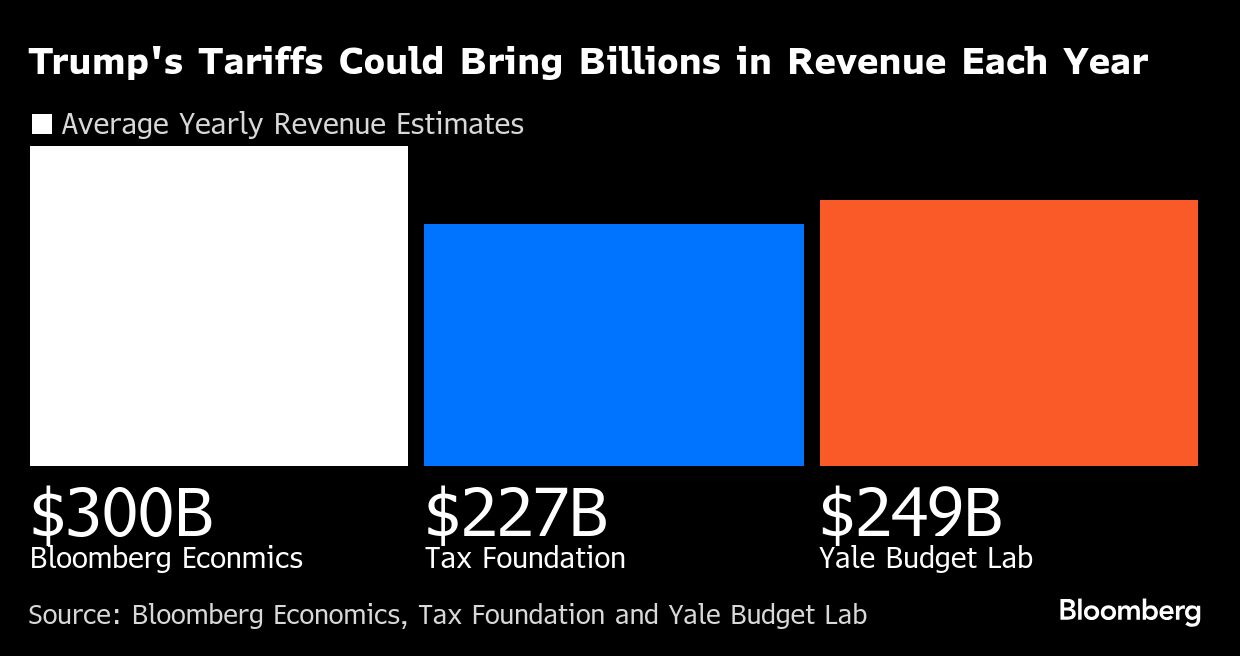
All of the tariffs Trump has imposed, along with those he has threatened, since January would generate around $300 billion in annual revenue on average, according to an analysis from Bloomberg Economics. That's at the low end of the range, with Treasury Secretary Scott Bessent having floated a figure of up to $600 billion.
The lower figure reflects expectations for a sharp downturn in trade. As a result of tariffs, total US imports of goods are expected to drop by around 30%, according to the Bloomberg Economics modeling.
The nonpartisan Tax Foundation released its own analysis that found Trump's tariffs could produce nearly $2.27 trillion in revenue over a decade, or about $227 billion on average each year, after accounting for the economic effects.
Separately, the Yale Budget Lab estimates all of Trump's tariffs announced so far could raise nearly $2.49 trillion over a decade, or $249 billion on average each year, including the impacts of retaliatory tariffs as of April 2 and considering the broader projected economic impact.
Trump last week announced a 10% tariff on all imports, while also imposing additional duties on about 60 US trading partners, including a 34% levy on imports from China, a 20% duty on the European Union and 24% on Japan. The baseline 10% tariff is already in place while the higher duties on selected countries are slated to take effect after midnight New York time.
The new duties are in addition to those previously announced, including a 25% tariff on imports from Canada and Mexico and 25% tariffs on aluminum, steel and auto imports.
The anticipated revenue from those import duties are an initial glimpse at how much US companies and consumers can expect to collectively pay. The figures also serve a political purpose — granting Republicans a way to justify an upcoming round of tax cuts that are projected to add trillions of dollars to US deficits over a decade.
Trump's tariffs mark the steepest American duties in more than a century. Trump has said his trade policies will “make America wealthy again,” and pledged that they will grow the country's industrial base.
But economists have warned the tariffs could have the opposite effect, serving as a drag on US imports, inviting retaliation from other countries and raising prices for consumers.
The Tax Foundation projects Trump's tariffs will reduce US gross domestic product by 0.7%. After factoring in retaliatory tariffs, the drag on GDP could be even bigger, the group said.
The added increase in consumer prices in the short run would result in a nearly $3,800 loss of purchasing power per household on average, according to a Yale Budget Lab analysis.
Other countries have already begun to impose their own duties on the US, including China — which announced it will levy a 34% tariff on all US imports in addition to previous targeted actions.

-
Talking Points This Week: Tech Nerves, FII Buying, And A Faraway Banking Shock

The global markets are not shining this Diwali. The exception in the large markets is, India.
-
Midterm Rally Lasted A Day. The Hard Reality Of A Divided US May Last Two Years | Opinion
Between a contested AI boom, a debt ceiling that arrives in 2027 and a president with every incentive to act alone, the next two years may prove more volatile than the first day's rally suggests.
-
Blue Wave Will Derail the AI Trade but Won't Dismantle the AI Era | Unhedged Position
The Democrats' sweep of the US Congress will see politics collide with economic forces both over the long and short term.
-
It's Time To Take The GST Council's Bet On Trust Global
Payment records can prove India's services exports, and clear, proportionate rules can bring foreign digital sellers into the tax net.
-
Opinion | India at 38: From Innovation Overperformer to Innovation Powerhouse
India now has 453 VC-backed deep science startups, 18 of them late-stage, after 117 percent growth since 2020. Laurus Labs, at USD 9.3 billion, is the most valuable deep science company in any middle-income economy outside China.
-
Navigating Energy Crossroads: S Jaishankar's Call For Diversified Supply Chains At G20 Ministerial Meeting
As geopolitical fault lines continue to test maritime trade routes and commodity flows, Jaishankar's message remains pertinent: true economic resilience requires open markets, protected transit lines, and a genuine commitment to multilateral cooperation rather than coercion.
-
Indians Are Travelling, But Not Every Journey Is A Holiday | The Week In Whys
Pilgrims, patients and working women are the real travellers, and the system hasn't quite caught up with them.
-
Getting To Work Costs Women More | The Reason Why
It is not just about women paying more than men. It is about women paying much more in cities than in villages.
-
AI Bias In Investing Cannot Be Eliminated, But It Can Be Governed
Framing is a particularly important example as identical financial information presented in terms of gains rather than losses can lead an LLM to reach a different assessment.









