US Payrolls Rise by More Than Forecast While Wage Growth Cools

(Bloomberg) -- US hiring picked up in August and wage growth slowed, offering a mixed picture of both resilience and moderation in the labor market.
Nonfarm payrolls rose by 187,000 after the prior two months were revised significantly lower, a Bureau of Labor Statistics report showed Friday. The unemployment rate climbed to 3.8%, the highest since early last year and largely reflecting a pickup in participation.
The payrolls figure also includes a combined drop of 54,000 in the film and trucking industries, mainly due to an entertainment strike and the shutdown of a major carrier, the report showed.
Follow the reaction in real time here on Bloomberg's TOPLive blog
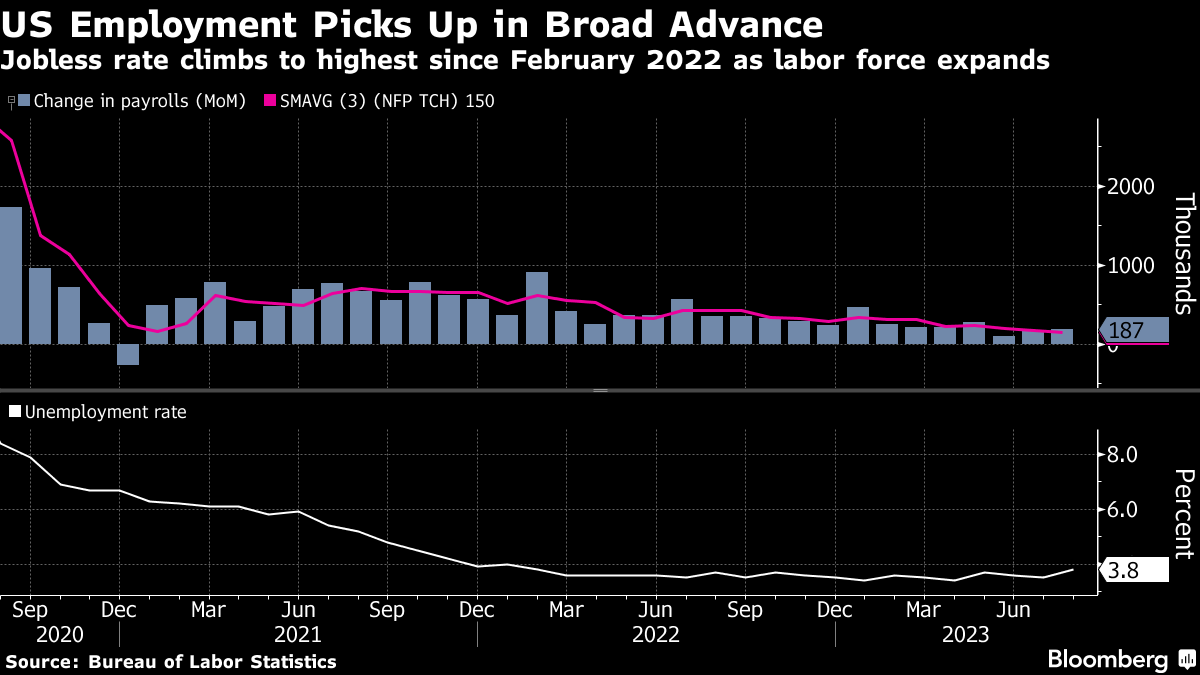
The labor market has been the stalwart of the US economy this year, supporting renewed momentum that may help the nation avert recession — at least in the near term. While job openings and wage gains have both retreated in recent months, hiring and incomes are still firm enough to bolster consumer spending.
That said, Friday's report offered fresh signs that hiring hasn't been as strong as previously reported. June and July payroll gains were revised lower by 110,000, following data last week that estimated US job growth was probably less robust in the year through March.
The unemployment and pay figures likely add to the case for the Federal Reserve to hold interest rates at a 22-year high this month and potentially leave them there for awhile. However, officials have indicated they may still consider another hike this year, especially if inflation fails to keep cooling.
Read more: Powell Targets High-or-Higher Rate Path as Economy Picks Up
Treasury yields slid, the S&P 500 opened higher and the dollar weakened. Traders continue to see the Fed leaving interest rates unchanged this month, and they also lowered the probability of a hike in November.
What Bloomberg Economics Says...
“Belying the upside surprise in the August payrolls print are weaknesses that suggest the should Fed pause its rate-hike cycle. Hourly wage growth slowed notably, labor-force participation increased — most notably for older workers and prime working-age women — and past prints were once again revised downward.”
— Stuart Paul and Eliza Winger
To read the full note, click here
The report showed more people are coming back into the labor force, which may also help soften wage pressures. The overall participation rate — the share of the population that is working or looking for work — rose for the first time since March to 62.8%, the highest since February 2020. For those ages 25-54, known as the prime-age group, it approached a record.
With the supply and demand for labor coming more into balance, the outsize pay gains during the pandemic have faded. Average hourly earnings were up 0.2% from July — the smallest increase since early last year — and 4.3% from a year earlier.
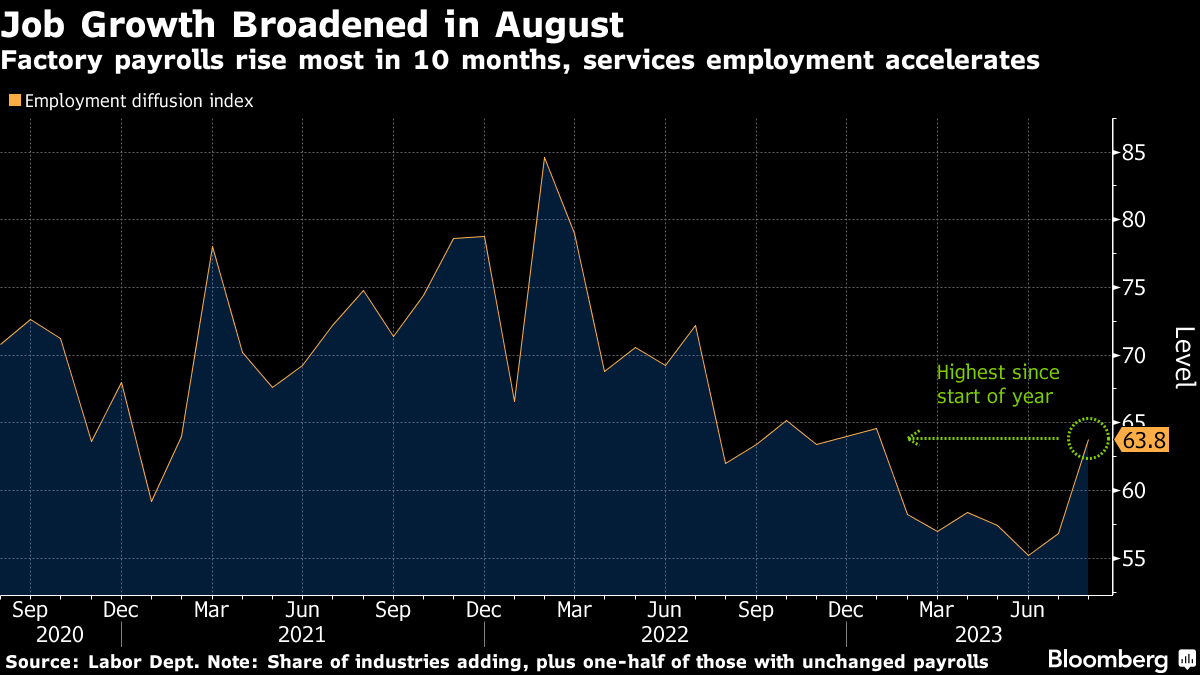
The August advance in payrolls was broad based, led by gains in health care, leisure and hospitality and construction. Manufacturing payrolls increased by the most since October and reflecting more hiring in machinery and fabricated metals.

Job growth would have been even higher if not for strikes by Hollywood workers and the bankruptcy of trucking firm Yellow Corp. Looking ahead, a potential strike by the United Auto Workers and a possible government shutdown could also weigh on payrolls in the coming months.
Read more: Strikes in US at Decades High Predict More Industries at Risk
Other firms are letting go of staff altogether. A measure of planned layoffs surged to a three-month high in August as companies like T-Mobile US Inc. and Charles Schwab Corp. announced fresh payroll cuts.
The labor market will continue to be key to the economy's trajectory, but other factors could thwart its momentum. High prices are still pinching consumers, and the upcoming resumption of student loan payments will be a renewed burden for millions of borrowers.
Some economists have recently questioned the accuracy of labor data due to lower response rates. The response rate for the establishment survey, which produces the payrolls and wage data, was the lowest for any August since 2006.
--With assistance from Matthew Boesler, Kristy Scheuble and Liz Capo McCormick.
(Adds more details from report, updates trading)
More stories like this are available on bloomberg.com
©2023 Bloomberg L.P.

-
Navigating Energy Crossroads: S Jaishankar's Call For Diversified Supply Chains At G20 Ministerial Meeting

As geopolitical fault lines continue to test maritime trade routes and commodity flows, Jaishankar's message remains pertinent: true economic resilience requires open markets, protected transit lines, and a genuine commitment to multilateral cooperation rather than coercion.
-
Indians Are Travelling, But Not Every Journey Is A Holiday | The Week In Whys
Pilgrims, patients and working women are the real travellers, and the system hasn't quite caught up with them.
-
Getting To Work Costs Women More | The Reason Why
It is not just about women paying more than men. It is about women paying much more in cities than in villages.
-
AI Bias In Investing Cannot Be Eliminated, But It Can Be Governed
Framing is a particularly important example as identical financial information presented in terms of gains rather than losses can lead an LLM to reach a different assessment.
-
Joining The Dots | Dark Skies, Steady Diya: Why Hope Holds This Diwali
With war, a weak rupee and foreign outflows weighing on sentiment, policymakers at the NDTV World Summit and market veterans at NDTV Profit Ignite: Diwali Edition offered the same advice: stay invested and filter out the noise.
-
The Curious Case of Equitas Small Finance Bank And A CEO Who Quit For Stock
PN Vasudevan believes persistent investor concerns over a perceived conflict of interest had become a governance overhang on Equitas Small Finance Bank's stock, even as the lender improved profitability and asset quality.
-
Talking Points This Week: AI Cash Burn, A Tiger Comeback And An India That Still Finds Its Own Path
India is not immune to higher oil or tighter global liquidity, yet its earnings base is broader, its domestic policy levers are still available.
-
Foreign Investors Own Half Of HDFC Bank and ICICI Bank. An LTCG Cut Could Matter Most Here
Foreign portfolio investors have US$115 billion parked in HDFC Bank, ICICI Bank. If the government cuts long-term capital gains tax, Jefferies says returning foreign money could land here first.
-
'Never Seen This Level Of Negativity': Sandeep Tandon Says The Next Rally May Be Closer Than You Think
Veteran investor Sandeep Tandon says foreign selling is easing, large-caps are due a comeback and mid-caps are crowded, while he turns positive on gold, power and pharma this Diwali.
-
Indians Stay With Family, Not In Hotels | The Reason Why
India still lacks enough clean, reliable and affordable hotels for budget-conscious travellers.










