Mortgage Rates In U.S. Surge To 20-Year High, Reaching 6.92%

(Bloomberg) -- Mortgage rates in the US jumped to the highest since April 2002.
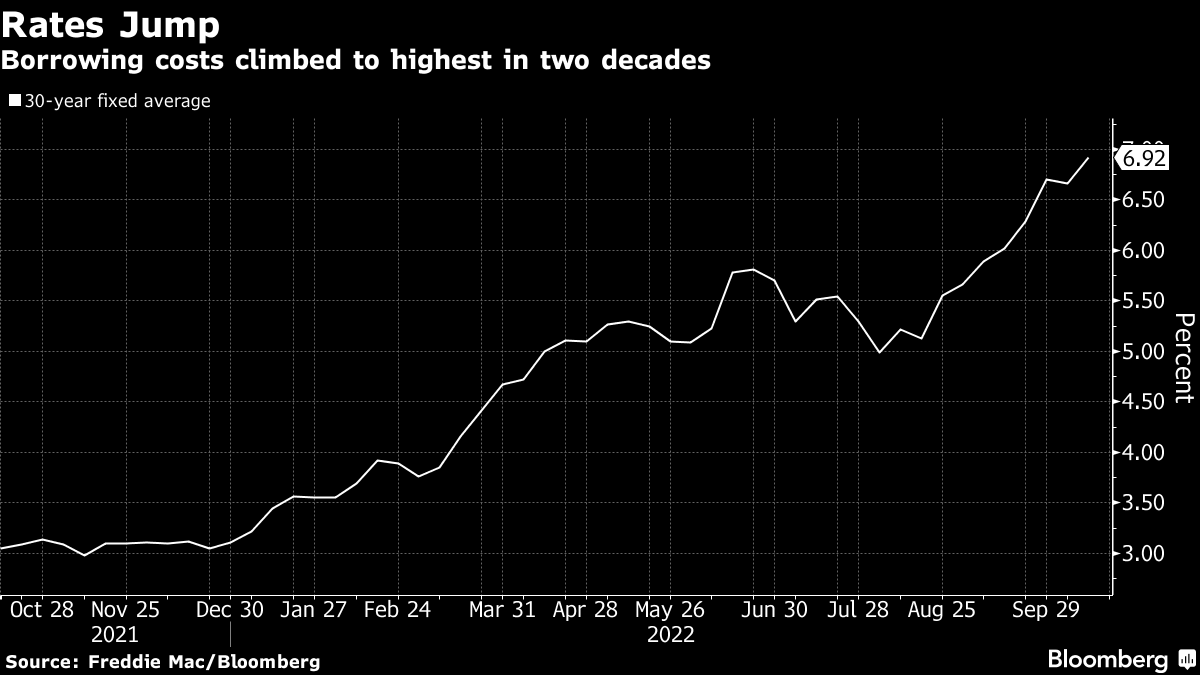
The average for a 30-year, fixed loan climbed to 6.92% from 6.66% last week, Freddie Mac said in a statement Thursday.
Borrowing costs have soared since the beginning of the year, stopping the pandemic housing boom in its tracks, as the Federal Reserve tries to tamp down inflation. Higher rates have sidelined potential buyers and driven sales down across the country.
“We continue to see a tale of two economies in the data: Strong job and wage growth are keeping consumers' balance sheets positive, while lingering inflation, recession fears and housing affordability are driving housing demand down precipitously,” Sam Khater, Freddie Mac's chief economist, said in the statement. “The next several months will undoubtedly be important for the economy and the housing market.”
Investors are expecting the central bank to raise rates by a three-quarter point at its next meeting in early November after a key gauge of US consumer prices climbed to a 40-year high in September. Freddie's survey is collected Monday through Wednesday, meaning the data wouldn't include any impact from the market's reaction to the recent consumer price index release.
Mortgage rates have been pushing toward 7% in recent weeks. Other measures have signaled that borrowing costs have crossed that threshold, with Mortgage News Daily, which releases a new figure more routinely, reporting that the rate on a 30-year fixed loan was 7.05% Thursday.
The monthly payment on a $300,000 mortgage now would be $1,980, about $679 more than in January, when the 30-year average was 3.22%.
“Homebuyers' are responding to worsening affordability conditions by moving away from expensive cities, seeking lower-cost markets around the country,” said George Ratiu, a senior economist for Realtor.com.
Higher borrowing costs have put pressure on refinancing as well as purchases. A gauge of applications to purchase or refinance a home fell to the lowest level since 1997 last week, according to data from the Mortgage Bankers Association. The slump has led mortgage lenders including Angel Oak and Lower.com to cut workers.
When rates were much lower last year, more than a third of all mortgage holders had an incentive to refinance. Now, that number is under 1%, according to Black Knight Inc. data.
“Any higher that we go in interest rates just puts further and further pressure on the market,” said Andy Walden, Black Knight's vice president of enterprise research strategy.
(Updates with quote in eighth paragraph.)
More stories like this are available on bloomberg.com
©2022 Bloomberg L.P.

-
High US Salaries, No Green Card Certainty: The Financial Calculation Facing Indian H-1B Families

The suspension of PERM processing at eight technology employers does not cancel existing H-1B visas. What it does is force a question many Indian families have been avoiding: is the US salary worth tying your career and family plans to one employer?
-
Unhedged Position: Can India See An Indonesia-Style Time Correction?
The Nifty is trading below levels it first clocked in 2024. Is there, then, as I have suggested in the headline, potential that the current time correction drags on painfully for the next three-five, even ten years?
-
Navigating Friction And Energy Realities: An Analysis Of Marco Rubio's October Visit To India
Occurring at a critical juncture marked by stalled trade negotiations and escalating geopolitical pressures over global energy supplies, the visit offers a profound window into modern US-India relations.
-
India Exports Capital. Why Not Export Trusteeship?
The big question, then, is whether India can build an institution that global borrowers, investors, banks, and lawyers can trust, even without an Indian connection.
-
France's Economy & Politics Are In Crisis | The Reason Why
Let's look at how the French economy and politics evolved under Nicolas Sarkozy, Franois Hollande and Emmanuel Macron.
-
You May Inherit The Business. You Must Earn Its Credibility.
Succession tests the founder's ability to share authority as much as it tests the next generation's readiness to assume it.
-
Signing Deals Is One Thing; Making Them Work Is Another | The Week In Whys
Sometimes, things don't turn out as planned. Indian companies have lost some bids to rivals, some projects won't produce until 2030.
-
FOMC Wall, PERM Suspension, Hospital Stocks | Talking Points This Week
A PERM suspension would directly affect green-card sponsorship rather than H-1B visas, so the near-term earnings impact could remain relatively limited. The key question is whether this marks a new phase in US scrutiny of Indian IT.
-
Everything, Everywhere, All At Once: Dalal Street's Week To Forget | Joining The Dots
Visa curbs, a Starlink spat and cancer drug caps: what connects this week's shocks for Indian markets
-
India Is Going Abroad For Critical Minerals. But It May Take Years To Pay Off | The Reason Why
Although India's steps are in the right direction, they remain modest compared with India's growing dependence.









