US Jobs Data Keep On Defying Expectations For Imminent Slowdown
(Bloomberg) -- Anyone looking for signs of an imminent downturn for the US economy won't find it in the latest employment data.
That's the takeaway from the monthly jobs numbers out Friday, which showed an acceleration in hiring and pay gains in April as working-age Americans continued streaming back into the labor market.

The combination of rising employment and wages is helping to underpin consumer spending even as banking turmoil is raising recession fears. While faster pay growth will keep the Federal Reserve uneasy about inflationary pressures, it likely won't be enough to spur the US central bank back into action after signaling earlier this week that its tightening cycle will probably pause for now.
“Labor market momentum is decelerating from a high level, but I don't see signs here that it's rolling over or that a recession is imminent,” said Blerina Uruci, chief US economist at T. Rowe Price. “But I do think the rapid tightening in monetary policy and the recent shock to credit conditions are eventually going to drive the US economy into some kind of a contraction.”
Nonfarm payrolls increased 253,000 last month following a downwardly revised 165,000 advance in March, Bureau of Labor Statistics figures showed. The unemployment rate fell back to a multi-decade low of 3.4%, defying expectations for an uptick.
Job growth was broad-based, reflecting gains in health care, professional and business services as well as leisure and hospitality. However, the prior two months of payrolls were revised lower by a combined 149,000.
The latest figures underscore the resilience of labor demand despite growing concerns about the toll high interest rates, inflation and tightening credit conditions are projected to take on the economy. While some businesses have paused hiring or laid off workers, others are still boosting pay in an effort to fill a multitude of open positions.
US stocks and Treasury yields rose on the news.
Earlier this week, the Fed raised interest rates for a 10th and possibly final time of this cycle in an effort to tame inflation. Chair Jerome Powell said that will likely require a period of below-trend growth and softer labor-market conditions.
Part of what the Fed would like to see is a further easing in pay gains. That didn't happen in Friday's report — average hourly earnings rose 0.5% in April, the most in about a year on an unrounded basis. From a year ago, they were up 4.4%.
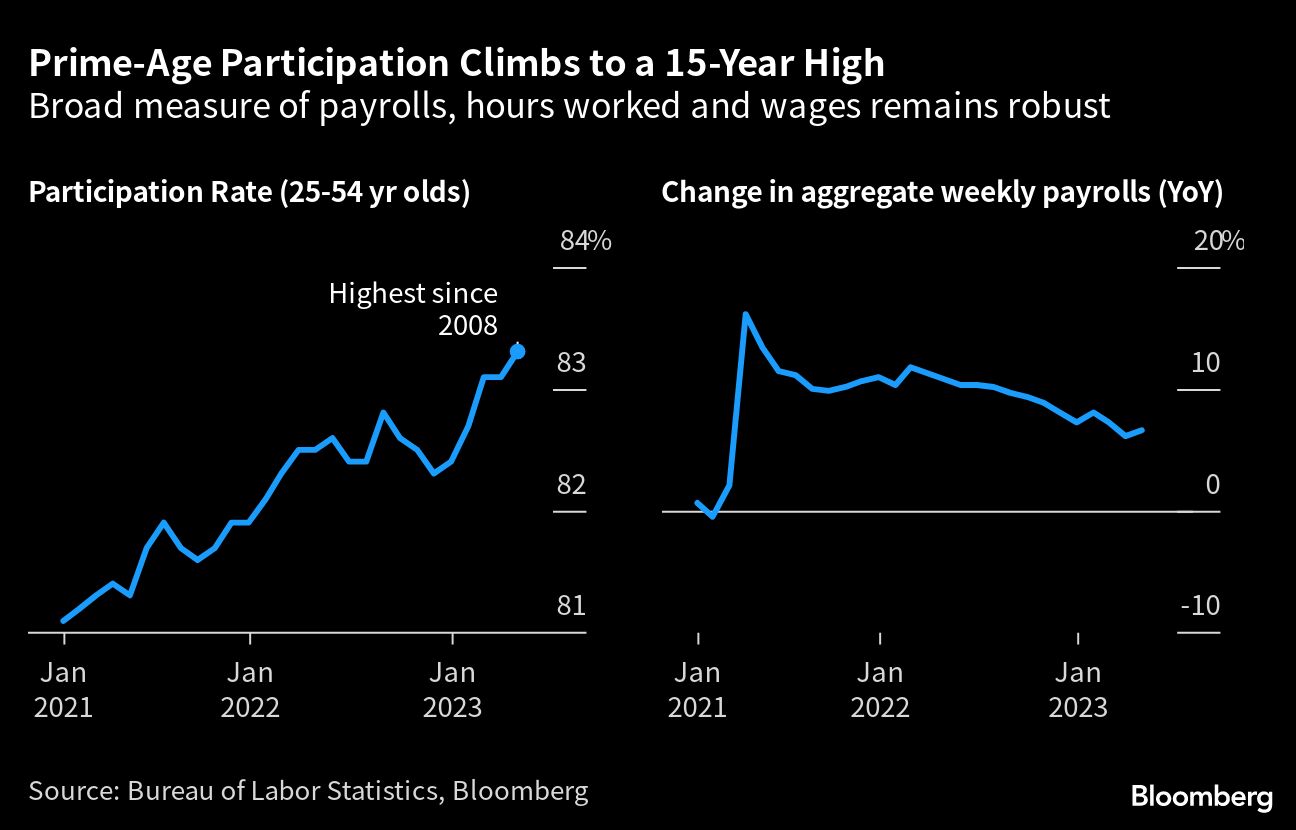
On the other hand, the labor market is coming more into balance — not only are job postings declining, but more people have been coming off the sidelines in recent months. For those aged 25-54, the labor force participation rate — the share of the population that is working or looking for work — climbed in April to 83.3%, the highest since 2008.
What Bloomberg Economics Says...
“April's surprisingly robust jobs print shows that banking-sector strains since the collapse of Silicon Valley Bank haven't yet affected the labor market ... That said, it takes time for tighter credit conditions to flow through to the real economy, something the central bank will take into account.”
— Anna Wong, Stuart Paul and Eliza Winger, economists
To read the full note, click here
On net, investors don't see the latest data as altering the Fed's path forward. The odds of another rate hike in June are about the same as a rate cut, according to prices of interest-rate swaps. Traders did, however, pare expectations for rate cuts later in the year.
Read more: Hot Jobs Report Raises Odds Fed Keeps Rates Higher for Longer
Powell, who's said his own expectation is that the economy will grow modestly this year, still acknowledged that the US could experience a “mild recession.” Many economists, however, see the labor market deteriorating more rapidly as the year goes on, underpinning expectations of a downturn.
“I've been surprised, admittedly — the jobs market, it's been pretty resilient thus far,” said Lawrence Werther, chief US economist at Daiwa Capital Markets. “But I think you're going to see material softening into the summer and fall.”
--With assistance from Augusta Saraiva and Vince Golle.
More stories like this are available on bloomberg.com
©2023 Bloomberg L.P.

-
Ten Things I Learnt This Samvat

Patience can be a trap. Cheap stocks can stay cheap. Leverage can wipe you out. What did Samvat 2082 teach us? Niraj Shah writes on 10 lessons from the year gone by.
-
Talking Points This Week: Tech Nerves, FII Buying, And A Faraway Banking Shock
The global markets are not shining this Diwali. The exception in the large markets is, India.
-
Midterm Rally Lasted A Day. The Hard Reality Of A Divided US May Last Two Years | Opinion
Between a contested AI boom, a debt ceiling that arrives in 2027 and a president with every incentive to act alone, the next two years may prove more volatile than the first day's rally suggests.
-
Blue Wave Will Derail the AI Trade but Won't Dismantle the AI Era | Unhedged Position
The Democrats' sweep of the US Congress will see politics collide with economic forces both over the long and short term.
-
It's Time To Take The GST Council's Bet On Trust Global
Payment records can prove India's services exports, and clear, proportionate rules can bring foreign digital sellers into the tax net.
-
Opinion | India at 38: From Innovation Overperformer to Innovation Powerhouse
India now has 453 VC-backed deep science startups, 18 of them late-stage, after 117 percent growth since 2020. Laurus Labs, at USD 9.3 billion, is the most valuable deep science company in any middle-income economy outside China.
-
Navigating Energy Crossroads: S Jaishankar's Call For Diversified Supply Chains At G20 Ministerial Meeting
As geopolitical fault lines continue to test maritime trade routes and commodity flows, Jaishankar's message remains pertinent: true economic resilience requires open markets, protected transit lines, and a genuine commitment to multilateral cooperation rather than coercion.
-
Indians Are Travelling, But Not Every Journey Is A Holiday | The Week In Whys
Pilgrims, patients and working women are the real travellers, and the system hasn't quite caught up with them.
-
Getting To Work Costs Women More | The Reason Why
It is not just about women paying more than men. It is about women paying much more in cities than in villages.









