U.S. Risks Government Shutdown With Congress Short On Time For A Deal
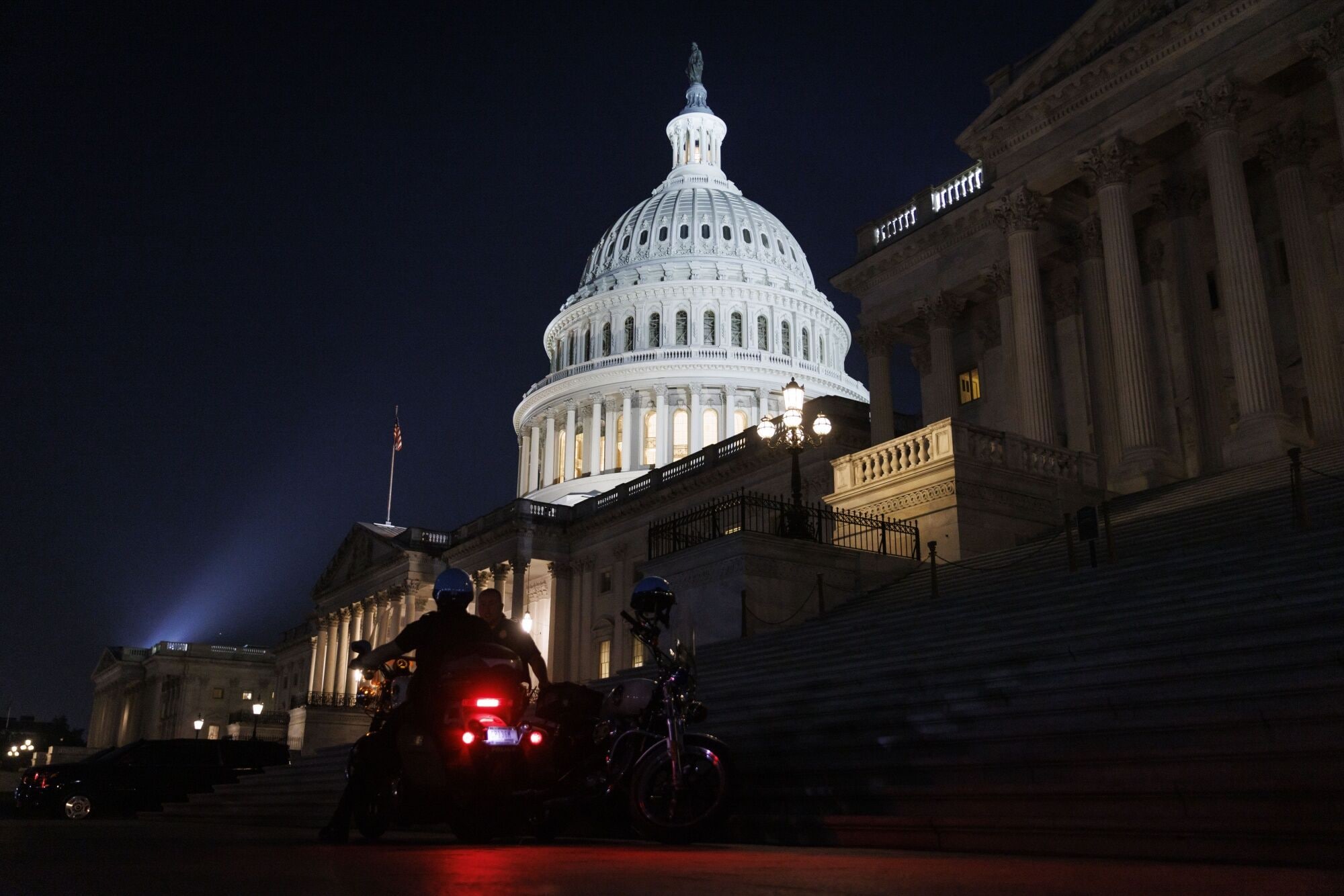
(Bloomberg) -- The US risks a government shutdown early next month, with Congress short on time to reach a temporary spending deal and House conservatives vowing to disrupt negotiations unless their demands for cuts are met.
Senators returned to Washington this week to discuss a short-term funding compromise to keep government services, salary payments and benefits flowing after the fiscal year ends Sept 30. The House returns next week.
Democrats want the stopgap measure to include billions of dollars in more aid for Ukraine's war effort — a sticking point with House Republican hardliners — and relief funding for victims of disasters such as the Maui wildfires and Florida hurricane.
Any interim deal amenable to the Democratic-led Senate is unlikely to include spending and policy concessions the hard right demands. Members of the conservative House Freedom Caucus say they don't fear a government shutdown and they intend to leverage the threat of one to force Democrats to accept priorities such as toughening the process for refugees seeking asylum.
Texas Republican Chip Roy on Monday said on X that a stopgap bill without cuts to programs conservatives oppose is a “non-starter.” He listed “weaponization” of the Justice Department and “wokeness” at the Defense Department among their objections.
While most forecasters see little risk of a recession, a government shutdown would hit the economy at a vulnerable moment. Job growth cooled over the summer, a major auto strike is looming later this month and consumer spending is expected to weaken as student loan payments resume in October.
Read More: A ‘Swift' Summer Papers Over Cracks in US Job Market
A shutdown and the resulting disruption poses a risk for any sitting president, especially if it weakens the economy ahead of a reelection year. But prior Republican-provoked shutdowns have damaged the party's standing with voters, and the White House is already using the shutdown threat as one more way to hammer the GOP as extremist.
Republican Senator Mitt Romney of Utah derided the threat as a losing strategy for his party.
“If you look at the prior shutdowns, Republicans basically just gave in and the shutdown didn't save any money. It actually cost more money,” Romney told reporters Tuesday.
There's too little time for agreement on the 12 spending bills traditionally used to fund the government before the Sept. 30 deadline, leaving a temporary stopgap as the only solution. But there is no certainty such a measure could pass the House, how long it would last and whether it would include Ukraine aid.
Democrats want a stopgap measure that keeps the government running through Dec. 8 and includes $44 billion in disaster, Ukraine and border aid. They also want to address their own priorities, including billion-dollar boosts to assure continuation of child nutrition benefits and refugee funds.
“Both parties in both chambers will have to work together,” Senate Majority Leader Chuck Schumer said Wednesday. “The last thing Americans need right now is a pointless government shutdown.”
Senate Republicans, whose votes Schumer needs to overcome any filibuster, appear largely open to a months-long stopgap as well as to Ukraine funding.
US aid for the Ukraine war effort weakens Russia “without firing a shot,” Senate Republican leader Mitch McConnell said Wednesday. “It's certainly not the time to go wobbly.”
McCarthy in the Middle
House Speaker Kevin McCarthy has acknowledged that a stopgap bill is likely necessary but his office says he wants it to be short-lived to avoid a year-end rush to pass a large spending bill. An extension into November is being considered.
To appeal to hardliners, McCarthy has argued that a shutdown could force a halt in any impeachment inquiry into President Joe Biden.
McCarthy almost certainly has the votes from Democrats and moderate Republicans to push a continuing resolution through the House. But doing so without Freedom Caucus support could risk his speakership and present the GOP as a party in disarray ahead of the 2024 elections.
Florida Representative Matt Gaetz has raised the possibility of trying to oust McCarthy if he doesn't take a more hardline stance on spending and on initiating an impeachment inquiry.
Alternatively, the speaker could tee up for a vote a bill that fulfills conservative demands. That, too, is risky as such a vote could haunt moderate Republicans, particularly those from districts Biden carried in 2020.
The Senate is planning to vote as soon as next week on a package that includes funding for the Veterans Affairs, Agriculture, Transportation and Housing and Urban Development departments.
The so-called “minibus” is expected to attract strong Senate Republican support, adding pressure on McCarthy to resolve the spending impasse before Oct. 1.
--With assistance from Laura Litvan.
(Updates with new detail in second-to-last paragraph)
More stories like this are available on bloomberg.com
©2023 Bloomberg L.P.

-
Navigating Energy Crossroads: S Jaishankar's Call For Diversified Supply Chains At G20 Ministerial Meeting

As geopolitical fault lines continue to test maritime trade routes and commodity flows, Jaishankar's message remains pertinent: true economic resilience requires open markets, protected transit lines, and a genuine commitment to multilateral cooperation rather than coercion.
-
Indians Are Travelling, But Not Every Journey Is A Holiday | The Week In Whys
Pilgrims, patients and working women are the real travellers, and the system hasn't quite caught up with them.
-
Getting To Work Costs Women More | The Reason Why
It is not just about women paying more than men. It is about women paying much more in cities than in villages.
-
AI Bias In Investing Cannot Be Eliminated, But It Can Be Governed
Framing is a particularly important example as identical financial information presented in terms of gains rather than losses can lead an LLM to reach a different assessment.
-
Joining The Dots | Dark Skies, Steady Diya: Why Hope Holds This Diwali
With war, a weak rupee and foreign outflows weighing on sentiment, policymakers at the NDTV World Summit and market veterans at NDTV Profit Ignite: Diwali Edition offered the same advice: stay invested and filter out the noise.
-
The Curious Case of Equitas Small Finance Bank And A CEO Who Quit For Stock
PN Vasudevan believes persistent investor concerns over a perceived conflict of interest had become a governance overhang on Equitas Small Finance Bank's stock, even as the lender improved profitability and asset quality.
-
Talking Points This Week: AI Cash Burn, A Tiger Comeback And An India That Still Finds Its Own Path
India is not immune to higher oil or tighter global liquidity, yet its earnings base is broader, its domestic policy levers are still available.
-
Foreign Investors Own Half Of HDFC Bank and ICICI Bank. An LTCG Cut Could Matter Most Here
Foreign portfolio investors have US$115 billion parked in HDFC Bank, ICICI Bank. If the government cuts long-term capital gains tax, Jefferies says returning foreign money could land here first.
-
'Never Seen This Level Of Negativity': Sandeep Tandon Says The Next Rally May Be Closer Than You Think
Veteran investor Sandeep Tandon says foreign selling is easing, large-caps are due a comeback and mid-caps are crowded, while he turns positive on gold, power and pharma this Diwali.
-
Indians Stay With Family, Not In Hotels | The Reason Why
India still lacks enough clean, reliable and affordable hotels for budget-conscious travellers.










