US Consumers Hit The Brakes While Goods Imports Plunged In April

US consumers hit the brakes in April while goods imports plummeted by a record as companies adjusted to higher tariffs.
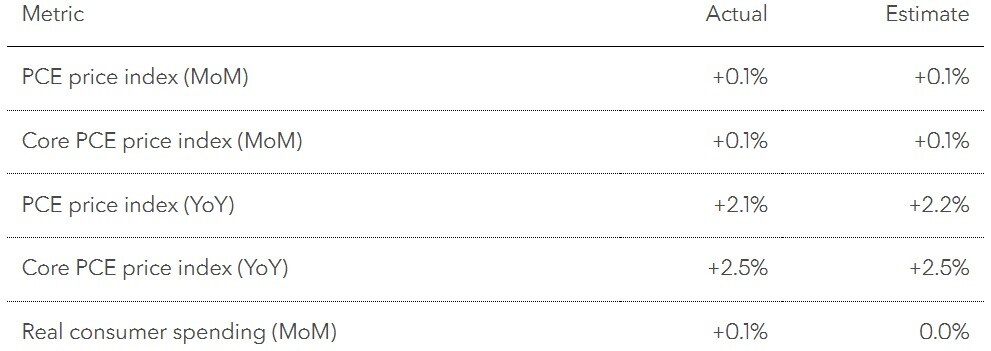
Inflation-adjusted personal spending rose 0.1% after rising 0.7% a month earlier, Bureau of Economic Analysis data showed Friday. Separate data showed an almost 20% slump in imports, leading to a massive narrowing in the US merchandise-trade deficit in April.
Meanwhile, the Federal Reserve's preferred price gauge remained tame. The personal consumption expenditures price index, excluding food and energy, increased 0.1% from a month earlier. Compared with a year earlier, the so-called core inflation gauge rose 2.5% from April 2024 — the smallest annual advance in more than four years.
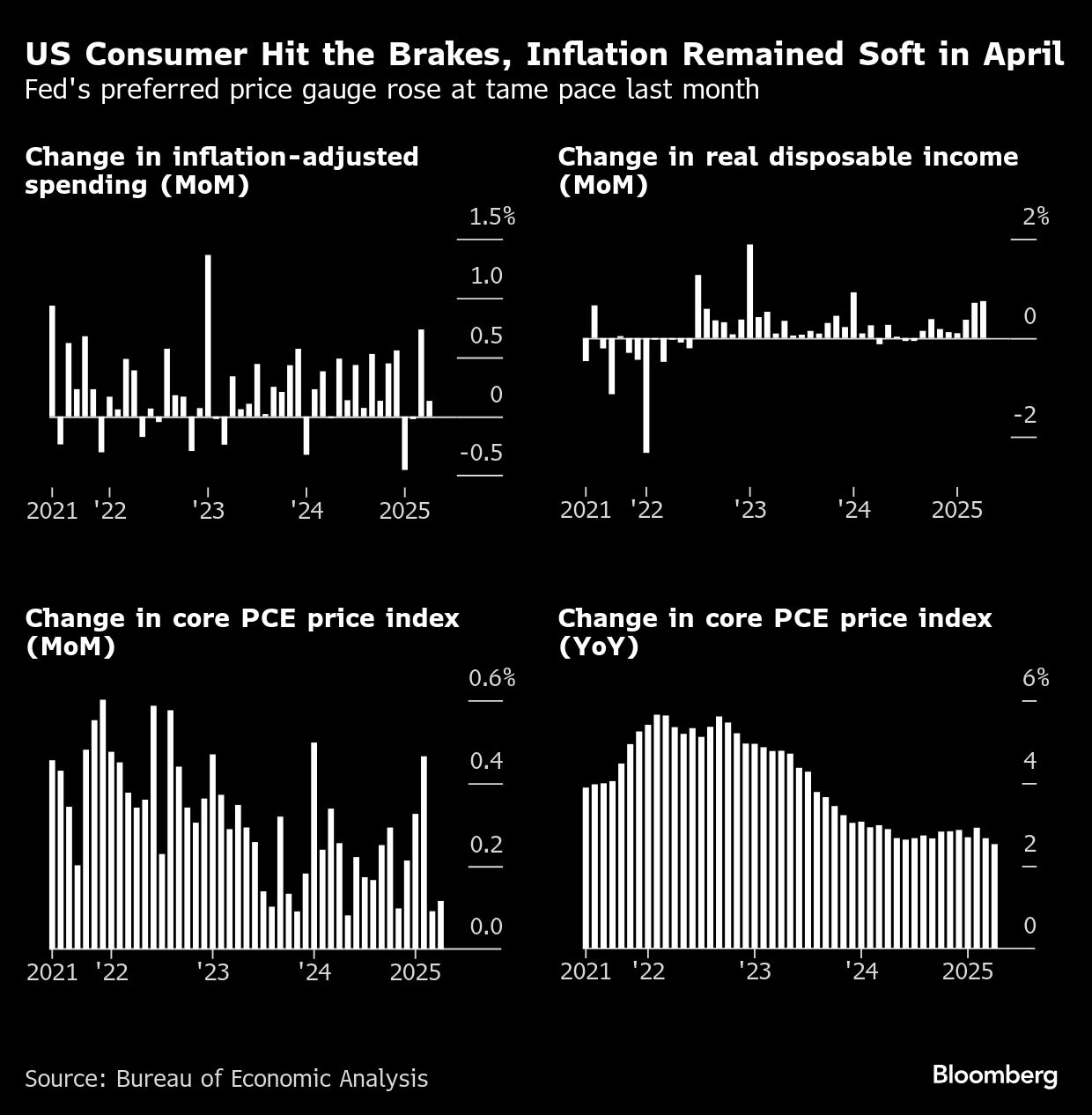
The figures illustrate an undercurrent of anxiety among many American consumers about the economy after the weakest quarter for spending in nearly two years. While higher duties on imports have yet to show up more broadly in higher goods prices, sentiment has slumped and the outlook for personal finances stands at a record low.
The modest rise in spending reflected an increase in services that more than offset a decline in durable goods outlays.
At the same time, the Trump administration has walked back or paused some tariffs as negotiators work toward trade deals with key partners including China and the European Union. On Wednesday, a US court issued a ruling that blocks many of the import taxes.
The constant state of flux in trade policy has nonetheless fueled uncertainty, with consumers' spending attitudes hanging in the balance. Meanwhile, Fed policymakers will likely keep interest rates unchanged for the foreseeable future until they get more clarity on the impact of tariffs not only on prices but also on other pillars of the economy like the labor market and consumer spending.
Economists are paying close attention to the degree to which companies are passing through higher import duties to consumers. A measure of goods inflation that excludes food and energy climbed 0.3%.
While many companies have so far been absorbing or offsetting much of the hit from tariffs, retailers including Walmart Inc. and Macy's Inc. have indicated Americans will start seeing price hikes soon.
Services Costs
Core services prices — a closely watched category that strips out housing and energy — were little changed. That was the tamest in five years.
According to minutes of the Fed's May meeting, released earlier this week, central bank staffers marked down their expectations for economic growth in 2025 and 2026, reflecting the announced trade policies.
And while job growth has shifted into a lower gear since last year, the labor market remains the main engine fueling consumer spending. Real disposable income increased 0.7% for a second month, fueled by government transfer payments, according to the BEA.
Excluding government transfers, personal income still advanced at a healthy pace. Nominal wages and salaries rose 0.5% for a third straight month. The saving rate increased to 4.9%, the highest in nearly a year

-
Midterm Rally Lasted A Day. The Hard Reality Of A Divided US May Last Two Years | Opinion

Between a contested AI boom, a debt ceiling that arrives in 2027 and a president with every incentive to act alone, the next two years may prove more volatile than the first day's rally suggests.
-
Blue Wave Will Derail the AI Trade but Won't Dismantle the AI Era | Unhedged Position
The Democrats' sweep of the US Congress will see politics collide with economic forces both over the long and short term.
-
It's Time To Take The GST Council's Bet On Trust Global
Payment records can prove India's services exports, and clear, proportionate rules can bring foreign digital sellers into the tax net.
-
Opinion | India at 38: From Innovation Overperformer to Innovation Powerhouse
India now has 453 VC-backed deep science startups, 18 of them late-stage, after 117 percent growth since 2020. Laurus Labs, at USD 9.3 billion, is the most valuable deep science company in any middle-income economy outside China.
-
Navigating Energy Crossroads: S Jaishankar's Call For Diversified Supply Chains At G20 Ministerial Meeting
As geopolitical fault lines continue to test maritime trade routes and commodity flows, Jaishankar's message remains pertinent: true economic resilience requires open markets, protected transit lines, and a genuine commitment to multilateral cooperation rather than coercion.
-
Indians Are Travelling, But Not Every Journey Is A Holiday | The Week In Whys
Pilgrims, patients and working women are the real travellers, and the system hasn't quite caught up with them.
-
Getting To Work Costs Women More | The Reason Why
It is not just about women paying more than men. It is about women paying much more in cities than in villages.
-
AI Bias In Investing Cannot Be Eliminated, But It Can Be Governed
Framing is a particularly important example as identical financial information presented in terms of gains rather than losses can lead an LLM to reach a different assessment.
-
Joining The Dots | Dark Skies, Steady Diya: Why Hope Holds This Diwali
With war, a weak rupee and foreign outflows weighing on sentiment, policymakers at the NDTV World Summit and market veterans at NDTV Profit Ignite: Diwali Edition offered the same advice: stay invested and filter out the noise.









