A Short-Term Fix Looks More Likely as US Debt-Limit Deadline Looms

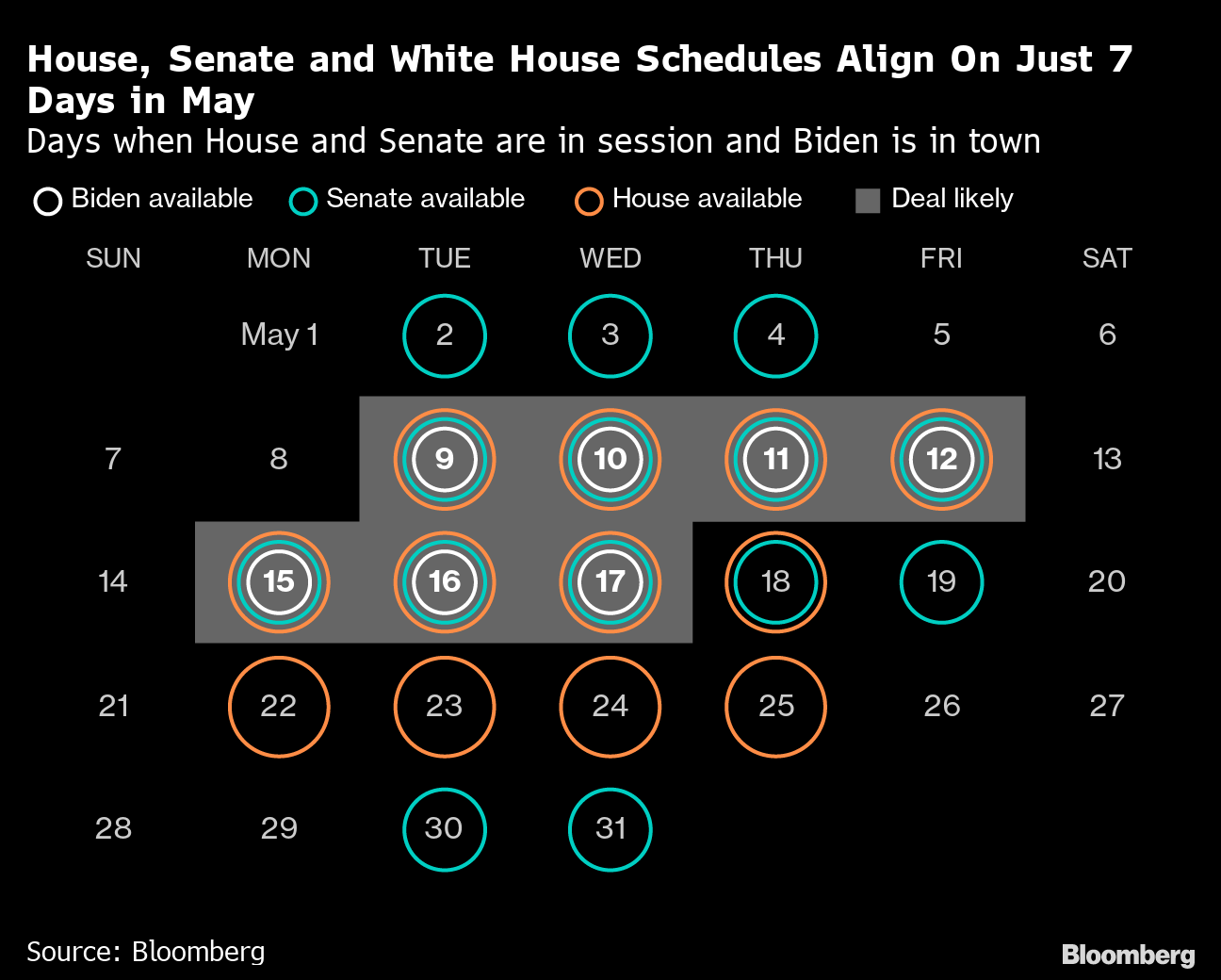
(Bloomberg) -- Washington's ability to avert a catastrophic US debt default risks coming down to as few as seven days in May, underscoring the enormous threat of the partisan impasse.
Between now and June 1 — the date by which the Treasury Department could run out of sufficient cash — President Joe Biden and members of the House and Senate are scheduled to be in town at the same time for the sum total of one week.
Lawmakers could cancel long-planned Memorial Day recesses, and Biden could forgo a trip to Japan to attend the Group of Seven summit. But even so, time is short and it's unlikely the two parties will strike a grand bargain before the potential X-date advised by Treasury Secretary Janet Yellen Monday — raising the likelihood of a short-term fix.
Yet even a punt of the debt limit to later this year will be difficult in a Washington where Republicans and Democrats are in the “no-no-no” stage of negotiations. For two deeply entrenched parties, it could take the push of financial-market turmoil to force a compromise.
Even a short-term extension would force a messy political choice: Either Republicans break their vow against approving a “clean” limit debt increase, or Democrats concede and set a precedent ahead of the main negotiation.
The White House on Tuesday stuck to its long-held position, with Press Secretary Karine Jean-Pierre saying, “Given the limited time Congress now has, it is clear that that the only practical path to avoid default is for Congress to suspend the debt limit, without conditions.”
If the Treasury lacks the cash to make all payments, it would take the US into uncharted territory.
Read More: US Debt Limit's Bad Options: The Coin, Premium Bonds and More
Wall Street's widespread presumption is that the government would keep current on payments on Treasury securities — based on revelations that appeared in earlier Federal Reserve contingency plans. It isn't clear how and whether Treasury could choose among other obligations, and Yellen has publicly rejected the idea of prioritizing specific payments.
Analysts at banks including Barclays Plc and Goldman Sachs Group Inc. suggested any short-term extension of borrowing authority could be designed to last until July — the X-date timeline many had thought likely until Yellen's Monday letter. Goldman's Alec Phillips wrote in a note to clients that the Sept. 30 end of the fiscal year is another option.
For now, there may not be sufficient pressure from markets to force a deal.
Evidence of concern is apparent in pockets of the bond market, however. Yields on Treasury securities maturing in early June are now firmly above 5%. Yields on debt due in May are substantially lower, while those for much of July are also below 5%.
No Concessions
Both parties are digging in ahead of a high-stakes May 9 White House meeting.
Democrats insist on a debt-limit bill without conditions — wary of Republicans's repeated attempts to use the ceiling as leverage. Kevin McCarthy owes his job as speaker to Republican hard-liners who insist on trillions in spending cuts and has vowed not to bring up a “clean”increase.
“The only real option that does not hurt the American people is a clean, bipartisan bill to avert default,” Senate Majority Leader Chuck Schumer said.
Senate Republicans, at the same time, see this as a fight between McCarthy and Biden, dashing some Democrats' hopes, for now, that Minority Leader Mitch McConnell would negotiate to stave off a crisis.
“It should be clear to the administration that the Senate is not a relevant player this time,” McConnell told reporters. “It has to have the support of the speaker and I'm behind the speaker.”
Problem Solvers
There's already a proposal for a short-term deal: The 64-member bipartisan Problem Solvers Caucus last month proposed suspending the debt limit through Dec. 31.
That proposal would allow a further extension to February 2025 if Congress creates a deficit-reduction commission. The extension would also be conditioned on adoption of unspecified budget “controls.”
So far, Democrats aren't talking up a third option: Executive action to bypass the debt limit.
Extreme measures include minting platinum coins and placing them with the Fed to free up cash, issuing premium bonds to mask the size of the debt, or declaring the debt limit to be a violation of the 14th Amendment, which prohibits questioning the public debt.
Those ideas each have drawbacks, and previous presidents have opted not to deploy them in past crises. Biden, a traditionalist who has spent his career in Washington, is unlikely to reach for these break-glass scenarios.
--With assistance from Erik Wasson, Alex Tanzi, Christopher Condon, Alexandra Harris and Denise Lu.
(Updates with McConnell, in 15th and 16th paragraphs)
More stories like this are available on bloomberg.com
©2023 Bloomberg L.P.

-
Ten Things I Learnt This Samvat

Patience can be a trap. Cheap stocks can stay cheap. Leverage can wipe you out. What did Samvat 2082 teach us? Niraj Shah writes on 10 lessons from the year gone by.
-
Talking Points This Week: Tech Nerves, FII Buying, And A Faraway Banking Shock
The global markets are not shining this Diwali. The exception in the large markets is, India.
-
Midterm Rally Lasted A Day. The Hard Reality Of A Divided US May Last Two Years | Opinion
Between a contested AI boom, a debt ceiling that arrives in 2027 and a president with every incentive to act alone, the next two years may prove more volatile than the first day's rally suggests.
-
Blue Wave Will Derail the AI Trade but Won't Dismantle the AI Era | Unhedged Position
The Democrats' sweep of the US Congress will see politics collide with economic forces both over the long and short term.
-
It's Time To Take The GST Council's Bet On Trust Global
Payment records can prove India's services exports, and clear, proportionate rules can bring foreign digital sellers into the tax net.
-
Opinion | India at 38: From Innovation Overperformer to Innovation Powerhouse
India now has 453 VC-backed deep science startups, 18 of them late-stage, after 117 percent growth since 2020. Laurus Labs, at USD 9.3 billion, is the most valuable deep science company in any middle-income economy outside China.
-
Navigating Energy Crossroads: S Jaishankar's Call For Diversified Supply Chains At G20 Ministerial Meeting
As geopolitical fault lines continue to test maritime trade routes and commodity flows, Jaishankar's message remains pertinent: true economic resilience requires open markets, protected transit lines, and a genuine commitment to multilateral cooperation rather than coercion.
-
Indians Are Travelling, But Not Every Journey Is A Holiday | The Week In Whys
Pilgrims, patients and working women are the real travellers, and the system hasn't quite caught up with them.
-
Getting To Work Costs Women More | The Reason Why
It is not just about women paying more than men. It is about women paying much more in cities than in villages.









