Ukraine's Zelenskiy Backs Ceasefire On Energy In Friendly Trump Call
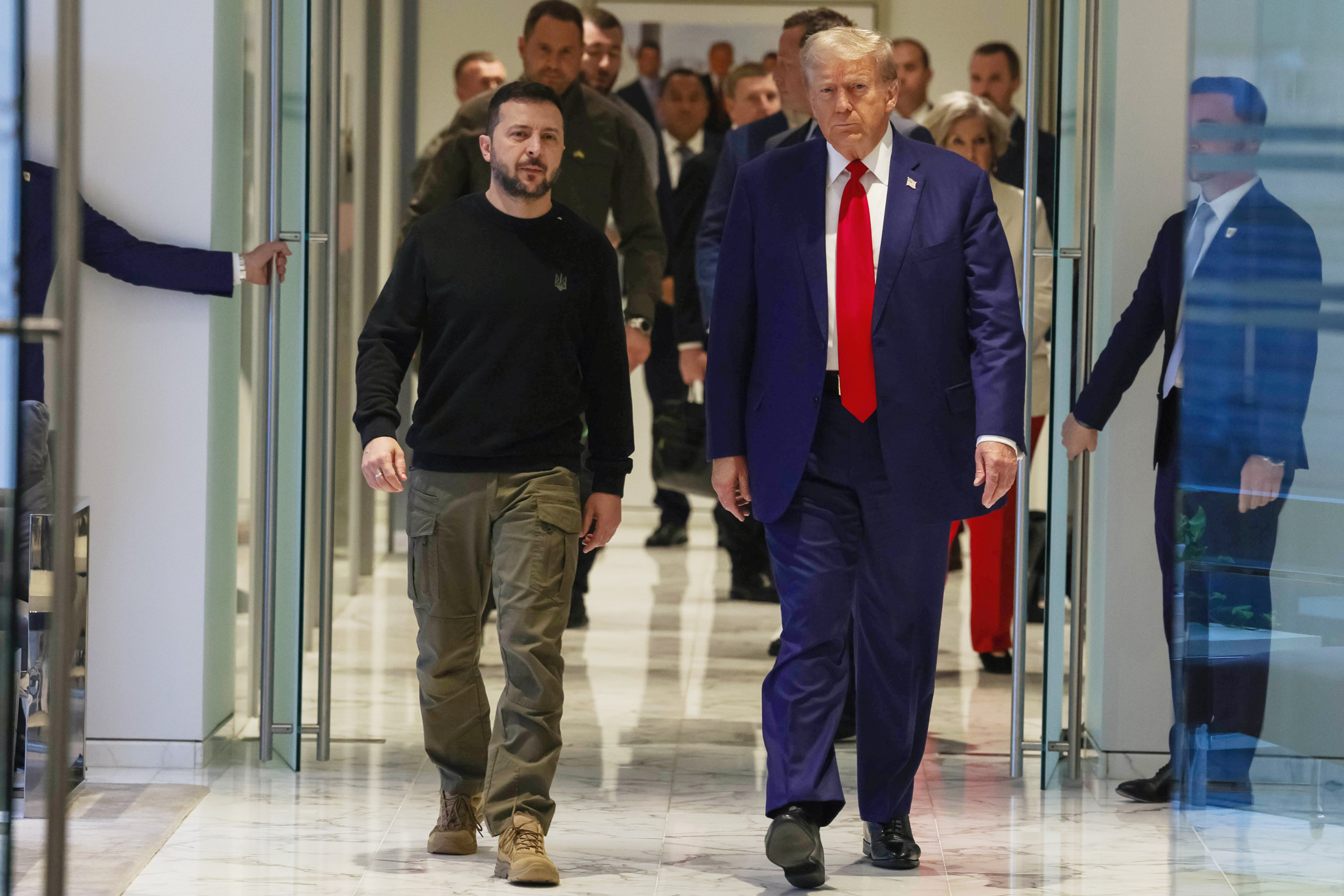
Ukrainian President Volodymyr Zelenskiy agreed to a proposal for a mutual halt to strikes on energy assets as an initial step in President Donald Trump's effort to end the war that began with Russia's full-scale invasion three years ago.
“One of the first steps toward fully ending the war could be ending strikes on energy and other civilian infrastructure,” Zelenskiy said in a statement on X after a call with Trump on Wednesday. “I supported this step, and Ukraine confirmed that we are ready to implement it.”
Trump, who had stormy exchanges earlier with Zelenskiy, described their call as “very good,” and top US officials called it “fantastic.” Trump, who at one point cut off weapons shipments and intelligence-sharing for Ukraine, promised fresh support, according to a statement on the call from Secretary of State Marco Rubio and National Security Advisor Mike Waltz.
Zelenskiy “asked for additional air defense systems to protect his civilians, particularly Patriot missile systems,” and “President Trump agreed to work with him to find what was available particularly in Europe,” they said.
The offers of support for Ukraine came a day after Trump had a friendly call with Russian President Vladimir Putin, who accepted the notion of a pause in attacks on energy facilities but gave no sign that he's dropped his insistence that Trump's proposed ceasefire be conditioned on a cutoff of weapons and intelligence aid to Ukraine and that Russia hold on to land it's seized in the war.
Trump even offered to help run Ukraine's electricity supply and nuclear power facilities, adding that “American ownership of those plants would be the best protection for that infrastructure,” according to Rubio and Waltz.
“President Trump shared details of his conversation with Putin and the key issues discussed,” Zelenskiy said. Rubio and Waltz said in their statement that “technical teams will meet in Saudi Arabia in the coming days to discuss broadening the ceasefire to the Black Sea on the way to a full ceasefire.”
Zelenskiy later told reporters on a conference call from Helsinki that he felt no pressure from Trump during their call and that no additional conditions were proposed for the partial ceasefire. He said US and Ukrainian teams will meet in Saudi Arabia March 22 to 24.
Eric Rubin, a former US ambassador to Bulgaria who's now a senior fellow at the Center for European Policy Analysis in Washington, said the Trump administration “is trying to say that Putin has agreed to Trump's proposal. But he has not. And it looks like he has no intention of agreeing to a simple ceasefire.” Rubin said Putin is “trying to use this process to negotiate” Russia's “actual, ultimate goals rather than agreeing to stop the fighting and stop the shelling.”
Trump and Zelenskiy held a disastrous meeting in the Oval Office in February, a public breach between the leaders that underscored their misalignment as Trump prioritizes a quick end to the fighting and restoring relations with Putin.
Putin's offer to stop attacks on energy infrastructure in Ukraine follows a painful series of strikes during the winter, which had already eased as the weather warms. Meanwhile, Ukraine has targeted Russian oil refineries to cut fuel supplies and revenues.
Russia has been occupying Ukraine's largest nuclear power plant in the southern region of Zaporizhzhia since early in the full-scale war.
Zelenskiy told reporters earlier Wednesday in Helsinki that mere promises from Putin to stop strikes on energy infrastructure wouldn't be enough for Ukraine to halt attacks on Russian oil assets. He said that overnight Moscow targeted energy and transport infrastructure as well as two hospitals. As he spoke Wednesday evening, the Ukrainian leader said, 107 Russian drones were in the sky over his country.
The Ukrainian leader also said before the Trump call that his country would never recognize areas currently occupied by Moscow's forces as Russian, signaling further friction ahead as both Trump and Putin have said some territory would be lost.
Trump's envoy, Steve Witkoff, said Wednesday in an interview with Bloomberg Television that he believed a full ceasefire between Russia and Ukraine can be reached “in a couple of weeks” and that a meeting between Trump and Putin is “likely to happen.”

-
Talking Points This Week: Tech Nerves, FII Buying, And A Faraway Banking Shock

The global markets are not shining this Diwali. The exception in the large markets is, India.
-
Midterm Rally Lasted A Day. The Hard Reality Of A Divided US May Last Two Years | Opinion
Between a contested AI boom, a debt ceiling that arrives in 2027 and a president with every incentive to act alone, the next two years may prove more volatile than the first day's rally suggests.
-
Blue Wave Will Derail the AI Trade but Won't Dismantle the AI Era | Unhedged Position
The Democrats' sweep of the US Congress will see politics collide with economic forces both over the long and short term.
-
It's Time To Take The GST Council's Bet On Trust Global
Payment records can prove India's services exports, and clear, proportionate rules can bring foreign digital sellers into the tax net.
-
Opinion | India at 38: From Innovation Overperformer to Innovation Powerhouse
India now has 453 VC-backed deep science startups, 18 of them late-stage, after 117 percent growth since 2020. Laurus Labs, at USD 9.3 billion, is the most valuable deep science company in any middle-income economy outside China.
-
Navigating Energy Crossroads: S Jaishankar's Call For Diversified Supply Chains At G20 Ministerial Meeting
As geopolitical fault lines continue to test maritime trade routes and commodity flows, Jaishankar's message remains pertinent: true economic resilience requires open markets, protected transit lines, and a genuine commitment to multilateral cooperation rather than coercion.
-
Indians Are Travelling, But Not Every Journey Is A Holiday | The Week In Whys
Pilgrims, patients and working women are the real travellers, and the system hasn't quite caught up with them.
-
Getting To Work Costs Women More | The Reason Why
It is not just about women paying more than men. It is about women paying much more in cities than in villages.
-
AI Bias In Investing Cannot Be Eliminated, But It Can Be Governed
Framing is a particularly important example as identical financial information presented in terms of gains rather than losses can lead an LLM to reach a different assessment.









