Trump Vows US Drug Price Cuts Of Up To 80% In Pharma Industry Blow
President Donald Trump said he plans to order a cut in US prescription drug costs by mandating that Americans pay no more than people in countries that have the lowest price. Shares of pharmaceutical companies fell worldwide.
In a social media post, Trump said he'll sign an executive order at 9 a.m. Monday in Washington to institute what he called a most-favored nation policy. While he didn't give details, investors grappled with the potential implications for the world's largest pharmaceutical market.
Trump said his plan would see the US “pay the same price as the Nation that pays the lowest price anywhere in the World.” Predicting that pharmaceutical prices could drop 30% to 80% in the US, Trump also said prices would likely “rise throughout the World in order to equalize and, for the first time in many years, bring FAIRNESS TO AMERICA!”
Shares in US drugmakers dropped before the official open on trading in New York, with Eli Lilly & Co., Pfizer Inc., Bristol-Myers Squibb Co. and Merck & Co. Inc. all down. European drugmakers including Novo Nordisk A/S, Sanofi SA and AstraZeneca Plc slid, missing out on a broader market rally, while in Asia, the pharmaceuticals subgroup in Japan's Topix Index posted its biggest one-day loss since August.
Few Details
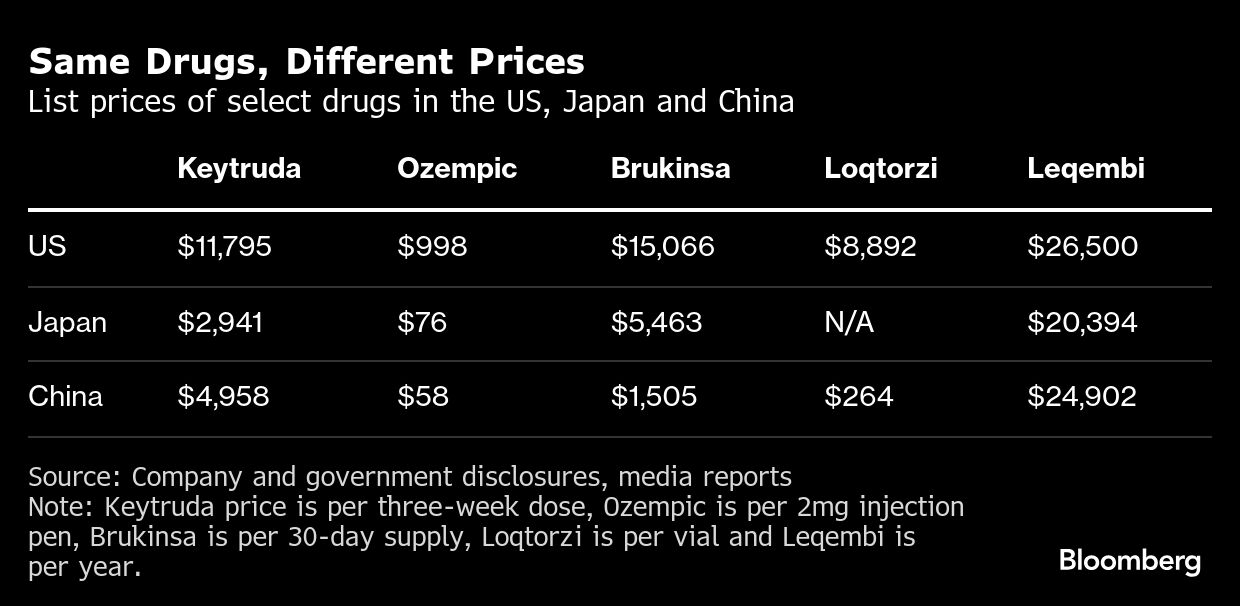
Americans pay the most in the world for medicines, fueling innovation and driving the growth of the pharmaceutical industry. Drugmakers have said revamping the system will slash revenue and stifle the development of breakthrough therapies that have the potential to lengthen and improve lives.
Trump cited the industry's argument, but said it meant that “the ‘suckers' of America” ended up bearing those costs “for no reason whatsoever.”
The US government already negotiates prices for some of the highest-cost medicines used in Medicare health insurance under the Inflation Reduction Act, which passed in 2022 under former President Joe Biden, with more slated to be added every year. The first two rounds of drug price' negotiations haven't included physician-administered drugs, but the next round might.
Trump's Truth Social post — preceded by an earlier one that promised “one of the most important and impactful” posts he has ever issued — didn't offer specifics on the order.
He also didn't outline potential limits on the policy, such as whether it would apply only to government programs such as Medicare or Medicaid, if it would be limited to certain drugs or categories of drugs or if the White House sees a way to apply this more broadly.
While it's still unclear which drug companies will be affected by the executive order, investors are most worried about blockbuster drugs in Medicare Part-B and drugs serving large Medicaid populations, according to Jared Holz, a health-care strategist at Mizuho Securities USA LLC.
Billionaire hedge fund manager Bill Ackman suggested Trump might have been inspired by an idea he floated on X in March, when he said the best way to reduce US drug prices “is to make it illegal for drug companies to sell the same drugs abroad for lower prices than they sell them for here.”
In his first term, Trump proposed a Medicare pilot program for drugs with no low-cost generic competition that are given in doctor's offices, saying he wanted to bring prices in line with countries like France and Japan where they cost dramatically less.
That plan, which would have phased in over three years, aimed to ensure Medicare paid the lowest price offered to a group of 22 nations.
The effort was struck down in federal court after drug companies challenged it, claiming the administration hadn't properly carried out the rulemaking process. The Biden administration didn't appeal that finding, and instead pursued legislation that led to the Inflation Reduction Act.
The latest proposal may also face difficulties, according to analysts.
“There is no easy way forward, as the executive order needs to be passed by the Senate to become legislation,” Cui Cui, an analyst at Jefferies, wrote in a note. The plan is expected to face pushback from both the Senate as well as the industry, she wrote.

-
A New Samvat Wishlist: Inclusive Prosperity And Human Development

India has strengthened its economic foundations through infrastructure, digital access and enterprise. Its next growth chapter must deepen productivity, create better livelihoods and widen participation in prosperity.
-
Love, Sex Aur Dhokha: The Audacious Plot To Spy On Jensen Huang
A Taipei dinner, a Singapore chip buyer and a suspected Chinese asset: inside the alleged spy operation that got close to NVIDIA's Jensen Huang.
-
Ten Things I Learnt This Samvat
Patience can be a trap. Cheap stocks can stay cheap. Leverage can wipe you out. What did Samvat 2082 teach us? Niraj Shah writes on 10 lessons from the year gone by.
-
Talking Points This Week: Tech Nerves, FII Buying, And A Faraway Banking Shock
The global markets are not shining this Diwali. The exception in the large markets is, India.
-
Midterm Rally Lasted A Day. The Hard Reality Of A Divided US May Last Two Years | Opinion
Between a contested AI boom, a debt ceiling that arrives in 2027 and a president with every incentive to act alone, the next two years may prove more volatile than the first day's rally suggests.
-
Blue Wave Will Derail the AI Trade but Won't Dismantle the AI Era | Unhedged Position
The Democrats' sweep of the US Congress will see politics collide with economic forces both over the long and short term.
-
It's Time To Take The GST Council's Bet On Trust Global
Payment records can prove India's services exports, and clear, proportionate rules can bring foreign digital sellers into the tax net.
-
Opinion | India at 38: From Innovation Overperformer to Innovation Powerhouse
India now has 453 VC-backed deep science startups, 18 of them late-stage, after 117 percent growth since 2020. Laurus Labs, at USD 9.3 billion, is the most valuable deep science company in any middle-income economy outside China.
-
Navigating Energy Crossroads: S Jaishankar's Call For Diversified Supply Chains At G20 Ministerial Meeting
As geopolitical fault lines continue to test maritime trade routes and commodity flows, Jaishankar's message remains pertinent: true economic resilience requires open markets, protected transit lines, and a genuine commitment to multilateral cooperation rather than coercion.









