Trump Says He’ll Announce Reciprocal Tariffs At 1 P.M. Thursday
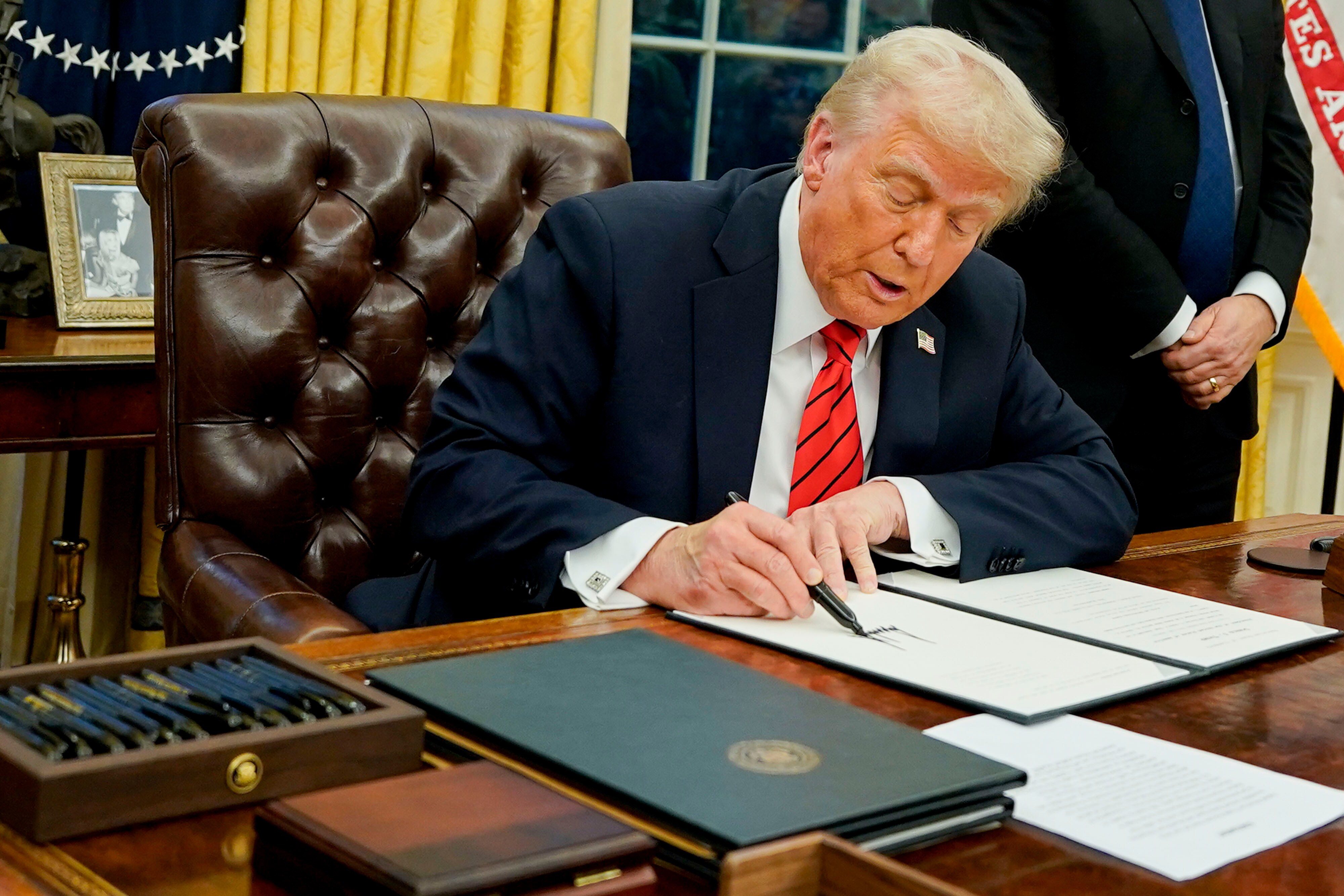
President Donald Trump said he would announce reciprocal tariffs on Thursday, promising to deliver on his threat to slap tariffs on imports from countries that impose higher duties on US goods.
The move would represent a major escalation of his trade war with economic partners. Trump announced the move on his Truth Social platform. He did not give any details on what the tariffs would be, how they would be structured or when they'd take effect.
“THREE GREAT WEEKS, PERHAPS THE BEST EVER, BUT TODAY IS THE BIG ONE: RECIPROCAL TARIFFS!!! MAKE AMERICA GREAT AGAIN!!!” he wrote. In a subsequent post, Trump said he would speak about the tariffs at a news conference at 1 p.m., Washington time, from the Oval Office.
The timing of the event comes just ahead of Trump's meeting with Indian Prime Minister Narendra Modi.
The dollar trimmed losses. Currencies of economies at the heart of the trade tensions with the US immediately reacted, with the euro paring gains and the Mexican peso lagging major currencies versus the greenback so far this session. Meanwhile, haven currencies like the Swiss Franc and Japanese yen held higher, outperforming peers.
Trump has gravitated toward the reciprocal tariff plan as a key part of his push to raise US levies overall. Trump has said it would apply to nations who generally have a higher average tariff rate than the US, which would raise its own tariff to match them.
“If they charge us, we charge them,” he said Sunday while speaking with reporters and confirming he planned to announce this week.
Negotiation tactics
The White House has not shared details of the plan, including what would be used to calculate the tariff rate and whether other trade barriers or taxes would be considered. It hasn't specified whether it would pick a single average for each country or differentiate by sector or product. It's also not clear whether the program would allow for exclusions.
The White House hasn't said when the tariffs would take effect. A longer lead time would raise speculation as to whether they would be used as leverage or a starting point for negotiations with world leaders.
Trump's action also could be the start of a longer administrative process to set reciprocal tariffs, by directing federal agencies to begin the work of assessing and developing new, matching levies that hit individual countries or products.
Trump has previously floated ways for countries to get around some of his specific tariffs. Despite saying there'd be no exceptions from the steel and aluminum duties, the president agreed after a call with Australian Prime Minister Anthony Albanese that he would “give consideration” to leeway for Australia. Trump cited an overall trade surplus with Australia, as well as their purchase of US-made airplanes.
Trump is announcing the plan on a day where he hosts India's Modi, whose country has high tariffs. In the last few weeks, India has slashed tariffs on items from motorcycles to luxury cars, agreed to take planeloads of undocumented migrants and pushed to ramp up purchases of US energy.
Trump earlier announced tariffs on China, Canada and Mexico, but paused the latter two for a month after the countries made border security pledges. He has also announced 25% tariffs on steel and aluminum that are set to take effect next month.

-
Navigating Energy Crossroads: S Jaishankar's Call For Diversified Supply Chains At G20 Ministerial Meeting

As geopolitical fault lines continue to test maritime trade routes and commodity flows, Jaishankar's message remains pertinent: true economic resilience requires open markets, protected transit lines, and a genuine commitment to multilateral cooperation rather than coercion.
-
Indians Are Travelling, But Not Every Journey Is A Holiday | The Week In Whys
Pilgrims, patients and working women are the real travellers, and the system hasn't quite caught up with them.
-
Getting To Work Costs Women More | The Reason Why
It is not just about women paying more than men. It is about women paying much more in cities than in villages.
-
AI Bias In Investing Cannot Be Eliminated, But It Can Be Governed
Framing is a particularly important example as identical financial information presented in terms of gains rather than losses can lead an LLM to reach a different assessment.
-
Joining The Dots | Dark Skies, Steady Diya: Why Hope Holds This Diwali
With war, a weak rupee and foreign outflows weighing on sentiment, policymakers at the NDTV World Summit and market veterans at NDTV Profit Ignite: Diwali Edition offered the same advice: stay invested and filter out the noise.
-
The Curious Case of Equitas Small Finance Bank And A CEO Who Quit For Stock
PN Vasudevan believes persistent investor concerns over a perceived conflict of interest had become a governance overhang on Equitas Small Finance Bank's stock, even as the lender improved profitability and asset quality.
-
Talking Points This Week: AI Cash Burn, A Tiger Comeback And An India That Still Finds Its Own Path
India is not immune to higher oil or tighter global liquidity, yet its earnings base is broader, its domestic policy levers are still available.
-
Foreign Investors Own Half Of HDFC Bank and ICICI Bank. An LTCG Cut Could Matter Most Here
Foreign portfolio investors have US$115 billion parked in HDFC Bank, ICICI Bank. If the government cuts long-term capital gains tax, Jefferies says returning foreign money could land here first.
-
'Never Seen This Level Of Negativity': Sandeep Tandon Says The Next Rally May Be Closer Than You Think
Veteran investor Sandeep Tandon says foreign selling is easing, large-caps are due a comeback and mid-caps are crowded, while he turns positive on gold, power and pharma this Diwali.
-
Indians Stay With Family, Not In Hotels | The Reason Why
India still lacks enough clean, reliable and affordable hotels for budget-conscious travellers.










