Trump Meets With Security Team After Demanding Iran ‘Surrender’
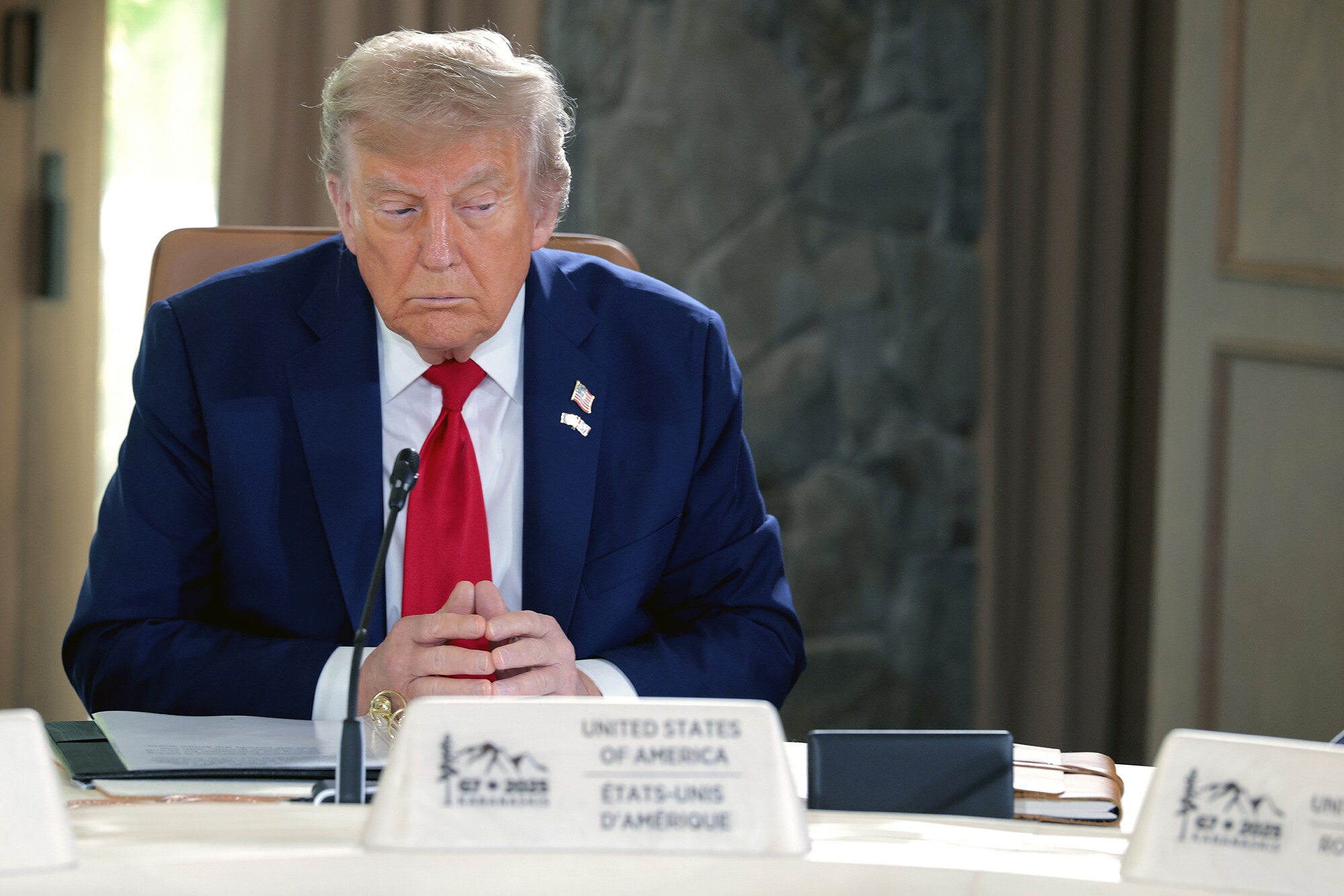
President Donald Trump met with his national security team in Washington on Tuesday to discuss the escalating Middle East conflict, according to people familiar with the matter, fueling fresh speculation that the US is on the verge of joining Israel's attack on Iran.
The meeting lasted more than an hour and White House officials declined to comment or issue a statement following its conclusion. Trump spoke with Israeli Prime Minister Benjamin Netanyahu following the meeting, according to a White House official, as speculation swirled around how the US president might proceed. American weapons are seen as crucial to achieving a more complete destruction of the Islamic Republic's atomic program than anything Israel can do alone.
Before gathering his advisers in the Situation Room, Trump posted a demand for Iran's “UNCONDITIONAL SURRENDER” and warned of a possible strike against the country's leader, Ayatollah Ali Khamenei. “We know exactly where the so-called ‘Supreme Leader' is hiding. He is an easy target, but is safe there - We are not going to take him out (kill!), at least not for now,” Trump posted on social media.
Both Israel and Iran indicated that they planned to ratchet up the conflict, which has seen the sworn enemies trade missile salvos for five days.
The Israel Defense Forces said they had identified missiles launched from Iran toward Israel and instructed the public to take shelter in protected spaces. Explosions were heard in Tel Aviv, according to Reuters. Separately, the New York Times reported that Iran was preparing missiles for possible retaliatory strikes on US military interests in the Middle East, were Trump to proceed with an offensive campaign.
At the same time, Israel also sought to heighten pressure on Iran, indicating it would intensify a campaign of air strikes that have targeted the country's nuclear facilities as well as military leaders and infrastructure.
Israeli Defense Minister Israel Katz said the military would attack “very significant targets in Tehran” and adding that residents should evacuate. Earlier in the day, a spokesman for the IDF said that while it was too early to assess the success of the current campaign in Iran, strikes on the country's nuclear facilities were “deepening” every day.
German Chancellor Friedrich Merz, who was attending the Group of Seven summit in Canada that Trump departed early to return to the White House for meetings on the crisis, told the country's public broadcaster ZDF that a US decision on whether to join the war militarily would come “in the course of the day” and said that if Iran doesn't return to the negotiating table, then “the complete destruction of Iran's nuclear program may be on the agenda.”
Iran had been negotiating with the US for weeks over a nuclear deal before Israel launched its surprise assault.
Iran's state-run Islamic Republic News Agency cited the country's armed forces chief of staff as saying that it plans a “punitive operation” against Israel and warned Israelis to evacuate Tel Aviv and Haifa.
Trump earlier Tuesday posted on social media that “we now have complete and total control of the skies over Iran,” crediting US military equipment for helping Israel gain air superiority.
Vice President JD Vance told reporters Tuesday that Trump was “making clear to the American people and the entire world that the US policy is that Iran can't have a nuclear weapon, and part of that is that they are not allowed” to enrich uranium, adding that “there are many different ways and different options at the president's disposal for how to accomplish that policy goal.”
US stocks declined on Tuesday as Trump played down the possibility of negotiations with Iran, fueling widespread fears the war would spread to other countries in the energy-producing region. Oil climbed near a five-month high.
Trump's exit from the G-7 followed another 24 hours of intense bombardments, with Iran firing ballistic missiles and Israel striking targets across the Islamic Republic, including the capital of Tehran. The USS Nimitz aircraft carrier strike group is sailing to the Middle East ahead of schedule, marking the first significant move of American military assets to the region since Friday. Reuters reported that the US military was deploying more fighters and other warplanes to the region.
New satellite images suggest Israeli strikes damaged underground uranium-enrichment facilities at Natanz, Iran's primary nuclear-fuel production site, the United Nations nuclear watchdog said in a post on X. The International Atomic Energy Agency has yet to detect damage at Iran's other underground enrichment site in Fordow, according to the statement.
Republican Senator Lindsey Graham of South Carolina, a longtime advocate of war against Iran, said he “100% supports” US participation in striking Fordow.
“I'm all in for destroying their nuclear program. You can't do it without destroying Fordow,” he told reporters in Washington. “If it takes bombs, bunker-buster bombs, so be it. If we need to fly with Israel, so be it.” Graham added that “the window for diplomacy has passed, we're in the land of force.”

Israel has sought to draw the US — which has provided defensive support against Iranian missile fire — deeper into the conflict. Netanyahu told ABC News on Monday that the countries share a common enemy in Iran, and that it's in America's interest to support Israel.
Trump has left open the possibility of further talks on Iran's atomic activities after five earlier rounds, but continued to hammer the idea that Tehran is at fault for not having already agreed to a deal that would have prevented Israel's attacks. He told reporters that he “may” send a high-level official, such as special envoy Steven Witkoff or Vance, to meet with Iranian representatives.
Trump is “telling Iran you can put a stop to this,” Missouri Republican Senator Josh Hawley said after speaking with the president on Tuesday.
Israel said it saw a drop-off in Iranian fire on Tuesday, with a military spokesperson saying “a few dozen” missiles had been launched since midnight compared with the hundreds seen over the weekend.
Still, Israel's Oil Refineries Ltd. shut down its refinery after the complex was damaged and three employees were killed, the company said Monday. The site has a peak production capacity of close to 200,000 barrels of oil per day, with 70% of products distributed in the Israeli market.
Long-standing tensions between Iran and Israel erupted into open fighting last week, when Israel carried out surprise attacks on Iranian military and nuclear sites and killed senior commanders and atomic scientists. Since then, it has achieved air superiority over much of Iran, allowing it to bomb major cities and infrastructure at will.
For Iran's government, the showdown poses a strategic dilemma. It can't risk appearing weak, yet its retaliatory options are shrinking. Proxy forces it supports across the region have been largely degraded by Israeli wars since Oct. 2023.
More than 200 people have been killed in Iran by the Israeli strikes, according to the last official tally from the Iranian government. In Israel, the government has said 24 people have been killed — the same number reported the day before — and more than 600 injured.
Oil prices have risen in the past week as the conflict escalated, raising concerns about a wider hit to the global economy, and they climbed further on Tuesday to the highest in almost five months. Many analysts say Iran has the ability to shut down the Strait of Hormuz, a key energy trade route. Qatar on Tuesday asked liquefied natural gas vessels to wait outside the strait until they're ready to load amid the escalating clash.
Two large tankers collided and caught fire near the strait early Tuesday. The owner of one of them said the incident was “unrelated to the current regional conflict.”

-
Navigating Energy Crossroads: S Jaishankar's Call For Diversified Supply Chains At G20 Ministerial Meeting

As geopolitical fault lines continue to test maritime trade routes and commodity flows, Jaishankar's message remains pertinent: true economic resilience requires open markets, protected transit lines, and a genuine commitment to multilateral cooperation rather than coercion.
-
Indians Are Travelling, But Not Every Journey Is A Holiday | The Week In Whys
Pilgrims, patients and working women are the real travellers, and the system hasn't quite caught up with them.
-
Getting To Work Costs Women More | The Reason Why
It is not just about women paying more than men. It is about women paying much more in cities than in villages.
-
AI Bias In Investing Cannot Be Eliminated, But It Can Be Governed
Framing is a particularly important example as identical financial information presented in terms of gains rather than losses can lead an LLM to reach a different assessment.
-
Joining The Dots | Dark Skies, Steady Diya: Why Hope Holds This Diwali
With war, a weak rupee and foreign outflows weighing on sentiment, policymakers at the NDTV World Summit and market veterans at NDTV Profit Ignite: Diwali Edition offered the same advice: stay invested and filter out the noise.
-
The Curious Case of Equitas Small Finance Bank And A CEO Who Quit For Stock
PN Vasudevan believes persistent investor concerns over a perceived conflict of interest had become a governance overhang on Equitas Small Finance Bank's stock, even as the lender improved profitability and asset quality.
-
Talking Points This Week: AI Cash Burn, A Tiger Comeback And An India That Still Finds Its Own Path
India is not immune to higher oil or tighter global liquidity, yet its earnings base is broader, its domestic policy levers are still available.
-
Foreign Investors Own Half Of HDFC Bank and ICICI Bank. An LTCG Cut Could Matter Most Here
Foreign portfolio investors have US$115 billion parked in HDFC Bank, ICICI Bank. If the government cuts long-term capital gains tax, Jefferies says returning foreign money could land here first.
-
'Never Seen This Level Of Negativity': Sandeep Tandon Says The Next Rally May Be Closer Than You Think
Veteran investor Sandeep Tandon says foreign selling is easing, large-caps are due a comeback and mid-caps are crowded, while he turns positive on gold, power and pharma this Diwali.
-
Indians Stay With Family, Not In Hotels | The Reason Why
India still lacks enough clean, reliable and affordable hotels for budget-conscious travellers.










