Trump, Ishiba Fail To Reach Trade Deal At G-7 Summit
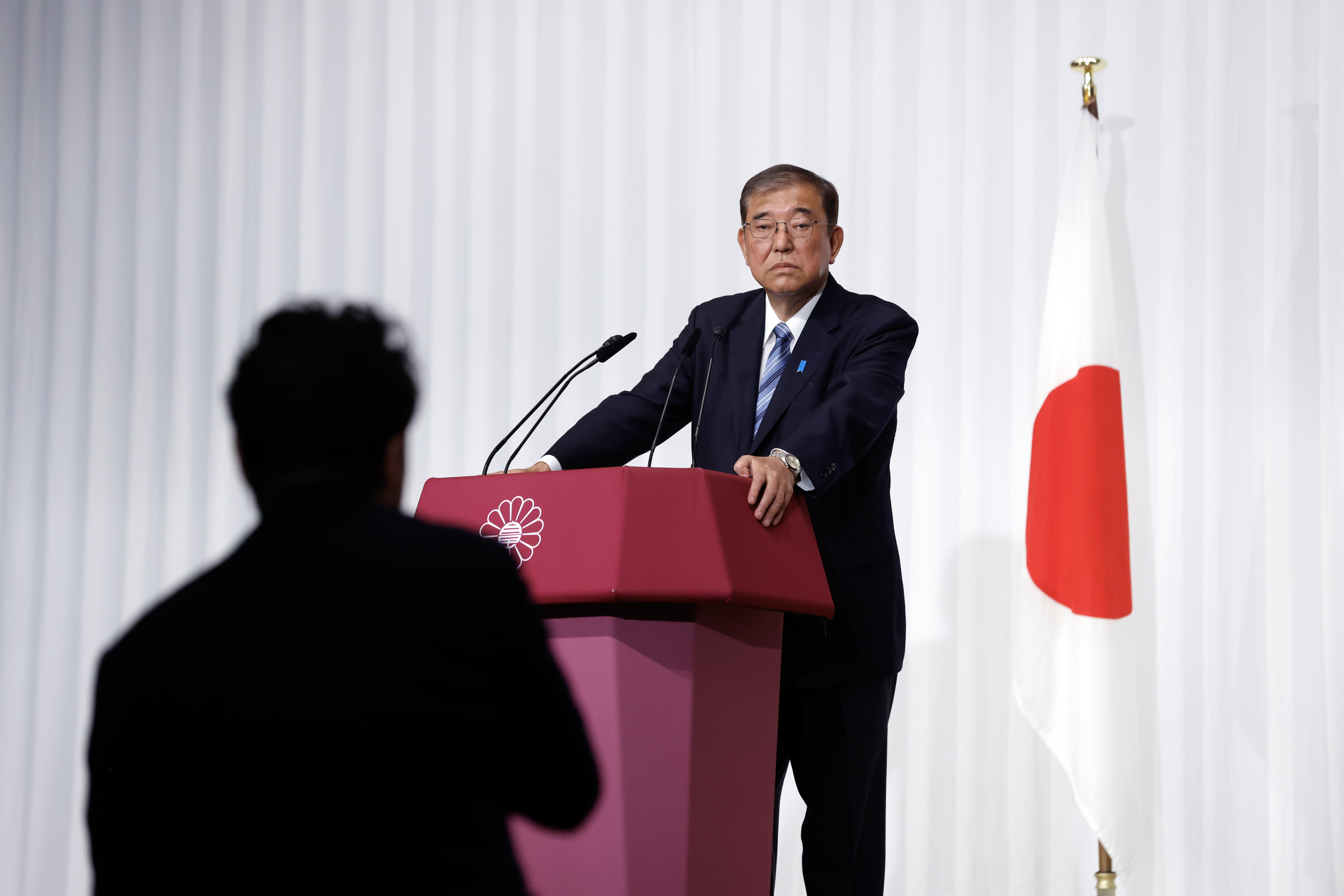
US President Donald Trump and Japanese Prime Minister Shigeru Ishiba failed to reach an agreement on a trade package on the sidelines of the Group of Seven summit, an outcome that leaves the Asian nation inching closer to a possible recession as the pain of US tariffs hits its economy.
"There are still some points on which the two sides are not on the same page, so we have not yet reached an agreement on the trade package," Ishiba said to reporters on Monday in Calgary in between G-7 meetings.
The failure to reach a concrete agreement will raise questions over Ishiba's effectiveness as leader ahead of a crucial upper house election next month, after he touted the summit as a possible “milestone” opportunity in tariff negotiations that have continued for about two months. With the 25% auto levy in particular dealing a direct blow to the nation's most important source of exports, Ishiba's standing will likely be damaged in the eyes of Japanese voters.
“We will continue to actively coordinate with the United States to reach an agreement that is beneficial for both countries, without sacrificing Japan's national interests,” he said. He added that he could not say when a deal may be reached and that negotiations will continue on the ministerial level.
As with other nations, Japan is subject to a 25% levy on cars and auto parts and a 50% tariff on steel and aluminum. A 10% across-the-board levy on other goods is set to rise to 24% in early July. Asked if the July deadline might be extended, Ishiba declined to comment.
There is a particular focus on auto tariffs, which Trump has threatened to hike even further. The auto industry is crucial to the Japanese economy, employing some 5.6 million people, about 8.3% of the country's work force, and generating around 10% of gross domestic product, according to the Japan Automobile Manufacturers Association.
Major automakers including Toyota Motor Corp., Honda Motor Co., Mazda Motor Corp. and Subaru Corp. are bracing for a collective hit of more than $19 billion this fiscal year alone from the tariffs.
“For Japan, automobiles are truly a matter of national interest. We will do whatever it takes to protect our national interests,” Ishiba told reporters.
The impact on major auto companies would reverberate through the web of small- and mid-sized businesses that form the industry's backbone. Two-thirds of Japan's workforce is employed by firms with fewer than 1,000 people, and many of those jobs are tied in some way to the auto industry.
Leading up to the summit, local media reported a vast array of potential concessions that Japan was suggesting in a bid to close the trade gap with the US, ranging from importing more soy from the US to cooperation on ship-building.
Tokyo has also tried to reason with the US by citing its standing as the leading investor to the US as leverage, saying the tariffs would negatively impact Japan's capability to invest in the US by cutting into its domestic economy.
Japan's cumulative foreign direct investment into the US stood at $783 billion at the end of 2023 and Ishiba pledged to boost Japan's overall investment in the US to $1 trillion during his summit with Trump in February.
In return, Ishiba and his top negotiator Ryosei Akazawa had consistently pushed for a full removal of all tariffs imposed by the US.
Ultimately, it doesn't appear that those promises impressed the US.
Ishiba has seen a bump in his ratings recently, thanks in part to Agriculture Minister Shinjiro Koizumi taking on rising rice prices — an issue emblematic of how inflation is hitting households. His approval ratings rose 5 percentage points to 38%, according to a poll conducted over the weekend by broadcaster FNN.
But the lack of substantial progress on a trade deal even after meeting with Trump threatens to erase those gains.
Japan was among the first nations to start talks with the US and was considered likely to be among the first to reach an agreement. But it appears to have fallen behind others as the US struck a deal with the UK and reached a truce over tariffs with China.

-
Navigating Energy Crossroads: S Jaishankar's Call For Diversified Supply Chains At G20 Ministerial Meeting

As geopolitical fault lines continue to test maritime trade routes and commodity flows, Jaishankar's message remains pertinent: true economic resilience requires open markets, protected transit lines, and a genuine commitment to multilateral cooperation rather than coercion.
-
Indians Are Travelling, But Not Every Journey Is A Holiday | The Week In Whys
Pilgrims, patients and working women are the real travellers, and the system hasn't quite caught up with them.
-
Getting To Work Costs Women More | The Reason Why
It is not just about women paying more than men. It is about women paying much more in cities than in villages.
-
AI Bias In Investing Cannot Be Eliminated, But It Can Be Governed
Framing is a particularly important example as identical financial information presented in terms of gains rather than losses can lead an LLM to reach a different assessment.
-
Joining The Dots | Dark Skies, Steady Diya: Why Hope Holds This Diwali
With war, a weak rupee and foreign outflows weighing on sentiment, policymakers at the NDTV World Summit and market veterans at NDTV Profit Ignite: Diwali Edition offered the same advice: stay invested and filter out the noise.
-
The Curious Case of Equitas Small Finance Bank And A CEO Who Quit For Stock
PN Vasudevan believes persistent investor concerns over a perceived conflict of interest had become a governance overhang on Equitas Small Finance Bank's stock, even as the lender improved profitability and asset quality.
-
Talking Points This Week: AI Cash Burn, A Tiger Comeback And An India That Still Finds Its Own Path
India is not immune to higher oil or tighter global liquidity, yet its earnings base is broader, its domestic policy levers are still available.
-
Foreign Investors Own Half Of HDFC Bank and ICICI Bank. An LTCG Cut Could Matter Most Here
Foreign portfolio investors have US$115 billion parked in HDFC Bank, ICICI Bank. If the government cuts long-term capital gains tax, Jefferies says returning foreign money could land here first.
-
'Never Seen This Level Of Negativity': Sandeep Tandon Says The Next Rally May Be Closer Than You Think
Veteran investor Sandeep Tandon says foreign selling is easing, large-caps are due a comeback and mid-caps are crowded, while he turns positive on gold, power and pharma this Diwali.
-
Indians Stay With Family, Not In Hotels | The Reason Why
India still lacks enough clean, reliable and affordable hotels for budget-conscious travellers.










