Supreme Court Says Trump Has Some Immunity, Delaying Trial
(Bloomberg) -- The US Supreme Court ruled that Donald Trump has some immunity from criminal charges for trying to reverse the 2020 election results, all but ensuring that a trial won't happen before the November election.
The justices, voting 6-3 along ideological lines, said a federal appeals court was too categorical in rejecting Trump's immunity arguments, ruling for the first time that former presidents are shielded from prosecution for some official acts taken while in office.
“The president is not above the law,” Chief Justice John Roberts wrote for the court. “But Congress may not criminalize the president's conduct in carrying out the responsibilities of the Executive Branch under the Constitution.”
Read the Full Supreme Court Ruling on Trump Immunity
The majority told US District Judge Tanya Chutkan, who is overseeing the case, to decide the full extent to which the allegations are off limits to prosecution.
The court stopped short of tossing out the indictment, as Trump had sought. But the ruling's timing nonetheless makes it a tactical triumph for the former president, effectively shutting the narrow window for Special Counsel Jack Smith to put Trump in front of a jury in Washington before Election Day on Nov. 5.
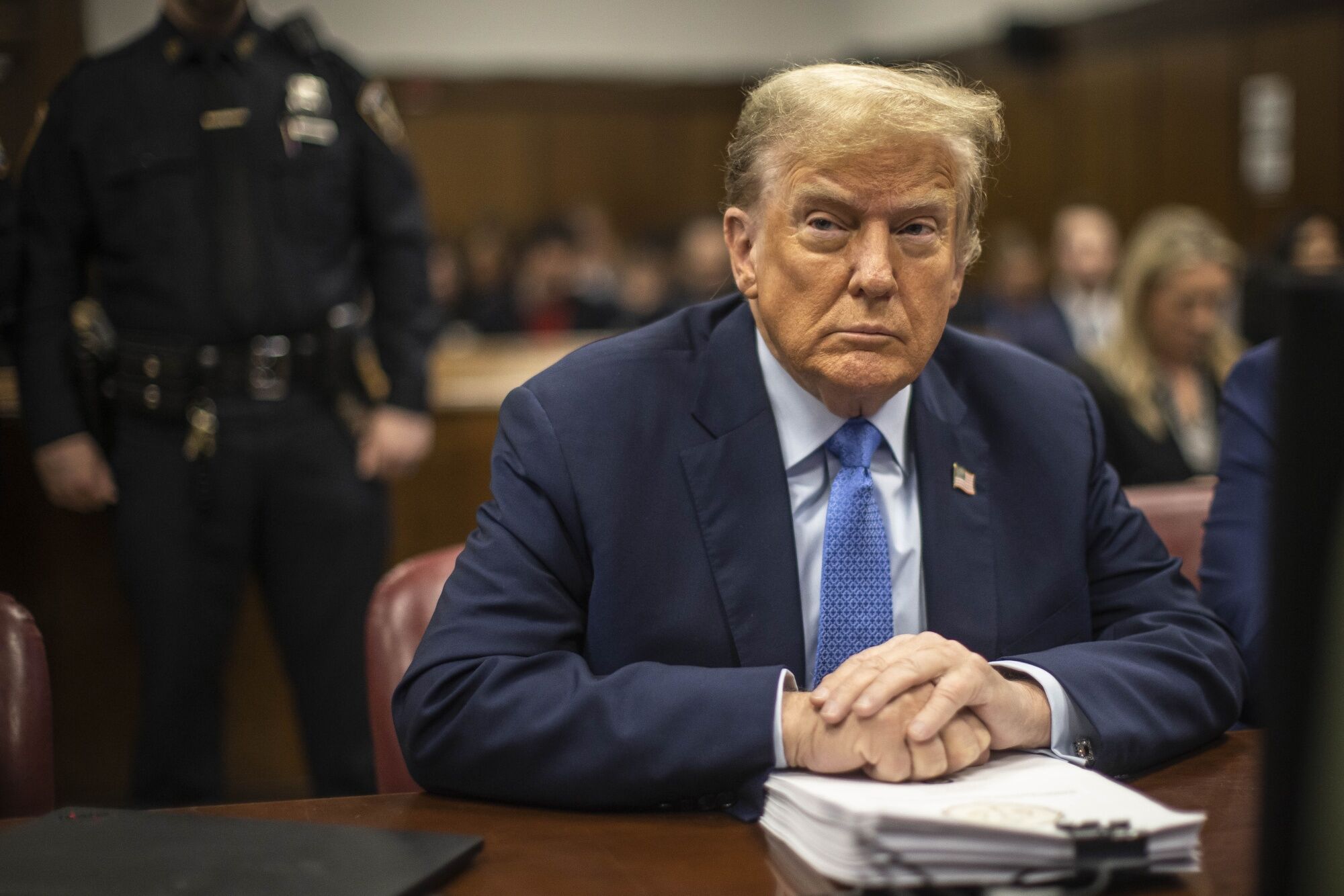
Trump is now likely to reach the November election with only one of the four criminal cases against him having gone to trial. He was convicted in New York state court May 30 for falsifying business records to conceal a hush money payment to porn star Stormy Daniels before the 2016 election. The Washington trial has been on hold while Trump pressed his immunity case.
Justices Sonia Sotomayor, Elena Kagan and Ketanji Brown Jackson dissented. Sotomayor said the decision is based on “misguided wisdom” and “reshapes the institution of the Presidency.”
‘A Mockery'
“It makes a mockery of the principle, foundational to our Constitution and system of government, that no man is above the law,” Sotomayor wrote.
Trump hailed the ruling. “BIG WIN FOR OUR CONSTITUTION AND DEMOCRACY. PROUD TO BE AN AMERICAN!” he said on a post on his social media network Truth Social.
All three of the justices Trump appointed — Neil Gorsuch, Brett Kavanaugh and Amy Coney Barrett — joined the majority, along with Justices Clarence Thomas and Samuel Alito.
The majority said Trump was entitled to immunity for allegations related to efforts to press the Justice Department to intervene in the postelection contests. The court said other pieces of the indictment might involve official acts that triggered immunity for Trump, sending the case back to the trial judge to dig into the record and make a new round of findings.
Roberts went beyond saying that Trump's official acts can't be part of the indictment, saying that conduct can't be used as evidence at trial. Doing so would “heighten the prospect that the president's official decisionmaking will be distorted,” he wrote.
Trump is accused of conspiring to defraud the US by promoting false claims of election fraud, pressuring the Justice Department to conduct sham investigations, pushing then-Vice President Mike Pence to undercut certification of Joe Biden's victory and inciting a crowd to storm the Capitol.
In another blow to Smith, the court said he couldn't use evidence of Trump's official acts in making his case, even if the jury is told it can convict only based on his private conduct. Smith had urged the Supreme Court at least to let him use Trump's official actions to show the outgoing president knew that his election-fraud claims were false.
Chutkan previously said she would allow three months to prepare for a trial that could last two to three months. The schedule is important because of the broad expectation that, should Trump reclaim the White House in January, he would insist the Justice Department drop the prosecution.
Although the Supreme Court said in 1982 that former presidents can't face civil lawsuits over official acts taken while in office, the justices had never before conferred criminal immunity.
The majority said presidents are completely immune for actions that fall within the exclusive powers the Constitution gives the chief executive. And the court said other types of official acts are insulated unless Congress has explicitly said criminal law applies to the president.
A federal appeals had court ruled 3-0 that Trump could be prosecuted. The panel said Trump's claim of sweeping immunity would give him “unbounded authority to commit crimes that would neutralize the most fundamental check on executive power — the recognition and implementation of election results.”
Critics have accused the Supreme Court, which has three Trump-appointed members, of slow-walking the case to prevent a trial before the November election. The court in December rejected Smith's request to take up the case on an expedited basis. When the justices eventually did intervene, they scheduled a hearing on the last argument day of the term.
The case is Trump v. United States, 22-939.
--With assistance from Zoe Tillman, Erik Larson and Kimberly Robinson.
(Updates with more information from the opinion and background.)
More stories like this are available on bloomberg.com
©2024 Bloomberg L.P.

-
Talking Points This Week: Tech Nerves, FII Buying, And A Faraway Banking Shock

The global markets are not shining this Diwali. The exception in the large markets is, India.
-
Midterm Rally Lasted A Day. The Hard Reality Of A Divided US May Last Two Years | Opinion
Between a contested AI boom, a debt ceiling that arrives in 2027 and a president with every incentive to act alone, the next two years may prove more volatile than the first day's rally suggests.
-
Blue Wave Will Derail the AI Trade but Won't Dismantle the AI Era | Unhedged Position
The Democrats' sweep of the US Congress will see politics collide with economic forces both over the long and short term.
-
It's Time To Take The GST Council's Bet On Trust Global
Payment records can prove India's services exports, and clear, proportionate rules can bring foreign digital sellers into the tax net.
-
Opinion | India at 38: From Innovation Overperformer to Innovation Powerhouse
India now has 453 VC-backed deep science startups, 18 of them late-stage, after 117 percent growth since 2020. Laurus Labs, at USD 9.3 billion, is the most valuable deep science company in any middle-income economy outside China.
-
Navigating Energy Crossroads: S Jaishankar's Call For Diversified Supply Chains At G20 Ministerial Meeting
As geopolitical fault lines continue to test maritime trade routes and commodity flows, Jaishankar's message remains pertinent: true economic resilience requires open markets, protected transit lines, and a genuine commitment to multilateral cooperation rather than coercion.
-
Indians Are Travelling, But Not Every Journey Is A Holiday | The Week In Whys
Pilgrims, patients and working women are the real travellers, and the system hasn't quite caught up with them.
-
Getting To Work Costs Women More | The Reason Why
It is not just about women paying more than men. It is about women paying much more in cities than in villages.
-
AI Bias In Investing Cannot Be Eliminated, But It Can Be Governed
Framing is a particularly important example as identical financial information presented in terms of gains rather than losses can lead an LLM to reach a different assessment.









