S&P 500 Sinks 2% As Economic Fears Spur Bond Rally: Markets Wrap
Stocks got hammered, bonds climbed and gold hit a record high, following signs of weakness in the main engine of the US economy and worries that inflation could gain further traction amid a trade war.
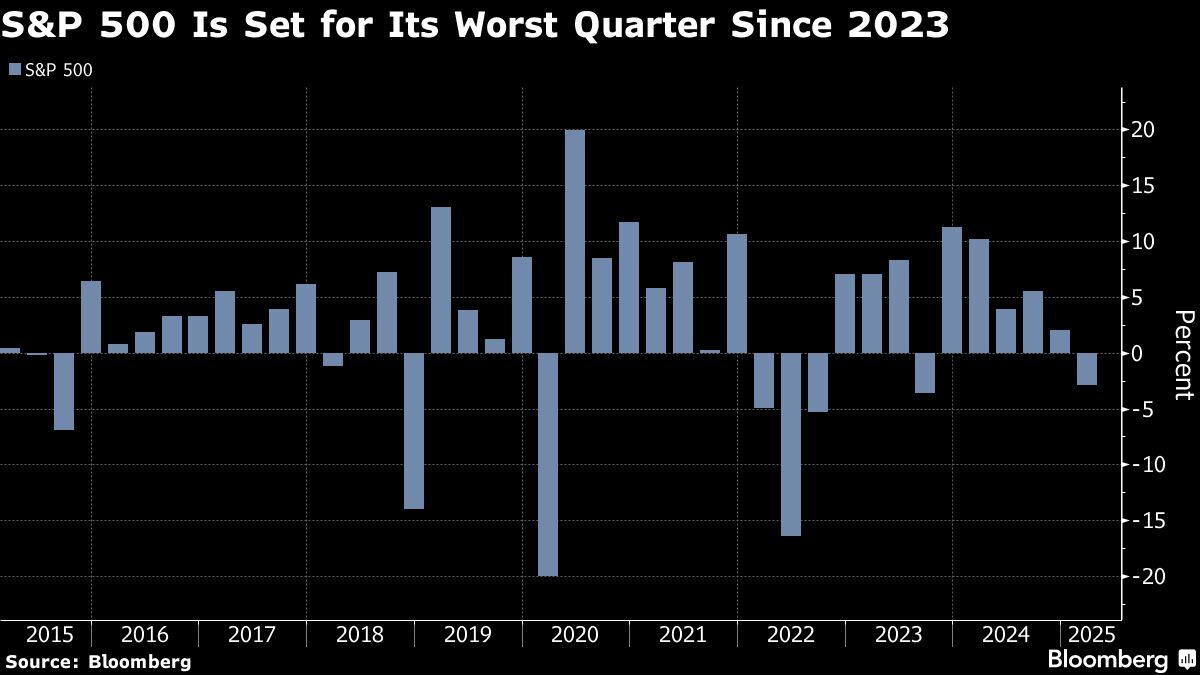
With just one more session left before the end of a quarter that's set to be the S&P 500's worst since 2022, the gauge fell 2%. Data showed a plunge in US consumer sentiment and a surge in long-term inflation expectations. That was after another report underscored tepid spending and a pick-up in prices ahead of next week's big US tariff rollout. A gauge of tech megacaps slumped 3.5%. The yield on 10-year Treasuries sank 10 basis points to 4.26%.
To Bret Kenwell at eToro, the biggest worry is that inflation will remain elevated amid a notable slowdown in the economy.
“And while that risk may not be the base case right now, any traction it gains could further weigh on investor sentiment,” he said. “But unless there's a larger deterioration in the economy, it's too soon to jump on the stagflation train.”
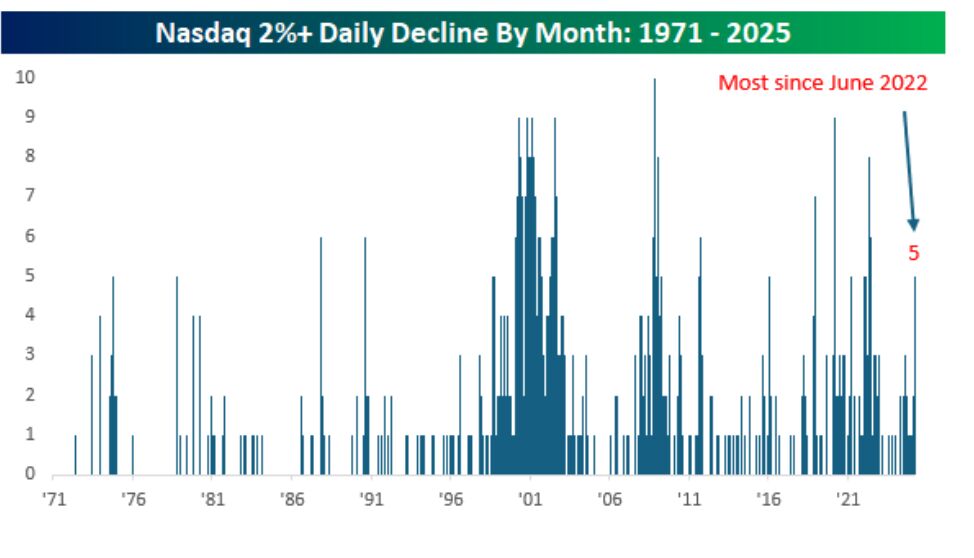
The Nasdaq Composite Index lost 2.7%, notching a drop of at least 2% in March for the fifth time — the most for a single month since the bear market in June 2022, according to Bespoke Investment Group. The Dow Jones Industrial Average slipped 1.7%. All megacaps sank, with Amazon.com Inc. and Alphabet Inc. sinking over 4%. Lululemon Athletica Inc. tumbled 14% on a gloomy outlook.
Wall Street's “fear gauge” - the VIX - topped 21. The dollar fell 0.1%. Bitcoin tumbled about 4%.
As President Donald Trump's tariff policy expands, consumers are growing more worried that the added duties will drive up prices. A prolonged rise in costs could prompt households to cut back on discretionary spending, which has implications for broader economy — and Corporate America.
“Today's data has the general pattern of what many observers will be looking for in the months ahead as new tariffs and other policy change begin to bite: weaker-than-expected spending and stronger-than-expected inflation,” according to David Alcaly at Lazard Asset Management.
While it's premature to be drawing judgments, seeing this pattern in hard data could feed apprehension before next week's announcements, Alcaly added.
“When you don't know what's coming, it's harder to plan,” said Jim Baird at Plante Moran Financial Advisors. “In the face of growing uncertainty, consumers are left with tough decisions. For now, inflation has re-emerged as a significant – and growing – concern.”
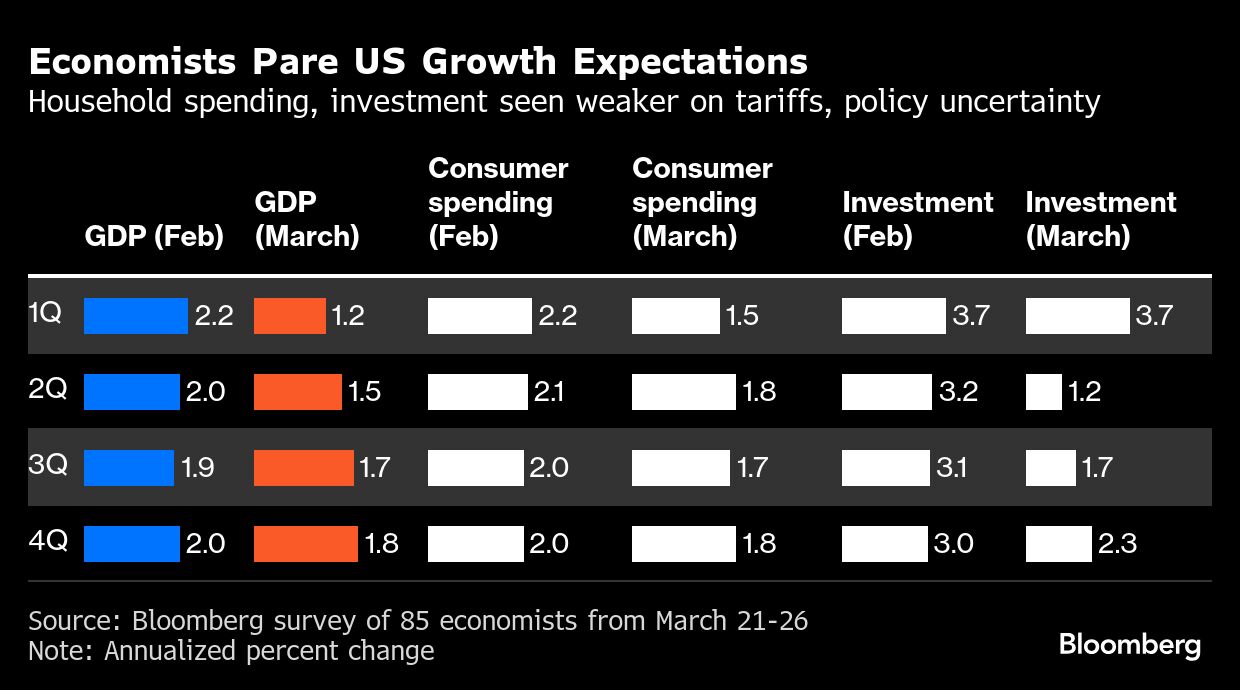
Economists dialed back their expectations for US growth this year, envisioning softer consumer spending and more limited capital investment amid mounting uncertainty created by the ever-evolving trade policy, according to the latest Bloomberg survey of economists.
US stock funds suffered their largest weekly outflow this year, while inflows continued to pour into European equities, Bank of America Corp. said, citing EPFR Global data.
“Looking ahead, the market's recovery is expected to be turbulent, with volatility persisting until policy uncertainty clears,” said Mark Hackett at Nationwide. “However, April has historically provided a seasonal tailwind – whether that holds true this year remains to be seen given the current environment.”
Hackett noted that investor sentiment has reached extreme levels, which often serves as a contrarian signal. Historically, when sentiment has been this stretched, the S&P 500 has posted strong gains over the following six and 12 months, he said.
“All in all, investors should stay patient for now,” Hackett concluded.
UBS Global Wealth Management's David Lefkowitz lowered his S&P 500 year-end target to 6,400 from 6,600 to account for recent economic turbulence, but he sees stocks reversing course and rising into the end of 2025.
“We still believe that US stocks can recover and post gains for the year,” he said in a Friday note to clients.
Some Of The Main Moves In Markets:
Stocks
The S&P 500 fell 2% as of 4 p.m. New York time
The Nasdaq 100 fell 2.6%
The Dow Jones Industrial Average fell 1.7%
The MSCI World Index fell 1.7%
The Nasdaq Composite fell 2.7%
Bloomberg Magnificent 7 Total Return Index fell 3.5%
The Russell 2000 Index fell 2.1%
Currencies
The Bloomberg Dollar Spot Index fell 0.1%
The euro rose 0.2% to $1.0826
The British pound was little changed at $1.2945
The Japanese yen rose 0.9% to 149.75 per dollar
The Canadian dollar was little changed at 1.4316
Cryptocurrencies
Bitcoin fell 4.1% to $83,733.65
Ether fell 6.7% to $1,872.77
Bonds
The yield on 10-year Treasuries declined 10 basis points to 4.26%
Germany's 10-year yield declined five basis points to 2.73%
Britain's 10-year yield declined nine basis points to 4.69%
Commodities
West Texas Intermediate crude fell 1.2% to $69.11 a barrel
Spot gold rose 0.8% to $3,081.23 an ounce
© 2025 Bloomberg L.P.

-
Talking Points This Week: Tech Nerves, FII Buying, And A Faraway Banking Shock

The global markets are not shining this Diwali. The exception in the large markets is, India.
-
Midterm Rally Lasted A Day. The Hard Reality Of A Divided US May Last Two Years | Opinion
Between a contested AI boom, a debt ceiling that arrives in 2027 and a president with every incentive to act alone, the next two years may prove more volatile than the first day's rally suggests.
-
Blue Wave Will Derail the AI Trade but Won't Dismantle the AI Era | Unhedged Position
The Democrats' sweep of the US Congress will see politics collide with economic forces both over the long and short term.
-
It's Time To Take The GST Council's Bet On Trust Global
Payment records can prove India's services exports, and clear, proportionate rules can bring foreign digital sellers into the tax net.
-
Opinion | India at 38: From Innovation Overperformer to Innovation Powerhouse
India now has 453 VC-backed deep science startups, 18 of them late-stage, after 117 percent growth since 2020. Laurus Labs, at USD 9.3 billion, is the most valuable deep science company in any middle-income economy outside China.
-
Navigating Energy Crossroads: S Jaishankar's Call For Diversified Supply Chains At G20 Ministerial Meeting
As geopolitical fault lines continue to test maritime trade routes and commodity flows, Jaishankar's message remains pertinent: true economic resilience requires open markets, protected transit lines, and a genuine commitment to multilateral cooperation rather than coercion.
-
Indians Are Travelling, But Not Every Journey Is A Holiday | The Week In Whys
Pilgrims, patients and working women are the real travellers, and the system hasn't quite caught up with them.
-
Getting To Work Costs Women More | The Reason Why
It is not just about women paying more than men. It is about women paying much more in cities than in villages.
-
AI Bias In Investing Cannot Be Eliminated, But It Can Be Governed
Framing is a particularly important example as identical financial information presented in terms of gains rather than losses can lead an LLM to reach a different assessment.









