A Landmark $8.5 Billion Climate Finance Deal Hangs In The Balance
(Bloomberg) -- A landmark $8.5 billion deal to help wean South Africa off its dependence on coal is hanging in the balance amid fraught negotiations with rich donor countries over how the funds should be spent.
The climate finance deal, unveiled at UN-led talks in Glasgow last year, was hailed as a prototype for helping other coal-dependent developing countries transition to cleaner energy sources. Its success or failure could have a knock-on effect at next month's COP27 summit in Egypt, which is expected to focus on the financing needs of poorer countries adapting to a warming atmosphere.
South Africa, which relies on coal for more than 80% of its power and is the world's 13th-biggest source of planet-warming gases, is pushing for cheaper money in the form of grants and low-interest loans, people familiar with the talks said, declining to be named as negotiations are private and ongoing.
One key factor holding back the deal is the lack of detail South Africa has given on how it will spend the money its partners - the US, UK, France, Germany and the EU - will invest, the people said.Negotiators have been aiming for the UN summit as a deadline, mindful that climate deals often come down to the wire. Key stakeholders are privately expressing confidence that some version of the South African finance plan will be ready.
“There's legitimate criticism and debate on whether or not this is the kind of best model, but a decent amount of political capital has been invested,” said Jake Schmidt, senior strategic director of the international climate program at the Natural Resources Defense Council, a US non profit. “We need to make it succeed because others are watching it.”
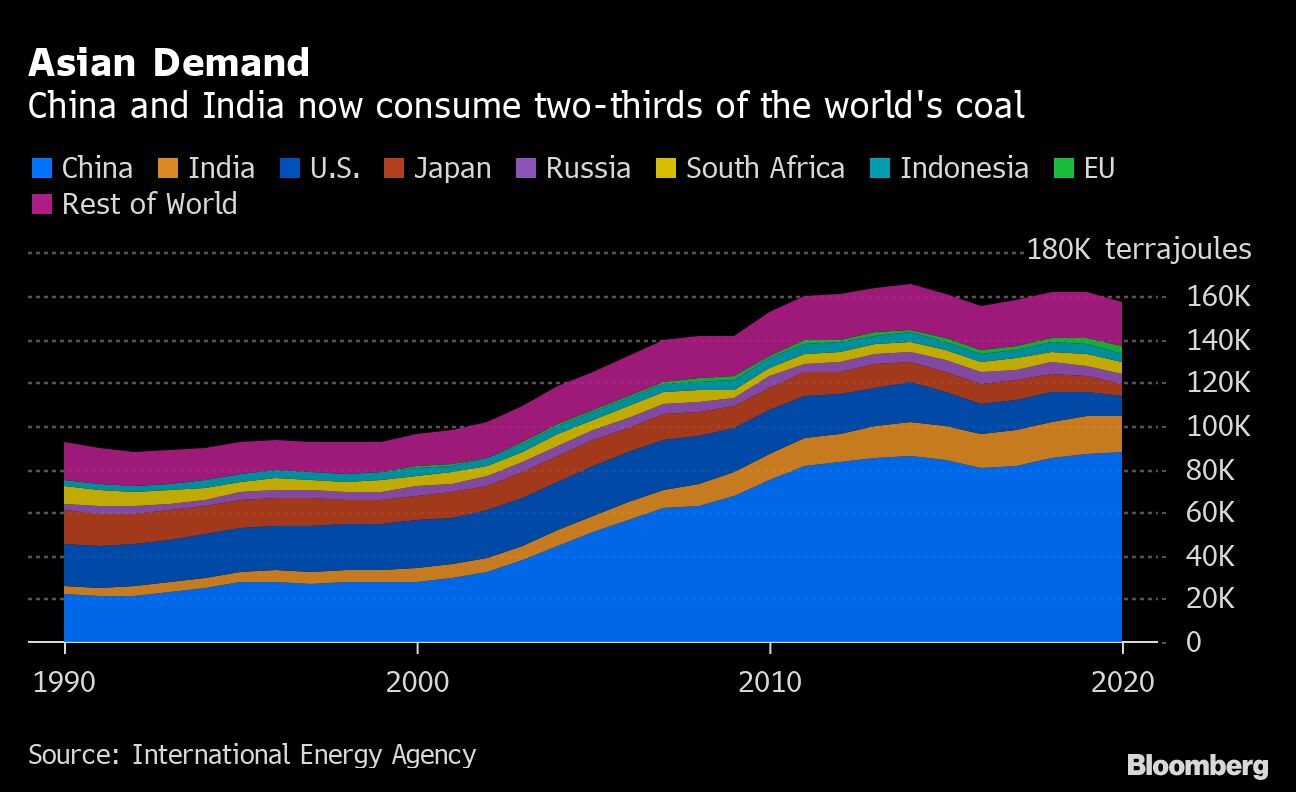
In theory, a deal with South Africa, which has a mid-sized power sector and elderly fleet of coal-fired plants, should be easier to conclude than those for bigger countries like Indonesia, which has recently commissioned new facilities, or India, the world's No. 2 coal user. Negotiations are underway on a similar energy transition package in Indonesia with the goal of unveiling that in November, and donor countries are hoping to use the model to spur similar shifts in India, Senegal and Vietnam.
It's also key at a time when Russia's invasion of Ukraine has seen gas supplies to Europe fall, prompting some countries to turn back to coal plants that were being decommissioned as part of international commitments to cut emissions and limit global warming to 1.5 Celsius above pre-industrial levels.
Despite ever more strident climate warnings, however, coal use is set to rise 0.7% this year to eight billion tons, the record level it reached almost a decade ago, according to the International Energy Agency.
Countries that are backing the South African deal, such as Germany, are using more coal themselves to stave off a winter energy crisis. Coal use in Europe will likely rise 7% this year after a 14% jump last year, according to the IEA.

South Africa has produced an initial draft of an investment plan but is behind schedule in producing a second, more detailed, version, some of the people said.
Vincent Magwenya, a spokesman for South African leader Cyril Ramaphosa, didn't answer calls made to his mobile or respond to a text message seeking comment. South Africa's Presidential Climate Finance Task Team, which is heading the talks for the country, declined to comment.
The investment partners have stressed that the deal is primarily meant to allow some of South Africa's coal-fired plants to close and be repurposed to produce renewable energy, with some funding also available to expand the national power grid in a country that suffers regular blackouts.
South African negotiators, however, have pushed for possible funding to develop green hydrogen -- a cleaner fuel that could offer a solution for heavy industry or aviation -- and electric vehicles.
The exasperation on both sides is evident.
“We need President Ramaphosa and the political establishment to come on board,” John Kerry, the US special presidential envoy for climate, said in a Sept. 28 interview with Bloomberg TV.
Barbara Creecy, South Africa's environment minister, said the complexity of the deal was underestimated and while she hopes there'll be an announcement at COP27, she can't guarantee it.
There are partners “and development institutions with different terms and conditions, and dependent on their own fiscal cycles and so on. So it's a complicated process,” she said in a Sept. 14 interview.
There's also concern about the UK's commitment given the recent change in leadership and radical changes to economic policy that have shattered confidence in its currency and government bond markets.
There are “legitimate concerns about whether or not the UK actually has money,” Schmidt said. “The underlying question is does this new government want to continue to put money into international climate stuff and will they stick to their end of the bargain.”
The UK's Department for Business, Energy & Industrial Strategy didn't immediately respond to a request for comment.
Read More:
- Devil in Detail of South Africa's $8.5 Billion Climate Funding
- Kerry Says South Africa Climate Deal Progress Up to Ramaphosa
- Eskom Transition Head Quits at Key Time in Climate Aid Talks
- Germany, France in $578 Million Climate-Loan Talks for Eskom
Despite the frustrations, some progress is being made.
Both the German and French embassies in South Africa confirmed that their countries, via finance institutions KFW and Agence Francaise de Developpement, are negotiating loans with the South African National Treasury that would be channeled to Eskom Holdings SOC Ltd., the state power utility that's the country's biggest emitter of greenhouse gas. The Treasury said announcements on loans may be made in a budget update on Oct. 29.
The Agence Francaise de Developpement said it's in early talks with South Africa's Industrial Development Corp. over funding electric vehicle studies and said France's total contribution will be around $1 billion.
Only a small portion of the French finance would come in the form of grants and those would cover the cost of studies, people familiar with the talks said.
John Morton, the US Treasury's climate counselor, said such complex agreements require “very difficult political decisions on behalf of governments” but the allure of finance can help drive transformative change.
“The aggregation of a large amount of capital - public, private and in some cases philanthropic,” he said, “can in fact enable difficult political decisions related to energy transition.”
More stories like this are available on bloomberg.com
©2022 Bloomberg L.P.

-
Love, Sex Aur Dhokha: The Audacious Plot To Spy On Jensen Huang

A Taipei dinner, a Singapore chip buyer and a suspected Chinese asset: inside the alleged spy operation that got close to NVIDIA's Jensen Huang.
-
Ten Things I Learnt This Samvat
Patience can be a trap. Cheap stocks can stay cheap. Leverage can wipe you out. What did Samvat 2082 teach us? Niraj Shah writes on 10 lessons from the year gone by.
-
Talking Points This Week: Tech Nerves, FII Buying, And A Faraway Banking Shock
The global markets are not shining this Diwali. The exception in the large markets is, India.
-
Midterm Rally Lasted A Day. The Hard Reality Of A Divided US May Last Two Years | Opinion
Between a contested AI boom, a debt ceiling that arrives in 2027 and a president with every incentive to act alone, the next two years may prove more volatile than the first day's rally suggests.
-
Blue Wave Will Derail the AI Trade but Won't Dismantle the AI Era | Unhedged Position
The Democrats' sweep of the US Congress will see politics collide with economic forces both over the long and short term.
-
It's Time To Take The GST Council's Bet On Trust Global
Payment records can prove India's services exports, and clear, proportionate rules can bring foreign digital sellers into the tax net.
-
Opinion | India at 38: From Innovation Overperformer to Innovation Powerhouse
India now has 453 VC-backed deep science startups, 18 of them late-stage, after 117 percent growth since 2020. Laurus Labs, at USD 9.3 billion, is the most valuable deep science company in any middle-income economy outside China.
-
Navigating Energy Crossroads: S Jaishankar's Call For Diversified Supply Chains At G20 Ministerial Meeting
As geopolitical fault lines continue to test maritime trade routes and commodity flows, Jaishankar's message remains pertinent: true economic resilience requires open markets, protected transit lines, and a genuine commitment to multilateral cooperation rather than coercion.
-
Indians Are Travelling, But Not Every Journey Is A Holiday | The Week In Whys
Pilgrims, patients and working women are the real travellers, and the system hasn't quite caught up with them.









