Shinzo Abe Assassination: Accused Killer Tetsuya Yamagami Pleads Guilty In Japanese Court
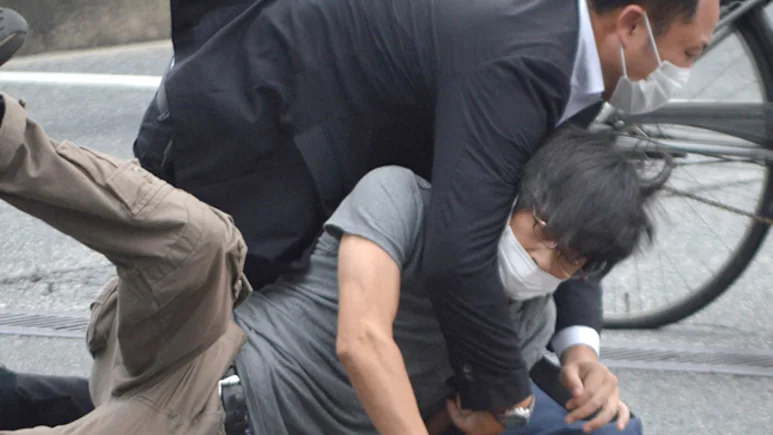
Three years after the assassination of former Japanese Prime Minister Shinzo Abe, the man accused of the killing, Tetsuya Yamagami, has pleaded guilty in court, marking a pivotal moment in one of Japan's most high-profile criminal cases.
Tetsuya Yamagami, 45, stood accused of murder and violations of arms control laws for allegedly using a handmade weapon to shoot dead Japan's longest-serving leader as he gave a speech in July 2022, AFP reported.
Appearing before the Nara District Court on Tuesday, Yamagami, admitted to charges of murder and violating Japan's strict arms control laws. In a brief but statement, he told the court, “Everything is true,” confirming his role in the fatal shooting that stunned the nation and reverberated across the globe, as per AFP.
Abe was shot on July 8, 2022, while delivering a campaign speech near Yamato-Saidaiji Station in Nara City. Despite being rushed to the hospital, the former leader was pronounced dead shortly after. The attack, carried out with a homemade firearm, raised serious concerns about political security and gun control in a country known for its low crime rates.
Yamagami had followed Abe to other campaign events including one in Okayama on July 7, apparently in an attempt to find a venue at which an attack would be possible. He arrived at the Nara site of the shooting at least an hour before Abe began speaking, according to NHK.

-
Where You Live Shapes How You Get To Work | The Reason Why

Two-wheelers are the most popular way to get to work in India, accounting for nearly 43% of workplace commutes.
-
High US Salaries, No Green Card Certainty: The Financial Calculation Facing Indian H-1B Families
The suspension of PERM processing at eight technology employers does not cancel existing H-1B visas. What it does is force a question many Indian families have been avoiding: is the US salary worth tying your career and family plans to one employer?
-
Unhedged Position: Can India See An Indonesia-Style Time Correction?
The Nifty is trading below levels it first clocked in 2024. Is there, then, as I have suggested in the headline, potential that the current time correction drags on painfully for the next three-five, even ten years?
-
Navigating Friction And Energy Realities: An Analysis Of Marco Rubio's October Visit To India
Occurring at a critical juncture marked by stalled trade negotiations and escalating geopolitical pressures over global energy supplies, the visit offers a profound window into modern US-India relations.
-
India Exports Capital. Why Not Export Trusteeship?
The big question, then, is whether India can build an institution that global borrowers, investors, banks, and lawyers can trust, even without an Indian connection.
-
France's Economy & Politics Are In Crisis | The Reason Why
Let's look at how the French economy and politics evolved under Nicolas Sarkozy, Franois Hollande and Emmanuel Macron.
-
You May Inherit The Business. You Must Earn Its Credibility.
Succession tests the founder's ability to share authority as much as it tests the next generation's readiness to assume it.
-
Signing Deals Is One Thing; Making Them Work Is Another | The Week In Whys
Sometimes, things don't turn out as planned. Indian companies have lost some bids to rivals, some projects won't produce until 2030.
-
FOMC Wall, PERM Suspension, Hospital Stocks | Talking Points This Week
A PERM suspension would directly affect green-card sponsorship rather than H-1B visas, so the near-term earnings impact could remain relatively limited. The key question is whether this marks a new phase in US scrutiny of Indian IT.
-
Everything, Everywhere, All At Once: Dalal Street's Week To Forget | Joining The Dots
Visa curbs, a Starlink spat and cancer drug caps: what connects this week's shocks for Indian markets









