Saudi Arabia Cuts Asia Oil Prices as Energy Market Weakens
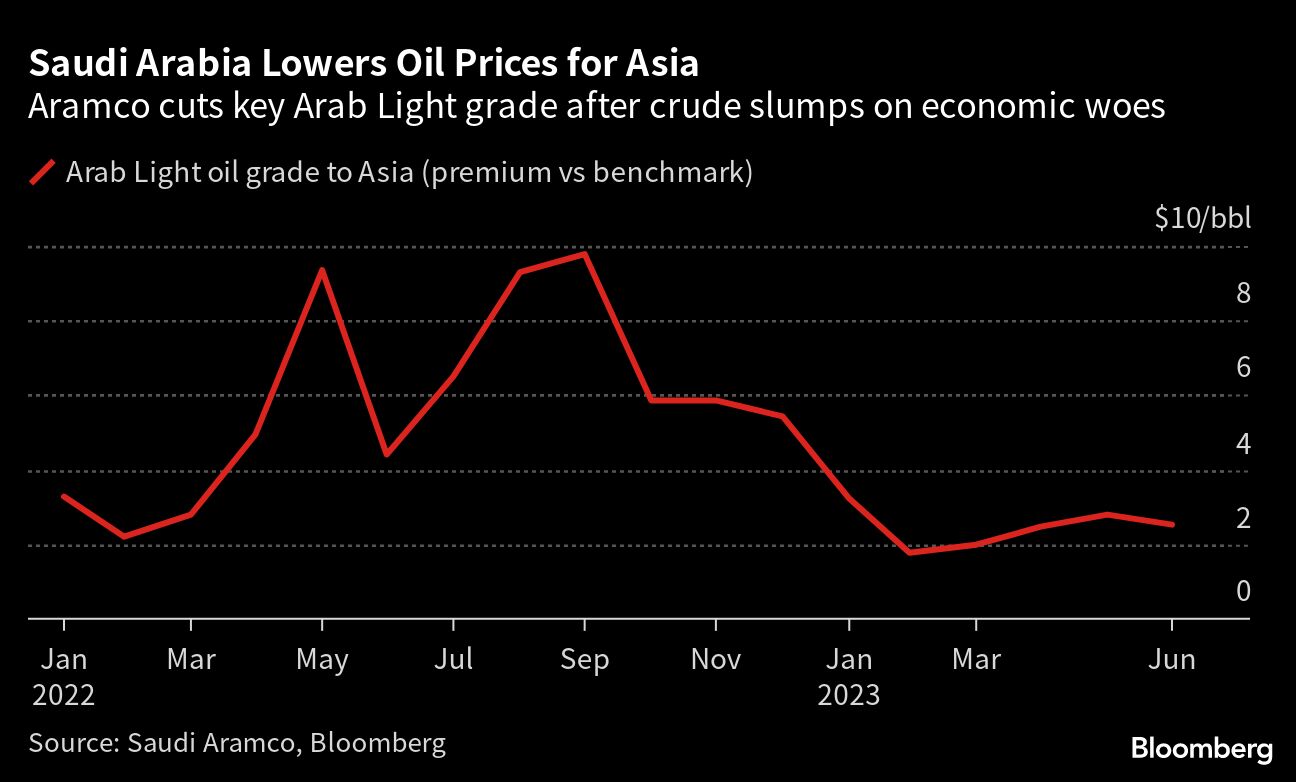
(Bloomberg) -- Saudi Arabia lowered oil prices for customers in its main market of Asia after futures slumped, with traders fretting about the health of the global economy.
A softening US economy and continued fragility among its banks, as well as weak manufacturing data in China, have triggered a renewed fall in Brent and WTI futures. Refining margins have also sunk.
State-controlled Saudi Aramco cut all official selling prices for Asia in June. The company's key Arab Light grade was reduced to $2.55 a barrel above the regional benchmark, 25 cents less than the price for this month.
A Bloomberg survey of refiners and traders from last week forecasted a slightly bigger drop of 45 cents.

Aramco sells about 60% of its crude shipments to Asia, most of them under long-term contracts, pricing for which is reviewed each month. China, Japan, South Korea and India are the biggest buyers.
The company raised all prices for European customers and left most US grades unchanged.
The kingdom is the world's largest oil exporter and leads the OPEC+ group of producers along with Russia. Several members of the 23-nation alliance, including Riyadh, decided early last month to cut production by more than 1 million barrels a day, saying it was a “precautionary measure” to stabilize the market.
Brent crude futures jumped above $87 a barrel after the announcement, but are now back to $72, signaling how bearish investors have become.
The next OPEC+ meeting is on June 3-4 and the group has decided to make it an in-person gathering rather than a virtual one. That signals the group's resolve to stabilize oil markets and it may opt for another supply reduction, according to Helima Croft, head of commodity strategy at RBC Capital Markets LLC.
The company's OSP decisions are often followed by other Gulf producers such as Iraq and Kuwait.
--With assistance from Grant Smith.
(Updates with European, US pricing.)
More stories like this are available on bloomberg.com
©2023 Bloomberg L.P.

-
Ten Things I Learnt This Samvat

Patience can be a trap. Cheap stocks can stay cheap. Leverage can wipe you out. What did Samvat 2082 teach us? Niraj Shah writes on 10 lessons from the year gone by.
-
Talking Points This Week: Tech Nerves, FII Buying, And A Faraway Banking Shock
The global markets are not shining this Diwali. The exception in the large markets is, India.
-
Midterm Rally Lasted A Day. The Hard Reality Of A Divided US May Last Two Years | Opinion
Between a contested AI boom, a debt ceiling that arrives in 2027 and a president with every incentive to act alone, the next two years may prove more volatile than the first day's rally suggests.
-
Blue Wave Will Derail the AI Trade but Won't Dismantle the AI Era | Unhedged Position
The Democrats' sweep of the US Congress will see politics collide with economic forces both over the long and short term.
-
It's Time To Take The GST Council's Bet On Trust Global
Payment records can prove India's services exports, and clear, proportionate rules can bring foreign digital sellers into the tax net.
-
Opinion | India at 38: From Innovation Overperformer to Innovation Powerhouse
India now has 453 VC-backed deep science startups, 18 of them late-stage, after 117 percent growth since 2020. Laurus Labs, at USD 9.3 billion, is the most valuable deep science company in any middle-income economy outside China.
-
Navigating Energy Crossroads: S Jaishankar's Call For Diversified Supply Chains At G20 Ministerial Meeting
As geopolitical fault lines continue to test maritime trade routes and commodity flows, Jaishankar's message remains pertinent: true economic resilience requires open markets, protected transit lines, and a genuine commitment to multilateral cooperation rather than coercion.
-
Indians Are Travelling, But Not Every Journey Is A Holiday | The Week In Whys
Pilgrims, patients and working women are the real travellers, and the system hasn't quite caught up with them.
-
Getting To Work Costs Women More | The Reason Why
It is not just about women paying more than men. It is about women paying much more in cities than in villages.









