Russia, Ukraine Start First Peace Talks In Three Years
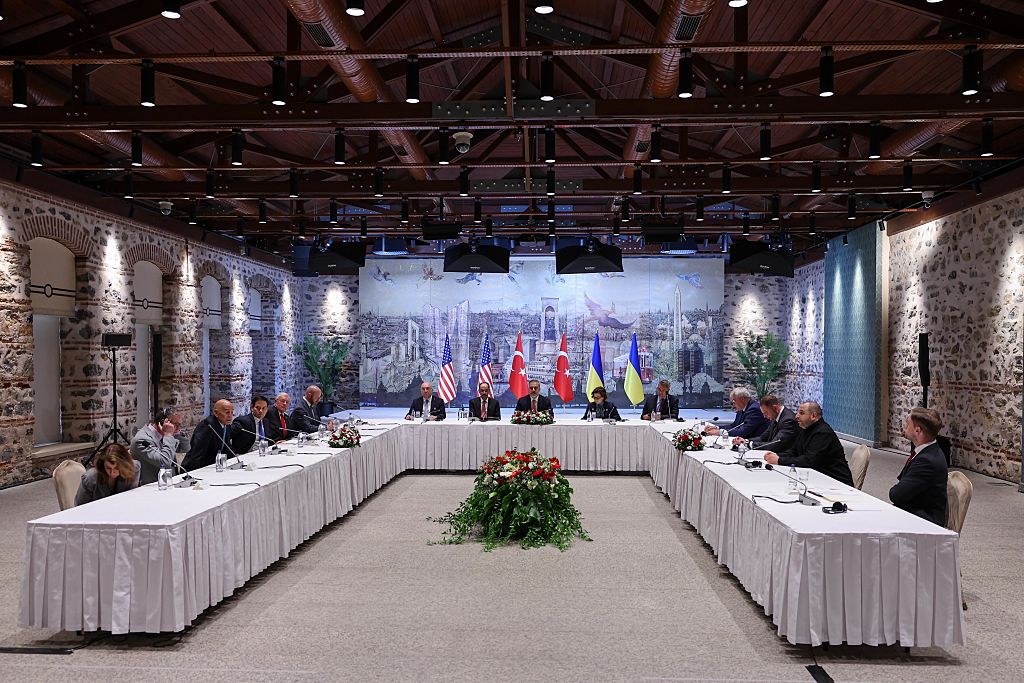
Russia and Ukraine began their first direct talks in more than three years in Turkey, amid US and European skepticism about prospects for a peace deal to end the war. Negotiating teams from the two sides met in Istanbul's Dolmabahce Palace on Friday, hosted by Turkish Foreign Minister Hakan Fidan.
“We're spending great effort in order to end the war,” Fidan said at the start of the meeting. “It is important that this meeting may form the basis for a meeting between the leaders,” of Ukraine and Russia, he said.
US Secretary of State Marco Rubio earlier said the likelihood of progress was low without a meeting between President Donald Trump and Russian counterpart Vladimir Putin.
Ukrainian President Volodymyr Zelenskiy had dismissed the Russian negotiating team as a “sham” after Putin announced that a low-level delegation led by his aide Vladimir Medinsky would take part. The Ukrainian side is headed by Defense Minister Rustem Umerov.
Putin has indicated he regards the talks as a resumption of 2022 negotiations held in Istanbul soon after Russia's full-scale invasion began. Medinsky led Russia's negotiators at those meetings, which broke down amid recriminations over a draft protocol of Russian demands that Putin later asserted had been largely accepted by Ukraine. The government in Kyiv has rejected this claim.
Ukraine and European powers have demanded that Putin commit to a 30-day unconditional ceasefire to create space for negotiations on a peace deal. Putin hasn't agreed to the truce and instead offered at the weekend to resume direct talks with Ukraine in Turkey.
Trump told reporters Friday he'd meet with Putin “as soon as we can set it up,” as the US president wrapped up a Middle East visit and said he'd return direct to Washington. He had previously signaled he'd be ready to travel to Turkey on Friday “if something happened.”
Trump on Thursday also said that “nothing's going to happen” in resolving the war until he meets with Putin.
European leaders meeting in Albania on Friday accused Putin of undermining the negotiations. UK Prime Minister Keir Starmer said Europeans should show “absolute unity” in renewing demands for a ceasefire.
“This is clear evidence that Putin doesn't seriously want peace,” Starmer said in Tirana. “He's dragging his heels.”
NATO Secretary General Mark Rutte, also in Tirana, told reporters Putin “made a mistake by sending a low-level delegation.”
The Ukrainian delegation “coordinated positions” in Istanbul with US presidential envoy Keith Kellogg and the national security advisers of France, Germany and the UK ahead of the meeting with Russia, Andriy Yermak, the Ukrainian presidential chief of staff, said in a post Friday on the X social media platform.
Rubio, who's in Istanbul, isn't taking part in the negotiations. He earlier held talks with the Ukrainian and Turkish foreign ministers.
The US will be represented by Director for Policy Planning Michael Anton at working level talks with the Russian delegation on Friday, State Department Spokesperson Tammy Bruce said. Anton met with Medinsky before the Ukraine-Russia talks began.
“I frankly do not believe that we're going to have a breakthrough here until President Trump sits face-to-face with President Putin and determines what his intentions are moving forward,” Rubio told reporters in Antalya, Turkey, following a meeting of NATO foreign ministers there on Thursday.
Moscow has so far refused to commit to a US ceasefire proposal, which would freeze the conflict broadly along the current lines, grant US recognition of the Black Sea peninsula of Crimea as Russian and see US sanctions lifted. Ukraine in return would receive strong security guarantees and a right to develop its own army, Bloomberg reported previously.
The US has added new details to its proposal for Russia, including an offer to revive security talks under the NATO-Russia Council, according to a person familiar with the matter who spoke on condition of anonymity. The partnership forum effectively ended after Russia's full-scale invasion in 2022.
Putin has shown little inclination to negotiate, in part because his army has maintained a slow but steady momentum in the war of attrition in Ukraine. Ukraine is running low on weapons and ammunition as the Trump administration balks at sending more, and has struggled to meet its recruitment quotas.

-
Medicine Pricing: Where Must Profit Stop?

India must confront excessive margins, hidden incentives and regulatory gaps that threaten the integrity of medicine.
-
Why Amazon And Flipkart Are Struggling To Beat Meesho In India's Smaller Cities
With 274 million users and lowest-cost logistics, Meesho is defending its value commerce crown against giants like Amazon and Flipkart.
-
High US Salaries, No Green Card Certainty: The Financial Calculation Facing Indian H-1B Families
The suspension of PERM processing at eight technology employers does not cancel existing H-1B visas. What it does is force a question many Indian families have been avoiding: is the US salary worth tying your career and family plans to one employer?
-
Swiggy vs Eternal: Food Delivery's Two Rivals Are No Longer In The Same Race
Eternal is building a private AI assistant, dark.ai. Swiggy is still working out how to make Instamart pay, with an operating loss of Rs 895 crore in the July-September quarter while Blinkit stayed profitable.
-
Where You Live Shapes How You Get To Work | The Reason Why
Two-wheelers are the most popular way to get to work in India, accounting for nearly 43% of workplace commutes.
-
Unhedged Position: Can India See An Indonesia-Style Time Correction?
The Nifty is trading below levels it first clocked in 2024. Is there, then, as I have suggested in the headline, potential that the current time correction drags on painfully for the next three-five, even ten years?
-
Navigating Friction And Energy Realities: An Analysis Of Marco Rubio's October Visit To India
Occurring at a critical juncture marked by stalled trade negotiations and escalating geopolitical pressures over global energy supplies, the visit offers a profound window into modern US-India relations.
-
India Exports Capital. Why Not Export Trusteeship?
The big question, then, is whether India can build an institution that global borrowers, investors, banks, and lawyers can trust, even without an Indian connection.
-
France's Economy & Politics Are In Crisis | The Reason Why
Let's look at how the French economy and politics evolved under Nicolas Sarkozy, Franois Hollande and Emmanuel Macron.
-
You May Inherit The Business. You Must Earn Its Credibility.
Succession tests the founder's ability to share authority as much as it tests the next generation's readiness to assume it.










