RIP Recession. Is It Time To Worry About Inflation Again?
(Bloomberg Opinion) -- In the spring of 2022, the US economy went through an abrupt shift as consumer spending moved from goods to services. Travel boomed. Retailers slumped. Warehouses overflowed with inventory no one wanted to buy, and factories and the freight industry went through a recessionary adjustment.
Last week we got data suggesting that this adjustment has ended. Our long national nightmare of consumers pulling back on “buying stuff” is over. On top of increased residential construction and a resilient labor market, it's another reason to believe that, far from a recession, economic growth should pick up over the next couple of quarters, raising the odds that inflation will once again accelerate in 2024.
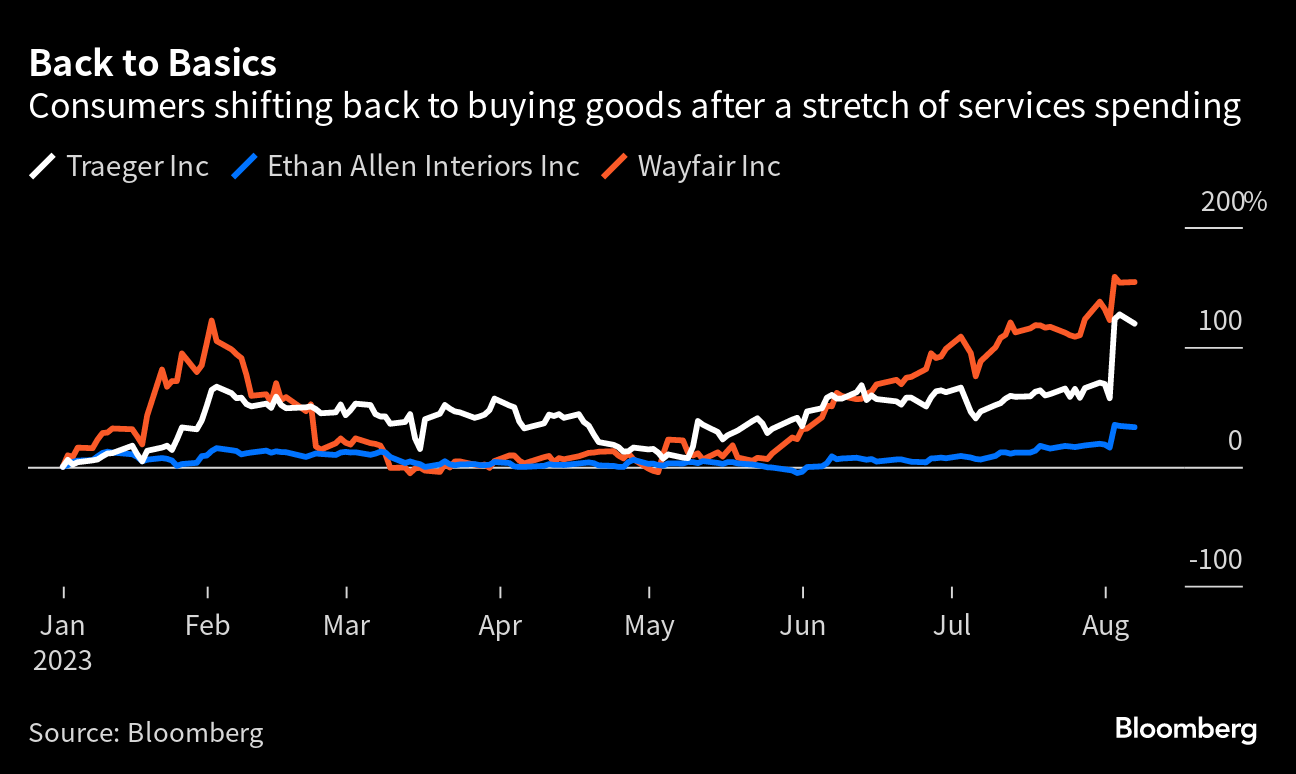
No consumption category felt the impact of the goods-to-services spending shift more than outdoor grills. Grill sales slumped in 2022 in large part because so many would-be buyers preponed their purchases during the pandemic summers of 2020 and 2021. Traeger Inc., maker of “outdoor cooking systems,” took advantage of the buying craze to launch an initial public offering in 2021, only to see its stock crash 90% from its peak by the end of the following year. Yet, Chief Executive Officer Jeremy Andrus said on an earnings' call last week that the company had seen a “continued stabilization in sell-through trends.” He indicated that the inventory destocking pressures Traeger had faced may be nearing an end. The stock surged 42% the following day and is up around 100% year-to-date.
Home furnishings company Ethan Allen Interiors Inc. saw its stock jump after reporting better-than-expected profit margins. The company said its order backlog remains above 2019 levels, suggesting that — similar to homebuilders — it's benefiting from a more-normalized selling environment than many predicted last autumn when interest rates were surging. Online household goods retailer Wayfair Inc. also reported good news, noting that "the outdoor shopping season picked up rapidly" toward the latter part of the quarter. Its stock is now up close to 150% year-to-date.
Goods spending has picked up for three reasons. First, for about a year now, workers' incomes have outpaced inflation, giving them the ability to buy more. Some of that, not surprisingly, has gone toward buying “stuff.” Second, the big deceleration in inflation we've gotten over the past year has been from goods rather than services. Energy costs for consumers have fallen 16.7% in that period. Food inflation has been near zero over the last four months after peaking at over 10%. Once food and energy are stripped out, goods inflation has been below 2% over the past year. Stronger incomes and stable prices are a recipe for more consumption.And third, it's now almost 18 months since consumers pulled back from buying items like grills and home furnishings. Enough time has passed that there's room for growth. We may never see sales volumes of grills and mini-fridges approach pandemic levels again, but it's not surprising that trends in the summer of 2023 look better than they did in the summer of 2022.
Inflation-adjusted spending growth on goods at 3.1% year-to-date has actually outpaced real spending growth on services at 1.4% as consumers have finally caught up on their travel plans and are using their growing paychecks to once again buy physical goods. That raises the possibility that goods inflation, which is currently dormant after having surged during the pandemic, could spike back up in coming quarters.Companies in the business of shipping and selling goods appear to be taking notice, with rail traffic showing some strength in recent weeks during a seasonally weak time of the year. Another burgeoning sign of costs pressures ahead is the run up in the Bloomberg Commodity Index, which bottomed at the end of May. Oil prices are flirting with their highest levels since autumn after climbing for six straight weeks.
The concern is that such economic strength, if sustained, will mean higher inflation towards the end of the year and into 2024.
Don't expect all this to start showing up in the inflation data immediately. The Consumer Price Index will reflect recent declines in used automobile prices and a cooling in shelter inflation for a few months to come. Still, a pickup in economic growth being driven increasingly by the goods sector and an unemployment rate that remains near 50-year lows suggests the risk of re-accelerating inflation is rising. This re-heating scenario has replaced recession risk as the biggest concern investors should have.More From Bloomberg Opinion:
- The US Economy Is Great, So Stop Worrying About It: Tyler Cowen
- Recessions Galore Are Lurking Beneath the Surface: Chris Bryant
- What Treasury Volatility Means for the Economy: Mohamed El-Erian
This column does not necessarily reflect the opinion of the editorial board or Bloomberg LP and its owners.
Conor Sen is a Bloomberg Opinion columnist. He is founder of Peachtree Creek Investments.
More stories like this are available on bloomberg.com/opinion
©2023 Bloomberg L.P.

-
Where You Live Shapes How You Get To Work | The Reason Why

Two-wheelers are the most popular way to get to work in India, accounting for nearly 43% of workplace commutes.
-
High US Salaries, No Green Card Certainty: The Financial Calculation Facing Indian H-1B Families
The suspension of PERM processing at eight technology employers does not cancel existing H-1B visas. What it does is force a question many Indian families have been avoiding: is the US salary worth tying your career and family plans to one employer?
-
Unhedged Position: Can India See An Indonesia-Style Time Correction?
The Nifty is trading below levels it first clocked in 2024. Is there, then, as I have suggested in the headline, potential that the current time correction drags on painfully for the next three-five, even ten years?
-
Navigating Friction And Energy Realities: An Analysis Of Marco Rubio's October Visit To India
Occurring at a critical juncture marked by stalled trade negotiations and escalating geopolitical pressures over global energy supplies, the visit offers a profound window into modern US-India relations.
-
India Exports Capital. Why Not Export Trusteeship?
The big question, then, is whether India can build an institution that global borrowers, investors, banks, and lawyers can trust, even without an Indian connection.
-
France's Economy & Politics Are In Crisis | The Reason Why
Let's look at how the French economy and politics evolved under Nicolas Sarkozy, Franois Hollande and Emmanuel Macron.
-
You May Inherit The Business. You Must Earn Its Credibility.
Succession tests the founder's ability to share authority as much as it tests the next generation's readiness to assume it.
-
Signing Deals Is One Thing; Making Them Work Is Another | The Week In Whys
Sometimes, things don't turn out as planned. Indian companies have lost some bids to rivals, some projects won't produce until 2030.
-
FOMC Wall, PERM Suspension, Hospital Stocks | Talking Points This Week
A PERM suspension would directly affect green-card sponsorship rather than H-1B visas, so the near-term earnings impact could remain relatively limited. The key question is whether this marks a new phase in US scrutiny of Indian IT.
-
Everything, Everywhere, All At Once: Dalal Street's Week To Forget | Joining The Dots
Visa curbs, a Starlink spat and cancer drug caps: what connects this week's shocks for Indian markets