Japan’s Rich Have The Most Cash In Asia. China’s Catching Up

(Bloomberg) -- Japan's rich have the largest accumulation of wealth in the Asia-Pacific region, at $7.7 trillion, but the legions of Chinese millionaires are rushing to catch up.
The pool of wealth held by China's high-net-worth individuals grew by more than 144 percent between 2010 and 2017, to reach $6.5 trillion, according to the latest Asia-Pacific Wealth Report from consultants Capgemini. The equivalent rate of growth in Japan over the same period was about 87 percent.
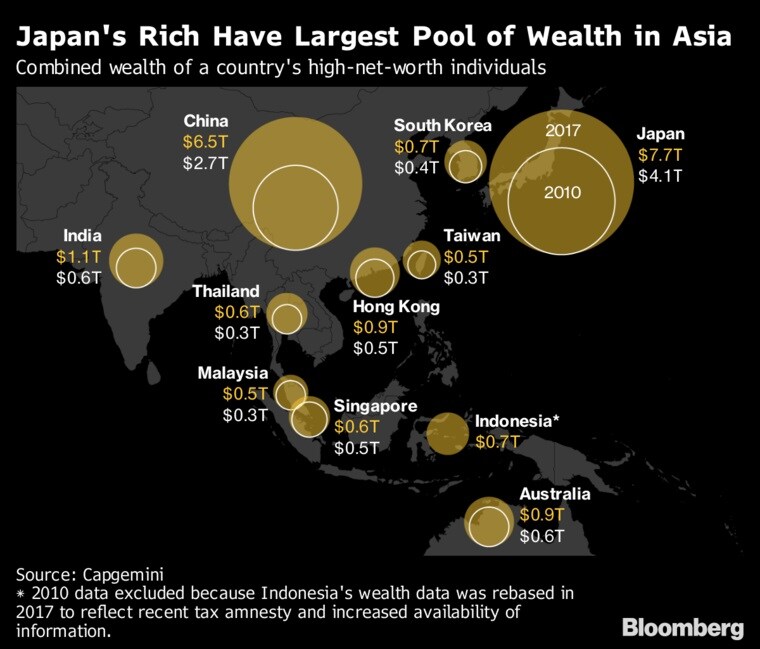
More recently, India's millionaires have been picking up the pace. Wealth held by Indian high-net-worth individuals rose close to 22 percent in 2017 compared with the previous year, the fastest growth in the region over that period, Capgemini said Wednesday.
Other important Asian wealth markets also saw rapid growth last year.
- Indonesia showed a massive increase in total wealth held by HNWIs, to $661 billion from $184 billion in 2016, but Capgemini attributed the jump to its rebasing of the 2017 data to reflect the impact of country's 2016-17 tax amnesty and better availability of information.
- South Korea's wealthy saw their fortunes grow by a combined 18 percent, the second-highest growth in the region.
- Hong Kong had the third-highest growth, at 16.3 percent, mainly thanks to a booming real estate market.
- Singapore came in sixth position, below Thailand and Taiwan, with 13 percent growth in HNWI assets.
And the rapid upward trajectory is expected to continue. After doubling between 2010 and 2017 to hit $21.6 trillion, the total pool of wealth held by HWNIs in Asia is expected to nearly double again to $42 trillion by 2025, Capgemini said.
Read about the search for ‘hunters' and ‘farmers' to handle Chinese wealth
Last year, wealth in Asia Pacific contributed 41.4 percent of all new HNWI wealth globally, the consultancy said. It defines HNWIs as those with investable assets of more than $1 million.
Despite challenges such as the trade war with the U.S., China's wealth generation continued this year, according to William Sullivan, Capgemini's global head of market intelligence. “It's an exciting time for Asia,” he added.
©2018 Bloomberg L.P.

-
Where You Live Shapes How You Get To Work | The Reason Why

Two-wheelers are the most popular way to get to work in India, accounting for nearly 43% of workplace commutes.
-
High US Salaries, No Green Card Certainty: The Financial Calculation Facing Indian H-1B Families
The suspension of PERM processing at eight technology employers does not cancel existing H-1B visas. What it does is force a question many Indian families have been avoiding: is the US salary worth tying your career and family plans to one employer?
-
Unhedged Position: Can India See An Indonesia-Style Time Correction?
The Nifty is trading below levels it first clocked in 2024. Is there, then, as I have suggested in the headline, potential that the current time correction drags on painfully for the next three-five, even ten years?
-
Navigating Friction And Energy Realities: An Analysis Of Marco Rubio's October Visit To India
Occurring at a critical juncture marked by stalled trade negotiations and escalating geopolitical pressures over global energy supplies, the visit offers a profound window into modern US-India relations.
-
India Exports Capital. Why Not Export Trusteeship?
The big question, then, is whether India can build an institution that global borrowers, investors, banks, and lawyers can trust, even without an Indian connection.
-
France's Economy & Politics Are In Crisis | The Reason Why
Let's look at how the French economy and politics evolved under Nicolas Sarkozy, Franois Hollande and Emmanuel Macron.
-
You May Inherit The Business. You Must Earn Its Credibility.
Succession tests the founder's ability to share authority as much as it tests the next generation's readiness to assume it.
-
Signing Deals Is One Thing; Making Them Work Is Another | The Week In Whys
Sometimes, things don't turn out as planned. Indian companies have lost some bids to rivals, some projects won't produce until 2030.
-
FOMC Wall, PERM Suspension, Hospital Stocks | Talking Points This Week
A PERM suspension would directly affect green-card sponsorship rather than H-1B visas, so the near-term earnings impact could remain relatively limited. The key question is whether this marks a new phase in US scrutiny of Indian IT.
-
Everything, Everywhere, All At Once: Dalal Street's Week To Forget | Joining The Dots
Visa curbs, a Starlink spat and cancer drug caps: what connects this week's shocks for Indian markets









