‘Respect’ RBI’s Authority To Decide Rates, Arun Jaitley Tells Bloomberg
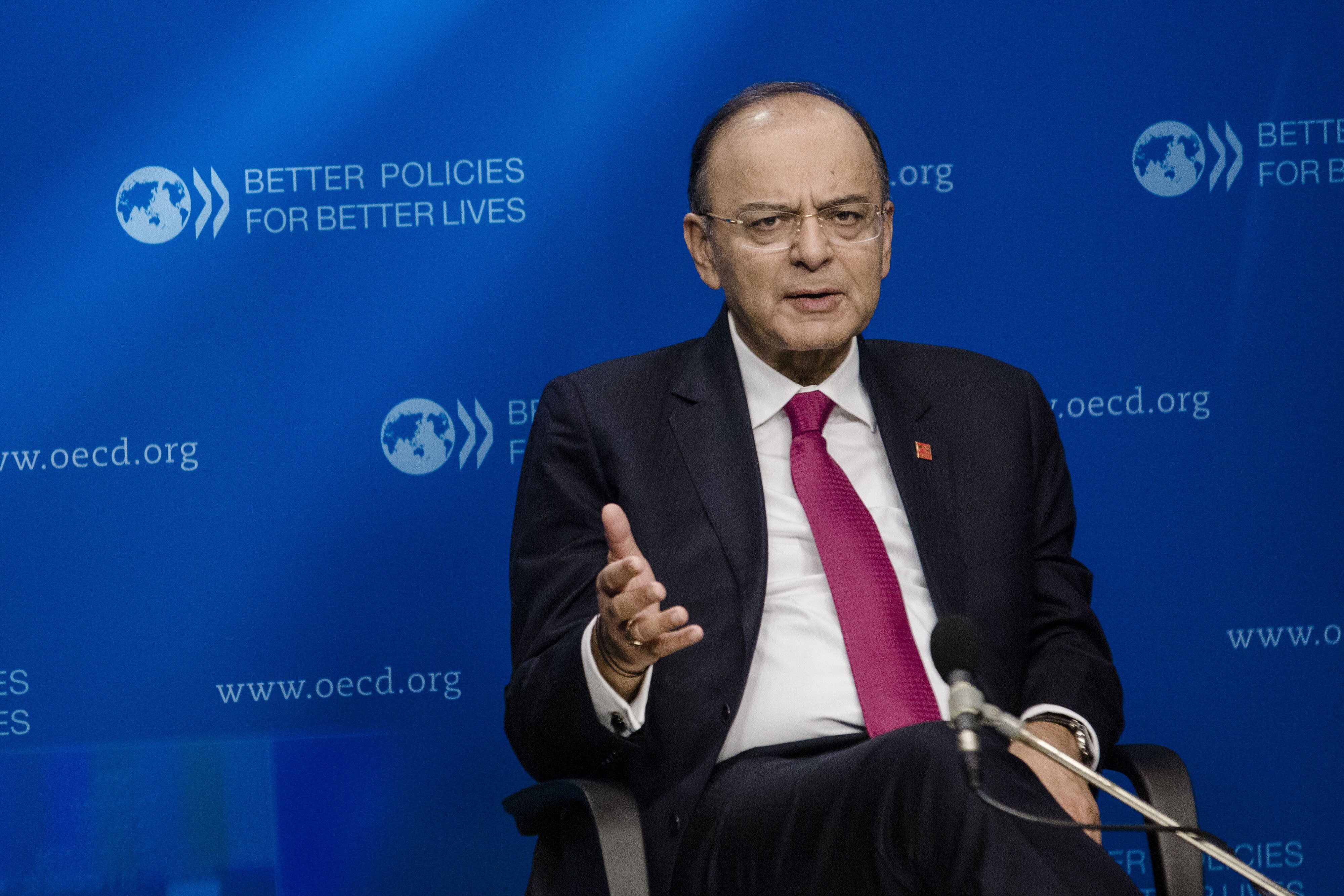
Finance Minister Arun Jaitley said the government respects the Reserve Bank of India's authority to decide rates, after the central bank's rate-setting committee declined to meet his ministry's officials ahead of the monetary policy announcement.
The ministry, representing the government, giving its own assessment of the economy to the RBI is the done thing, Jaitley said in an interview to Bloomberg TV.
The six-member monetary policy committee had unanimously declined a meeting with finance ministry officials ahead of the policy review, RBI Governor Urjit Patel said on Wednesday while announcing the policy. He was replying to a question if such a meeting would compromise the RBI's autonomy.
The central bank's decision to keep rates unchanged amid a slower growth and low inflation came under fire from Arvind Subramanian, adviser to the finance ministry, who said the RBI made “large forecast errors” and overstated inflation. India's growth as measured by gross value added fell to 5.6 percent in the quarter ended March from 6.7 percent in previous three months while consumer inflation fell below 3 percent in April.
Jaitley said he expected to the growth to improve as the government continues to spend on infrastructure and clear reforms like a universal indirect tax, billed as India's biggest reform in more than two decades. Excerpts of his interview...
What can the finance ministry can do to support growth and get things back on a higher track?
First of all let me tell you the word poor may not be appropriate. In the last three years we have had a 7.5 percent, 8 percent and a 7.1 percent growth. Last year on account of global demand being a little depressed, the capacity of Indian banks to support growth being somewhat inadequate, we were anticipating a lower growth rate. And even then, notwithstanding the fact that demonetisation took place in the third quarter of last year, we have ended the year with 7.1 percent growth. Our normal today is 7-8 percent.
India has carried on a large number of structural reforms in the last few years. And now with the kind of structural reforms which are setting in, the kind of public expenditure and foreign direct investment we are getting in, I expect growth to turn around and improve this year. That's what all global agencies are indicating. I do believe that the net effect of demonetisation, that is the integration of the informal economy with the formal one, GST likely to set in by July 1 this year, hopefully with a good monsoon being predicted this year, growth revival is again going to take place.
The one important challenge that we have is with regards to private sector investment. We do believe that the global curve is also turning, though turning slowly. Domestic consumption is improving. And hopefully if we are able over the next one year or so, to address the problem of the Indian banking system, growth will again pick up significantly.
PSU Bank Consolidation
How much capacity do have to enable these banks to have more public sector bank mergers. That's something you can achieve without pushing growth further down.
I think the merger itself will only strengthen Indian banks, it won't weaken the capacity of the banks to support growth. I don't think India needs numerically a very larger number of public sector banks because the banking industry has undergone a significant change. Now, we have foreign banks, private sector banks, payment banks and now the nature of the banking industry with technology itself has changed and therefore I have announced that amalgamations and mergers are very much on the cards. The first big one was the State Bank of India with its subsidiaries, that has already taken place and we will be contemplating a few more. Initially, the idea was to allow the health of the banks to improve a little, but there are some bits on which we can still work on.
Also Read: RBI Made Large Inflation Forecast Errors, Arvind Subramanian Says
Assessing Demonetisation
Do you truly believe demonetisation has been a success?
We were conscious of the fact that demonetisation, to the extent that it causes a cash crunch may temporarily, for a quarter or two, impact us adversely. But there were some long-term advantages which were envisaged. The first significant advantage that has taken place is, there is a substantial movement towards digitisation of the economy. The use of cash relatively comes down, the use of other mode of payments increases. The second is, there is a substantial number of assessees who have been added.
In the first three months after demonetisation, 9.2 million new tax assessees have been added. Therefore, I anticipate tax collection to substantially increase.
Thirdly, I think the norm has been established in India, and the message has gone out loud and clear that it is no longer safe to deal with cash.
Signs Of Stress?
What you think of the MPC declining to meet with finance ministry officials before the policy today?
I think the finance ministry represents the Government of India, and the finance ministry representing the country is an accountable institution. Therefore, the government to give its own assessment of the economy to the RBI is a normally thing and therefore it's done orally or it's done in writing. It's immaterial. I think it's an important input that the economic division of the finance ministry gives to the central bank. Ultimately, it's within the domain and the authority of the central bank itself to decide the rates and for us to respect their jurisdiction
Also Read: RBI Done With Rate Cuts For Remainder Of The Year, Says Morgan Stanley's Chetan Ahya

-
Navigating Energy Crossroads: S Jaishankar's Call For Diversified Supply Chains At G20 Ministerial Meeting

As geopolitical fault lines continue to test maritime trade routes and commodity flows, Jaishankar's message remains pertinent: true economic resilience requires open markets, protected transit lines, and a genuine commitment to multilateral cooperation rather than coercion.
-
Indians Are Travelling, But Not Every Journey Is A Holiday | The Week In Whys
Pilgrims, patients and working women are the real travellers, and the system hasn't quite caught up with them.
-
Getting To Work Costs Women More | The Reason Why
It is not just about women paying more than men. It is about women paying much more in cities than in villages.
-
AI Bias In Investing Cannot Be Eliminated, But It Can Be Governed
Framing is a particularly important example as identical financial information presented in terms of gains rather than losses can lead an LLM to reach a different assessment.
-
Joining The Dots | Dark Skies, Steady Diya: Why Hope Holds This Diwali
With war, a weak rupee and foreign outflows weighing on sentiment, policymakers at the NDTV World Summit and market veterans at NDTV Profit Ignite: Diwali Edition offered the same advice: stay invested and filter out the noise.
-
The Curious Case of Equitas Small Finance Bank And A CEO Who Quit For Stock
PN Vasudevan believes persistent investor concerns over a perceived conflict of interest had become a governance overhang on Equitas Small Finance Bank's stock, even as the lender improved profitability and asset quality.
-
Talking Points This Week: AI Cash Burn, A Tiger Comeback And An India That Still Finds Its Own Path
India is not immune to higher oil or tighter global liquidity, yet its earnings base is broader, its domestic policy levers are still available.
-
Foreign Investors Own Half Of HDFC Bank and ICICI Bank. An LTCG Cut Could Matter Most Here
Foreign portfolio investors have US$115 billion parked in HDFC Bank, ICICI Bank. If the government cuts long-term capital gains tax, Jefferies says returning foreign money could land here first.
-
'Never Seen This Level Of Negativity': Sandeep Tandon Says The Next Rally May Be Closer Than You Think
Veteran investor Sandeep Tandon says foreign selling is easing, large-caps are due a comeback and mid-caps are crowded, while he turns positive on gold, power and pharma this Diwali.










