Powell’s Favored Curve on Cusp of Inversion as Pivot Hopes Swell
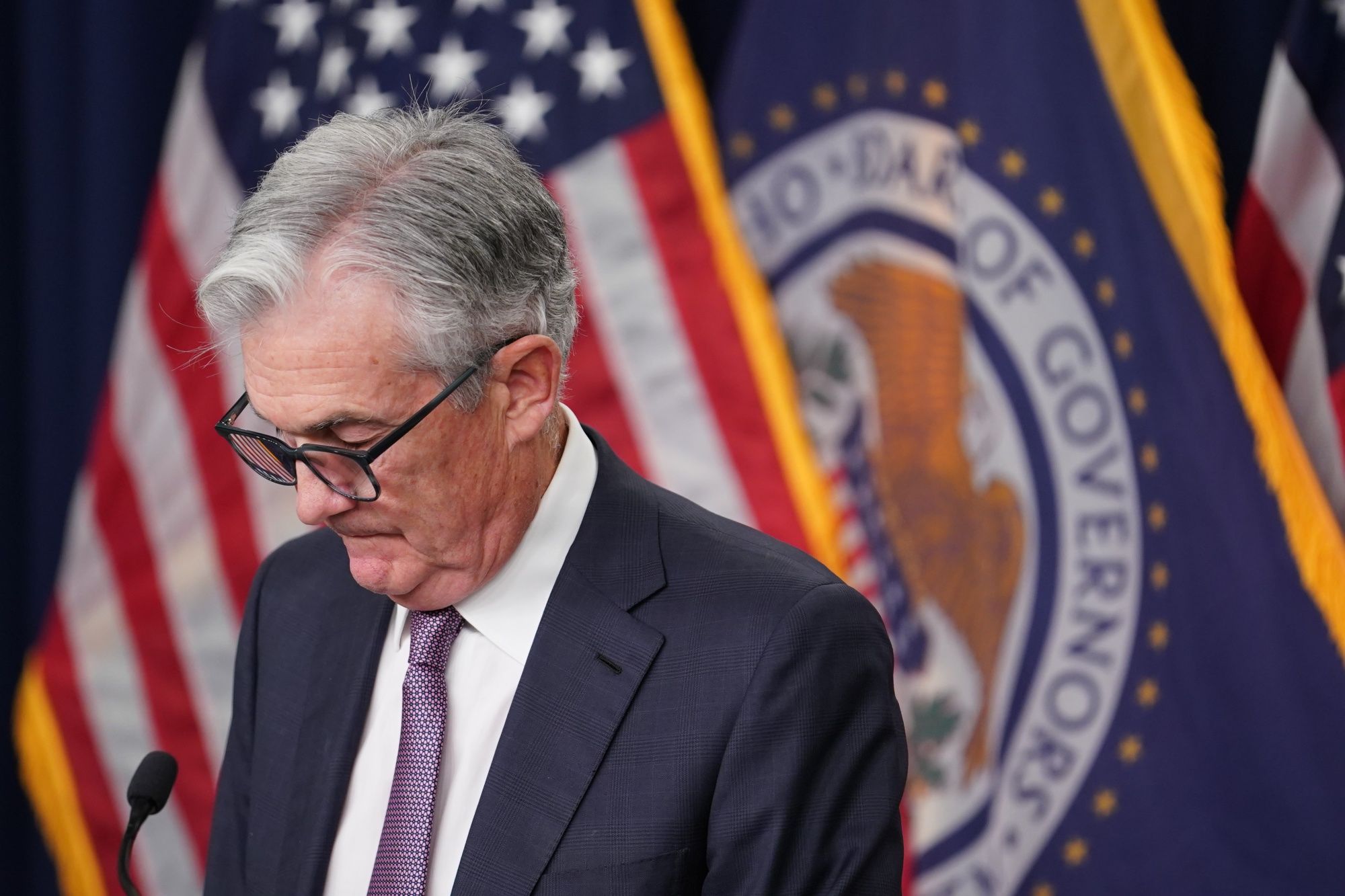
(Bloomberg) -- The Federal Reserve's fifth-straight outsized rate hike may spur fresh warnings that a recession is inevitable, based on a bond-market signal preferred by Chair Jerome Powell himself.
Powell's favored yield curve -- where three-month rates are now versus where they are expected to be in 18 months' time -- is on the cusp of inverting, with the spread between the two tumbling to a mere 0.2% Tuesday from 2.7% in April. An inverted yield curve is a key warning sign for many investors that a recession is coming and many closely-watched spreads in the Treasury market have already flipped below zero.

“Policy rates are entering restrictive levels while there have been some soft patches of economic data of late,” said Frances Cheung, a Singapore-based rates strategist at Oversea-Chinese Banking Corp. “At some point, the Fed needs to move to smaller rate hikes, and this may happen at the December FOMC meeting.”
In March, Powell downplayed the significance of two-year yields rising above 10-year rates -- an often-cited harbinger of recession. He argued traders were looking at the wrong metric and that the shorter-end measure gives a clearer read because “if it's inverted, that means the Fed's going to cut, which means the economy is weak.”
Global markets have been roiled this year by an increasingly-hawkish Fed arguing that it needs to quash sky-high inflation even at the risk of a so-called hard landing for the economy. Its conundrum looks to be intensifying as robust inflation and labor-market data contrast with signs of weakness in other parts of the US economy.
Another widely-followed yield curve -- the gap between 3-month and 10-year Treasuries -- inverted last week for the first time since March 2020.
More stories like this are available on bloomberg.com
©2022 Bloomberg L.P.

-
It's Time To Take The GST Council's Bet On Trust Global

Payment records can prove India's services exports, and clear, proportionate rules can bring foreign digital sellers into the tax net.
-
Opinion | India at 38: From Innovation Overperformer to Innovation Powerhouse
India now has 453 VC-backed deep science startups, 18 of them late-stage, after 117 percent growth since 2020. Laurus Labs, at USD 9.3 billion, is the most valuable deep science company in any middle-income economy outside China.
-
Navigating Energy Crossroads: S Jaishankar's Call For Diversified Supply Chains At G20 Ministerial Meeting
As geopolitical fault lines continue to test maritime trade routes and commodity flows, Jaishankar's message remains pertinent: true economic resilience requires open markets, protected transit lines, and a genuine commitment to multilateral cooperation rather than coercion.
-
Indians Are Travelling, But Not Every Journey Is A Holiday | The Week In Whys
Pilgrims, patients and working women are the real travellers, and the system hasn't quite caught up with them.
-
Getting To Work Costs Women More | The Reason Why
It is not just about women paying more than men. It is about women paying much more in cities than in villages.
-
AI Bias In Investing Cannot Be Eliminated, But It Can Be Governed
Framing is a particularly important example as identical financial information presented in terms of gains rather than losses can lead an LLM to reach a different assessment.
-
Joining The Dots | Dark Skies, Steady Diya: Why Hope Holds This Diwali
With war, a weak rupee and foreign outflows weighing on sentiment, policymakers at the NDTV World Summit and market veterans at NDTV Profit Ignite: Diwali Edition offered the same advice: stay invested and filter out the noise.
-
The Curious Case of Equitas Small Finance Bank And A CEO Who Quit For Stock
PN Vasudevan believes persistent investor concerns over a perceived conflict of interest had become a governance overhang on Equitas Small Finance Bank's stock, even as the lender improved profitability and asset quality.
-
Talking Points This Week: AI Cash Burn, A Tiger Comeback And An India That Still Finds Its Own Path
India is not immune to higher oil or tighter global liquidity, yet its earnings base is broader, its domestic policy levers are still available.










