Pakistan Economy In Shambles But Stock Market Rallies 60% YTD — Three Reasons Why
Pakistan's economy has been in shambles as it grapples with low foreign exchange reserves, piling external debt, inflation, and sluggish growth. In addition, the country remains gripped under political turmoil with tensions simmering over the continued imprisonment of ex-premier Imran Khan.
The country's gross domestic product contracted by 0.6% in fiscal 2023, and despite the low-base, it grew by a modest 2.4% in fiscal 2024. The burgeoning inflation last year—peaking to as high as 37.8% in May 2023—crippled a significant section of the population, leading to a cost-of-living crisis.
And yet, in this period of gloom, Pakistan's stock market has marked a steep turnaround this year, outperforming major global peers.
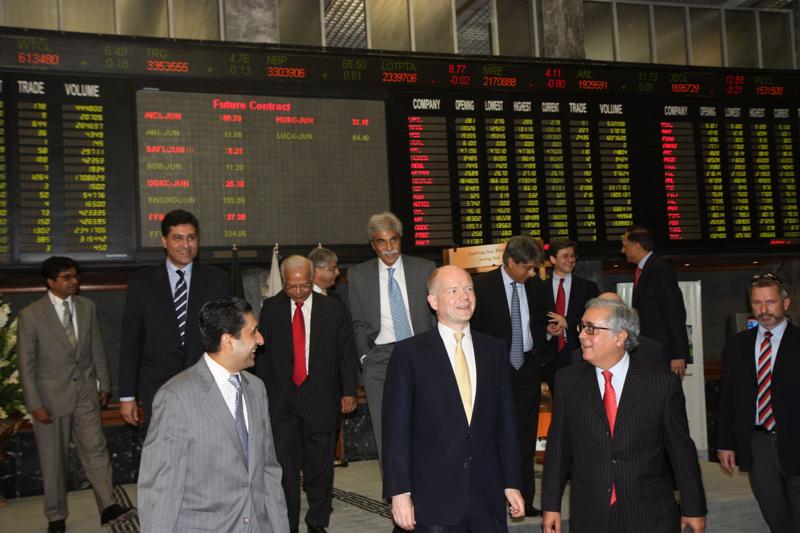
The KSE-100, which is the benchmark index of the Karachi Stock Exchange, crossed the 100,000-mark for the first time ever on Thursday. KSE-100 climbed to as high as 100,216.57 points, marking a jump of 947.32 points, or 0.95%, against the previous day's close.
The surge in KSE-100 is not seen as a flash-in-the-pan, as it has risen consistently over the past 15 months. The index's outperformance makes Pakistan's stock market the second-best performer in 2024, after Argentina, according to Bloomberg.
KSE-100, that covers 100 companies, has grown at a faster pace than global majors like FTSE-100 and S&P 500 in 2024. On a year-to-date basis, it has risen by 62,379.4 points, or 59.6%, as compared to a 25.7% climb in the S&P 500 and a 7.2% rise in the FTSE-100.
The pace of KSE-100's climb is also sharper as compared to neighbouring India's NSE Nifty 50, which has advanced by 10.4% on a year-to-date basis.
Here's a look at the three key reasons behind the accelerated rise in Pakistan's benchmark equity market index.
Bouncing Back From Low Valuations
One of the foremost reasons behind the extraordinary performance of Pakistan's stock market in 2024 is that valuations are at a historic low. The price-to-earnings ratio of the KSE 100 Index presently stands at 4.6x, lower as compared to the five-year average PE ratio of 6x, Karachi-based brokerage Topline Securities Ltd. highlighted in its recent report.
The current valuation is primarily driving the bullish sentiment, as investors with appetite are overlooking the political and economic risks to reap strong dividends, experts suggested.
The market had been underperforming for more than five years, due to which valuations had remained depressed, explained Ammar Habib Khan, the chief executive officer of National Credit Guarantee Co., a joint venture floated by Pakistan's finance ministry and non-governmental organisation Karandaz Pakistan to facilitate easier access to credit.
"The current run-up in prices barely covers for inflation over the last five years, due to which the valuations continue to remain attractive on the basis of future earnings and even future cash flow," he told NDTV Profit.
Equity buyers, whether they are overseas investors or domestic high-net-worth individuals, tend to look for a bounce back in the market from low valuations. This kind of bounce back helps investors to make a windfall in a period of crisis, analysts said.
"There is a notion in the market that when equity valuations dip to a historic low, there will be a strong bounce back in the market. Sometimes, this bounce may be low. Sometimes it may be high," said Kranti Bathini, director of equity strategy at WealthMills Securities Pvt.
In Pakistan's case, the bounce back has been strong, but that does not mean that investors worldwide would flock to their equity market, he added.
Topline Securities Ltd., a Karachi-based brokerage, said in a report released on Nov. 16 that it expects the P/E ratio to rise from 4.6x at present to 5.75x by December 2025. This will be driven by declining bond yields and increasing liquidity in equities, it said.
Domestic Liquidity Driving Surge
Data suggests foreign investors are still averse towards Pakistan's equity market despite the historic dip in valuations. This makes domestic high-net-worth individuals, combined with other local entities, one of the primary factors fuelling the stock market's climb.
Domestic entities, which include Pakistani companies, brokers, HNIs, and other investors, cumulatively hold 75.8% ownership in KSE All Shares, according to a report released recently by Arif Habib Ltd., another Karachi-based brokerage firm.
On the other hand, foreign holdings in the KSE All Shares have "significantly decreased to 3.2% of free float market cap as compared to 28.7% back in 2017," it pointed out.
In this backdrop, the stellar returns given by the Pakistan stock market in 2024 highlight the role of "ample domestic liquidity," which has enabled local investors to absorb the impact of foreign selling amounting to $35.7 million, the brokerage firm stated.
A section of Pakistani economists believes that foreign investors could head towards Pakistan if the political risks and the resultant economic uncertainty fade. The country has been witness to periodic nationwide protests by supporters of Imran Khan, the former prime minister jailed for more than 450 days.
"As the economy stabilises and risk premium subsides, we may see more foreign investors entering the space," Ammar Habib Khan said.
IMF's $7-Billion Bailout
The IMF's $7 billion bailout package for Pakistan, approved in September, was one of the key factors behind the KSE-100's meteoric climb.
The IMF aid, which is crucial for Pakistan to meet its debt obligations, was cleared on Sept. 26. In the two-month period that followed, KSE-100 has soared by 18,533.53 points, or 22.7%.
The bailout was expected to inject the much-needed support into the Pakistani economy. The IMF action also indicated that the UN-affiliated body was seeing progress in Islamabad's recent inflation-combating measures, analysts said, adding that this in turn lifted the stock market sentiment over the past couple of months.
The climbdown of retail inflation to 7.2% in October 2024 was viewed favourably by market participants. This also allowed the State Bank of Pakistan to slash the benchmark lending rates by 250 basis points to 15%, with effect from Nov. 5.

Pakistan central bank's current monetary policy stance is to "appropriate to achieve the objective of price stability on a durable basis by maintaining inflation within the 5%-7% target range".
The life of this stock market rally could be extended if the economic conditions improve, some economists said. "If Pakistan's economy continues to stabilise and is able to pick up sustainable growth, the rally will continue as the valuation multiples are much lower than the long-term historic average, and there exists sufficient room to cover," said Khan.
According to Bathini, it would be too early to comment on whether the Pakistan stock market would be able to sustain its momentum in the period to come. "That depends on how the macroeconomic fundamentals shape up. As of now, I don't see an economic recovery."

-
Opinion | India at 38: From Innovation Overperformer to Innovation Powerhouse

India now has 453 VC-backed deep science startups, 18 of them late-stage, after 117 percent growth since 2020. Laurus Labs, at USD 9.3 billion, is the most valuable deep science company in any middle-income economy outside China.
-
Navigating Energy Crossroads: S Jaishankar's Call For Diversified Supply Chains At G20 Ministerial Meeting
As geopolitical fault lines continue to test maritime trade routes and commodity flows, Jaishankar's message remains pertinent: true economic resilience requires open markets, protected transit lines, and a genuine commitment to multilateral cooperation rather than coercion.
-
Indians Are Travelling, But Not Every Journey Is A Holiday | The Week In Whys
Pilgrims, patients and working women are the real travellers, and the system hasn't quite caught up with them.
-
Getting To Work Costs Women More | The Reason Why
It is not just about women paying more than men. It is about women paying much more in cities than in villages.
-
AI Bias In Investing Cannot Be Eliminated, But It Can Be Governed
Framing is a particularly important example as identical financial information presented in terms of gains rather than losses can lead an LLM to reach a different assessment.
-
Joining The Dots | Dark Skies, Steady Diya: Why Hope Holds This Diwali
With war, a weak rupee and foreign outflows weighing on sentiment, policymakers at the NDTV World Summit and market veterans at NDTV Profit Ignite: Diwali Edition offered the same advice: stay invested and filter out the noise.
-
The Curious Case of Equitas Small Finance Bank And A CEO Who Quit For Stock
PN Vasudevan believes persistent investor concerns over a perceived conflict of interest had become a governance overhang on Equitas Small Finance Bank's stock, even as the lender improved profitability and asset quality.
-
Talking Points This Week: AI Cash Burn, A Tiger Comeback And An India That Still Finds Its Own Path
India is not immune to higher oil or tighter global liquidity, yet its earnings base is broader, its domestic policy levers are still available.
-
Foreign Investors Own Half Of HDFC Bank and ICICI Bank. An LTCG Cut Could Matter Most Here
Foreign portfolio investors have US$115 billion parked in HDFC Bank, ICICI Bank. If the government cuts long-term capital gains tax, Jefferies says returning foreign money could land here first.










