Nuclear-Capable Agni-IV Missile Successfully Test-Fired
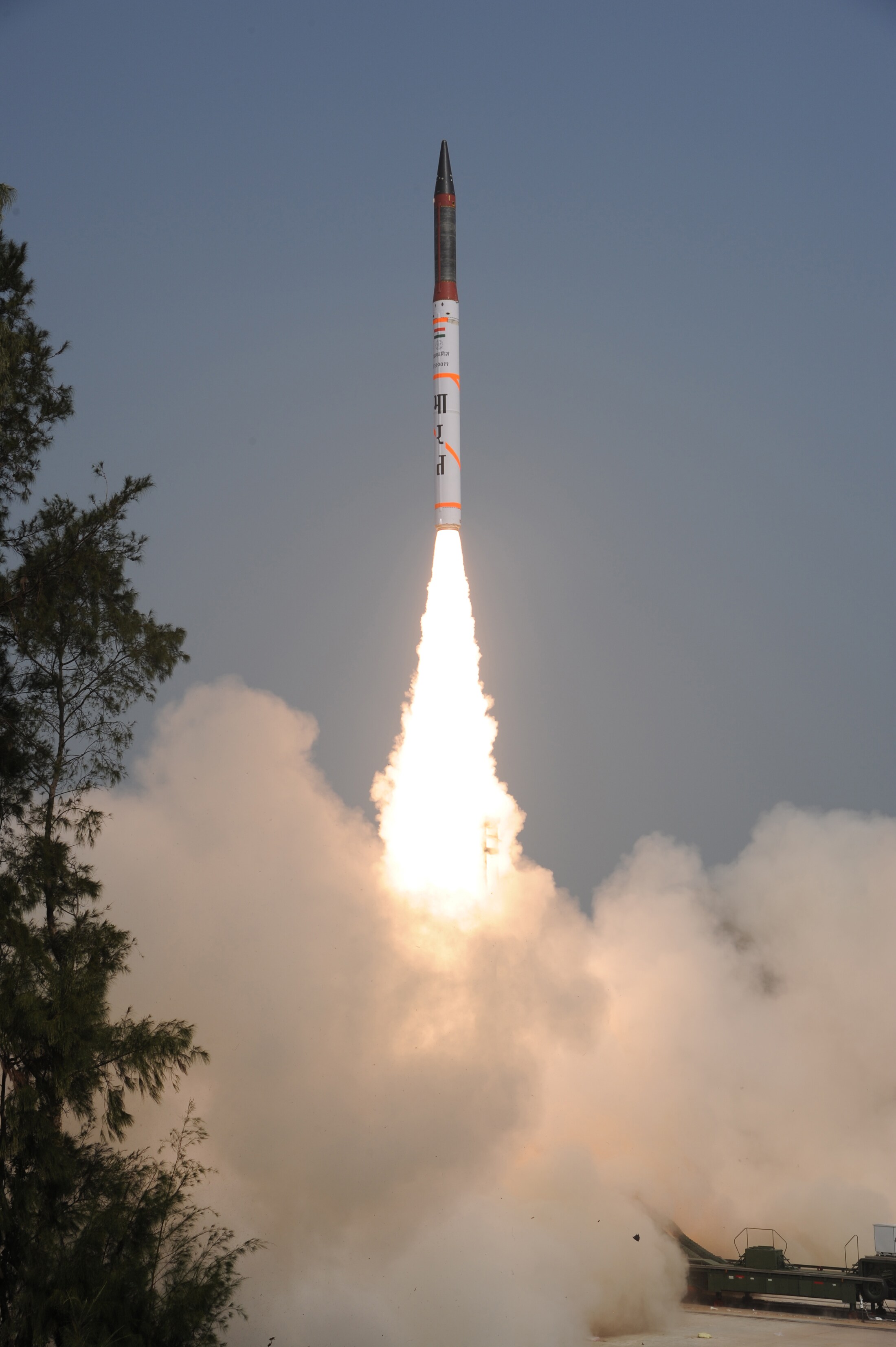
India successfully test-fired its nuclear-capable long-range ballistic missile Agni-IV, with a strike range of 4,000 km, as part of a user trial by the Army.
The strategic surface-to-surface missile was flight tested from launch complex-4 of the Integrated Test Range at Dr. Abdul Kalam Island, earlier known as Wheeler Island, at about 8.35 am, defence sources said.
All radars, tracking systems and range stations tracked and monitored the flight performance of the missile, which was launched with support of a mobile launcher. Radars and electro-optical systems had been positioned along the coast of Odisha for tracking and monitoring all parameters of the missile, the sources said, adding two naval ships were anchored near the target area to witness the final event.
This was the seventh trial of Agni-IV missile. The last trial conducted by the strategic force command of the Indian Army from the same base on Jan. 2, 2018 was successful.
The indigenously developed sophisticated Agni-IV having 4,000 km strike range is a two-stage missile. It is 20 meter long with a weight of 17 tonnes, they said.
"The state-of-the-art missile is equipped with modern and compact avionics to provide high level of reliability and precision," Defence Research and Development Organisation sources said.
Agni-IV missile is equipped with advanced Avionics, 5th generation On Board Computer and distributed architecture. It has the latest features to correct and guide itself for in-flight disturbances, they said.
The accurate Ring Laser Gyro-based Inertial Navigation System, supported by highly reliable redundant Micro Navigation System, ensures the vehicle reaches the target with accuracy.
The re-entry heat shield can withstand temperatures inthe range of 4000 degrees centigrade and makes sure avionics function normally with inside temperature remaining less than 50 degrees centigrade.
Ballistic missiles like Agni-I, II and III and Prithvi have been included in the arsenal of the armed forces, giving India an effective deterrence capability.

-
Where You Live Shapes How You Get To Work | The Reason Why

Two-wheelers are the most popular way to get to work in India, accounting for nearly 43% of workplace commutes.
-
High US Salaries, No Green Card Certainty: The Financial Calculation Facing Indian H-1B Families
The suspension of PERM processing at eight technology employers does not cancel existing H-1B visas. What it does is force a question many Indian families have been avoiding: is the US salary worth tying your career and family plans to one employer?
-
Unhedged Position: Can India See An Indonesia-Style Time Correction?
The Nifty is trading below levels it first clocked in 2024. Is there, then, as I have suggested in the headline, potential that the current time correction drags on painfully for the next three-five, even ten years?
-
Navigating Friction And Energy Realities: An Analysis Of Marco Rubio's October Visit To India
Occurring at a critical juncture marked by stalled trade negotiations and escalating geopolitical pressures over global energy supplies, the visit offers a profound window into modern US-India relations.
-
India Exports Capital. Why Not Export Trusteeship?
The big question, then, is whether India can build an institution that global borrowers, investors, banks, and lawyers can trust, even without an Indian connection.
-
France's Economy & Politics Are In Crisis | The Reason Why
Let's look at how the French economy and politics evolved under Nicolas Sarkozy, Franois Hollande and Emmanuel Macron.
-
You May Inherit The Business. You Must Earn Its Credibility.
Succession tests the founder's ability to share authority as much as it tests the next generation's readiness to assume it.
-
Signing Deals Is One Thing; Making Them Work Is Another | The Week In Whys
Sometimes, things don't turn out as planned. Indian companies have lost some bids to rivals, some projects won't produce until 2030.
-
FOMC Wall, PERM Suspension, Hospital Stocks | Talking Points This Week
A PERM suspension would directly affect green-card sponsorship rather than H-1B visas, so the near-term earnings impact could remain relatively limited. The key question is whether this marks a new phase in US scrutiny of Indian IT.
-
Everything, Everywhere, All At Once: Dalal Street's Week To Forget | Joining The Dots
Visa curbs, a Starlink spat and cancer drug caps: what connects this week's shocks for Indian markets









