Thousands Of Russians Mourn Navalny At Funeral, Defying Kremlin
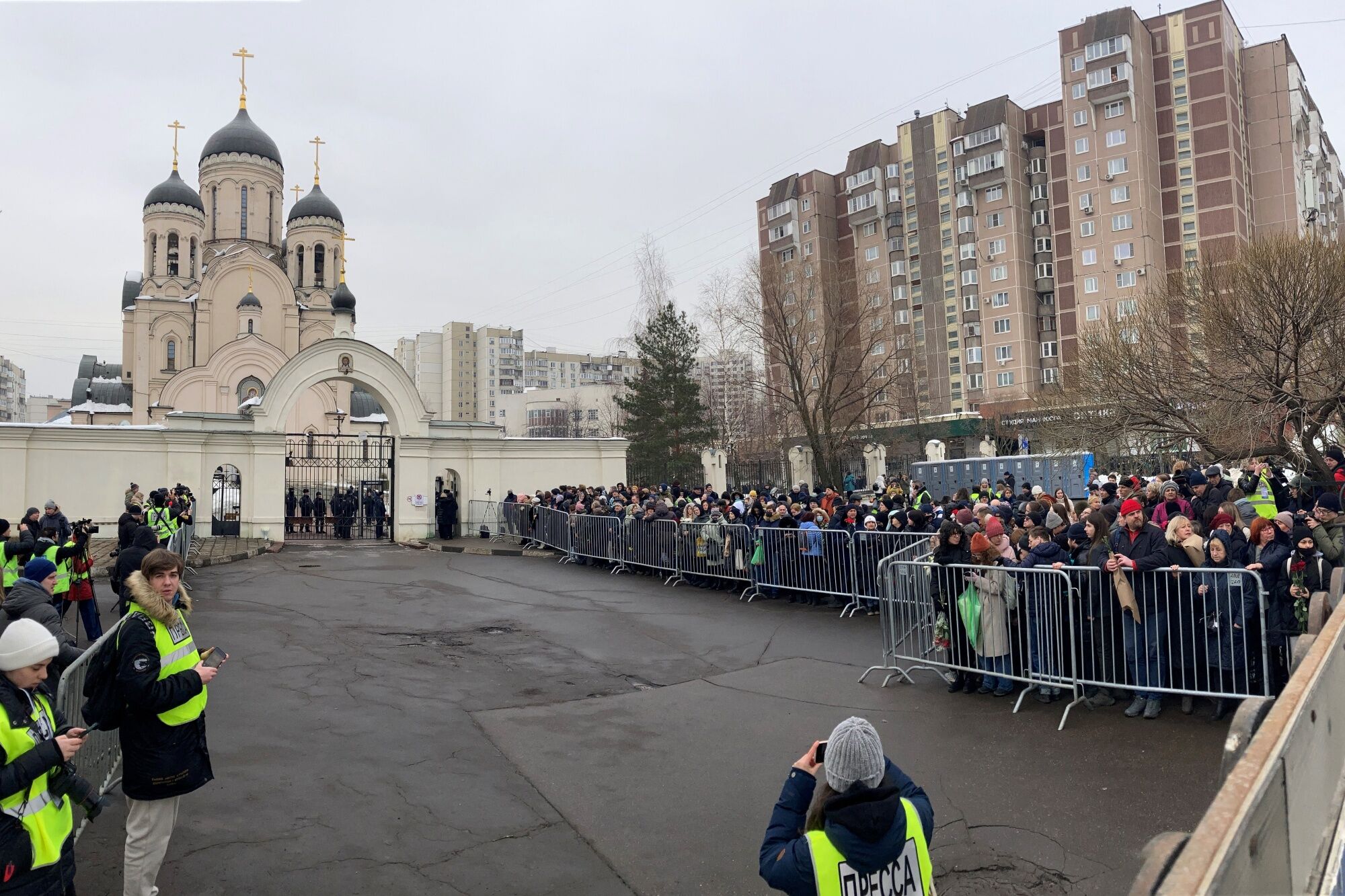
(Bloomberg) -- Thousands of people lined up to pay their final respects at the funeral of Russian opposition leader Alexey Navalny on Friday, in defiance of a heavy police presence aimed at deterring protests against President Vladimir Putin.
Mourners chanted “Navalny” and “we won't forgive” as his coffin was brought to the Church of the Icon of the Mother of God in Moscow's southeastern Marino district. Some shouted “Putin is a killer” as the Kremlin critic's body was carried out after the service for burial at the nearby Borisov cemetery.
Riot police were stationed outside the church and at the cemetery, as authorities threatened punishment for any unsanctioned gathering. Putin's spokesman, Dmitry Peskov, said the Kremlin had nothing to say about Navalny, in response to questions from reporters, the Interfax news service reported.
US President Joe Biden and European leaders have joined Navalny's family and allies in blaming Putin for the activist's Feb. 16 death in an Arctic prison camp. Ambassadors from the US and a number of European states joined those gathered outside for the funeral.

The crowds turned out in defiance of an unprecedented Kremlin crackdown on dissent in recent years, in a display of discontent with Putin's nearly quarter-century rule and as Russia is waging war in Ukraine. The funeral was held a day after Putin set out plans for his next six years in power, in an address to Russia's Federal Assembly ahead of the March 15-17 presidential election.
The US and Europe responded to the death of Putin's most formidable domestic opponent by imposing sanctions on Russia that have had a largely symbolic impact.
Russian police have arrested hundreds of people in Moscow and other cities for laying flowers at makeshift memorials to Navalny since his death.
State media have almost completely ignored the fallout from Navalny's demise. In contrast, it devoted extensive coverage to the death this week of former Soviet Prime Minister Nikolai Ryzhkov, aged 94, who was also being buried on Friday following a memorial service at Moscow's main Christ the Saviour Cathedral.
Navalny's widow, Yulia, didn't attend his funeral after aides said it would be unsafe for her to return to Russia from Europe. She denounced Putin as the “leader of an organized, criminal gang” in an address to the European Parliament in Strasbourg, France, on Wednesday, and has said she plans to continue her husband's fight against the Kremlin.
Penitentiary officials said Navalny, 47, died after falling ill at the maximum-security prison where he was serving 19 years on extremism charges.
Officials kept the body for more than a week before handing it over to Navalny's mother, Lyudmila, who accused them of trying to pressure her into agreeing to a secret burial. Navalny's spokeswoman, Kira Yarmysh, said Thursday the family had difficulties in finding a vehicle to transport the body to the church.
Navalny died as talks were underway that could have seen him freed as part of a prisoner exchange with the US and Germany, a western official said.
Read more: Navalny's Death Sends Message About Putin's Grip on Russia
The opposition leader, who was barred from running against Putin in 2018 elections, built up a huge following inside Russia with slick videos exposing high-level corruption and a campaign aimed at loosening the Kremlin's grip on power. He helped lead protests that at their peak in 2011-2012 brought tens of thousands to the streets.
After a near-fatal nerve-agent poisoning in Siberia in 2020 that he and the West blamed on the Kremlin, which denied involvement, Navalny was taken to Germany for treatment. He was detained at passport control in Moscow when he returned in January 2021 and remained in prison until his death.
More stories like this are available on bloomberg.com
©2024 Bloomberg L.P.

-
Love, Sex Aur Dhokha: The Audacious Plot To Spy On Jensen Huang

A Taipei dinner, a Singapore chip buyer and a suspected Chinese asset: inside the alleged spy operation that got close to NVIDIA's Jensen Huang.
-
Ten Things I Learnt This Samvat
Patience can be a trap. Cheap stocks can stay cheap. Leverage can wipe you out. What did Samvat 2082 teach us? Niraj Shah writes on 10 lessons from the year gone by.
-
Talking Points This Week: Tech Nerves, FII Buying, And A Faraway Banking Shock
The global markets are not shining this Diwali. The exception in the large markets is, India.
-
Midterm Rally Lasted A Day. The Hard Reality Of A Divided US May Last Two Years | Opinion
Between a contested AI boom, a debt ceiling that arrives in 2027 and a president with every incentive to act alone, the next two years may prove more volatile than the first day's rally suggests.
-
Blue Wave Will Derail the AI Trade but Won't Dismantle the AI Era | Unhedged Position
The Democrats' sweep of the US Congress will see politics collide with economic forces both over the long and short term.
-
It's Time To Take The GST Council's Bet On Trust Global
Payment records can prove India's services exports, and clear, proportionate rules can bring foreign digital sellers into the tax net.
-
Opinion | India at 38: From Innovation Overperformer to Innovation Powerhouse
India now has 453 VC-backed deep science startups, 18 of them late-stage, after 117 percent growth since 2020. Laurus Labs, at USD 9.3 billion, is the most valuable deep science company in any middle-income economy outside China.
-
Navigating Energy Crossroads: S Jaishankar's Call For Diversified Supply Chains At G20 Ministerial Meeting
As geopolitical fault lines continue to test maritime trade routes and commodity flows, Jaishankar's message remains pertinent: true economic resilience requires open markets, protected transit lines, and a genuine commitment to multilateral cooperation rather than coercion.
-
Indians Are Travelling, But Not Every Journey Is A Holiday | The Week In Whys
Pilgrims, patients and working women are the real travellers, and the system hasn't quite caught up with them.









