Morgan Stanley Says Inflation in Asia Set to Peak This Quarter

(Bloomberg) -- Bets that Asian central banks will keep ramping up interest rates are overdone as inflation is likely to peak this quarter, according to Morgan Stanley.
Consumer prices may rise less rapidly than currently expected given supply imbalances are reversing, global food costs have fallen and wage pressures will be muted, economists led by Chetan Ahya wrote in a note Wednesday. Price gains may be stickier in Australia, South Korea and Singapore while remaining within the comfort zone in China, they said.
Morgan Stanley's prognosis may offer some comfort to Asia's stock and bond traders who have been rocked by fears that regional central banks will follow the Federal Reserve in pushing up rates aggressively. The forecast also coincides with speculation the weakening global outlook will cause policy makers to opt for more measured increases.
“The level of interest rates needed to slow growth and demand will not be as high as what is being perceived by markets,” the Morgan Stanley analysts wrote. “We are increasingly confident that inflation is peaking this quarter, and that inflation could start to surprise on the downside in the coming months.”
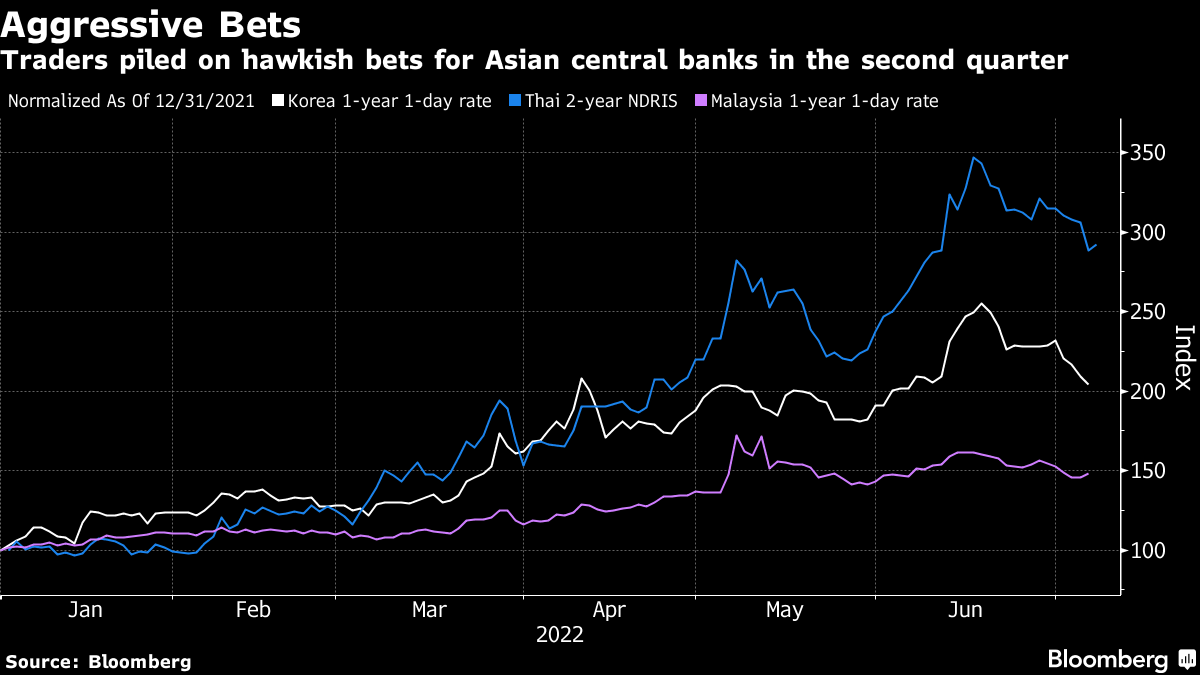
Emerging Asia bonds have fallen for four straight months, while the MSCI Asia Pacific Index of shares is trading near a two-year low after the Fed delivered a series of outsized rate hikes to tame inflation. Policy makers in South Korea, the Philippines, India and Malaysia have also tightened in recent months.
South Korea's one-year one-day swap rate predicts policy makers will raise their benchmark to 4.20% by mid-June, versus economists' forecasts for it to peak at 2.50% by year-end. Thailand's two-year non-deliverable interest-rate swap shows traders are pricing in more than 200 basis points of rate hikes over that period.
Read More: Food Inflation Fears Abate as Cooking Oils and Grains Plummet
While traders are betting on further rate hikes, global inflation is already showing some signs of cooling. Costs of everything from cooking oils to wheat and corn -- a key component of Asian inflation gauges -- have tumbled to their lowest level in months, while the Bloomberg Commodity Index has plummeted from a high set a month ago.
“With growth concerns now coming to the fore and perhaps taking some precedence over inflation risks, we think it has reduced the risks that central banks in the region will have to go deeply into restrictive territory as implied by market pricing,” the economists wrote.
More stories like this are available on bloomberg.com
©2022 Bloomberg L.P.

-
A New Samvat Wishlist: Inclusive Prosperity And Human Development

India has strengthened its economic foundations through infrastructure, digital access and enterprise. Its next growth chapter must deepen productivity, create better livelihoods and widen participation in prosperity.
-
Love, Sex Aur Dhokha: The Audacious Plot To Spy On Jensen Huang
A Taipei dinner, a Singapore chip buyer and a suspected Chinese asset: inside the alleged spy operation that got close to NVIDIA's Jensen Huang.
-
Ten Things I Learnt This Samvat
Patience can be a trap. Cheap stocks can stay cheap. Leverage can wipe you out. What did Samvat 2082 teach us? Niraj Shah writes on 10 lessons from the year gone by.
-
Talking Points This Week: Tech Nerves, FII Buying, And A Faraway Banking Shock
The global markets are not shining this Diwali. The exception in the large markets is, India.
-
Midterm Rally Lasted A Day. The Hard Reality Of A Divided US May Last Two Years | Opinion
Between a contested AI boom, a debt ceiling that arrives in 2027 and a president with every incentive to act alone, the next two years may prove more volatile than the first day's rally suggests.
-
Blue Wave Will Derail the AI Trade but Won't Dismantle the AI Era | Unhedged Position
The Democrats' sweep of the US Congress will see politics collide with economic forces both over the long and short term.
-
It's Time To Take The GST Council's Bet On Trust Global
Payment records can prove India's services exports, and clear, proportionate rules can bring foreign digital sellers into the tax net.
-
Opinion | India at 38: From Innovation Overperformer to Innovation Powerhouse
India now has 453 VC-backed deep science startups, 18 of them late-stage, after 117 percent growth since 2020. Laurus Labs, at USD 9.3 billion, is the most valuable deep science company in any middle-income economy outside China.
-
Navigating Energy Crossroads: S Jaishankar's Call For Diversified Supply Chains At G20 Ministerial Meeting
As geopolitical fault lines continue to test maritime trade routes and commodity flows, Jaishankar's message remains pertinent: true economic resilience requires open markets, protected transit lines, and a genuine commitment to multilateral cooperation rather than coercion.









