More US Job Offers Include Retirement Benefits, Student Loan Help To Lure Workers
(Bloomberg) -- Over a year of rapid wage growth has US companies turning to enhanced benefits to attract and retain workers.
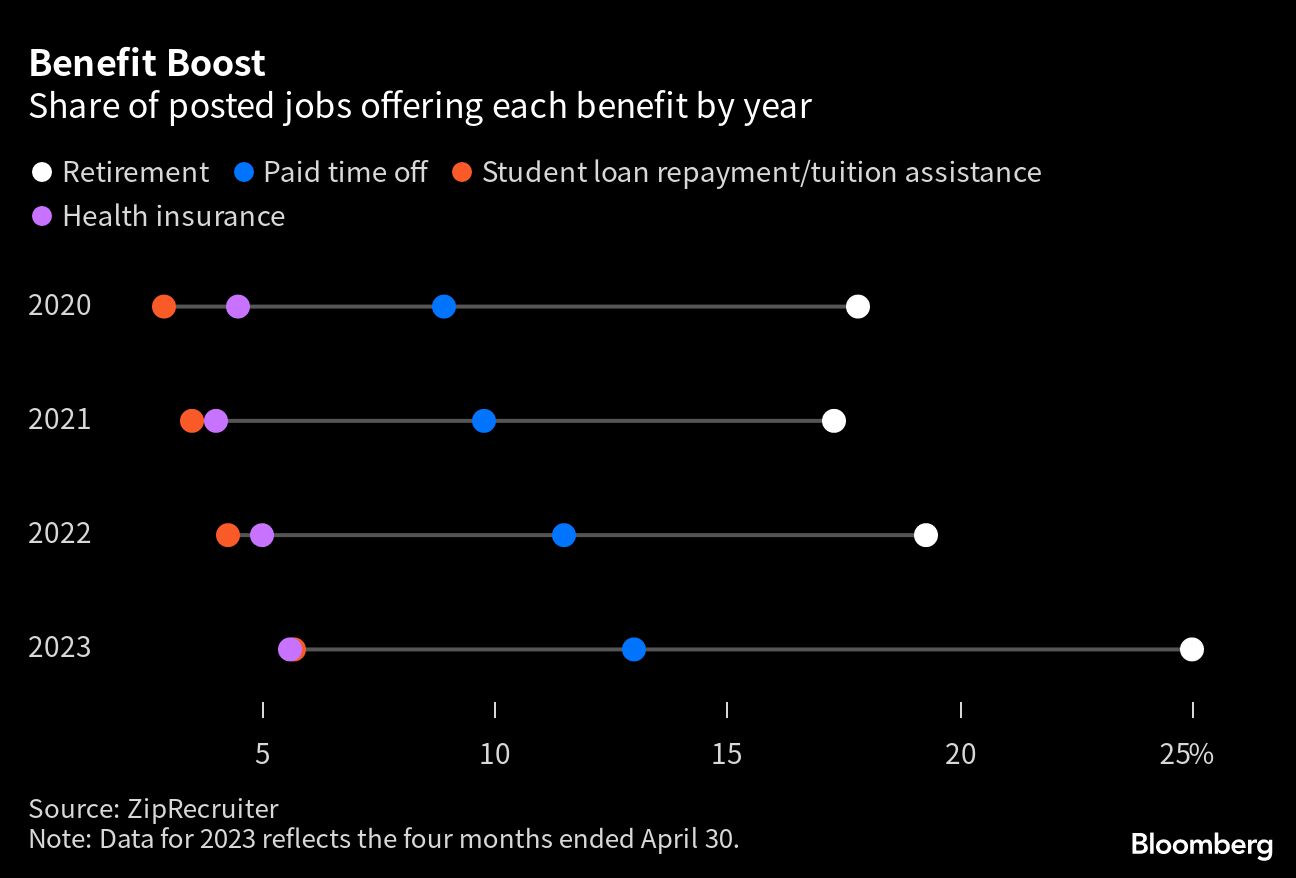
Mentions of employee benefits in job postings on ZipRecruiter soared to the highest rates on record, according to an analysis by the jobs site. A greater share of positions offered benefits like health insurance, paid time off, and paid parental leave than in prior years.
One in four jobs now offer retirement benefits, and a growing number are offering student loan repayment and tuition assistance.

“Customers tell ZipRecruiter that they are trying to end out-of-cycle wage increases and cap the size of regular increases to keep costs under control,” said Julia Pollak, chief economist at the jobs website. Against a backdrop of low unemployment and high employee turnover, “many are therefore expanding their benefits offerings.”
Despite some recent cooling in the labor market, many companies are still struggling to fill positions and limit attrition given the enduring mismatch between the supply and demand for workers.
While businesses have been raising wages quite aggressively to do that, it's unclear how much pricing power firms will have in the months ahead if the economy continues to lose momentum.
Government data also point to a recent increase in benefit offerings. The employment cost index, a broad measure of labor costs, accelerated in the first three months of the year in part due to a pickup in benefits. Benefit costs at companies in the three months ended in March rose 1.1% from the prior quarter, an acceleration from the prior period.
Getting Creative
Wells Fargo & Co. economist Shannon Seery said she's been hearing in client conversations that firms are “trying to get creative” to avoid hiking wages at the pace they have been.
Even with labor demand slowing, there is still a shortage of workers, and “providing better benefits may be a solution firms explore,” she said.
Pollak specifically flagged the challenges of recruiting and retaining talent for in-person roles in hospitality, manufacturing, and tourism ahead of the summer season.
Cooling wage pressures would certainly be welcomed by Fed officials, particularly Chair Jerome Powell, who has voiced concerns about their inflationary impact. Benefits, however, still come at a cost for firms — even if it's smaller than wages.
While the Fed is likely more focused on wages, especially in the near-term, “the benefits angle does have weight and is important — particularly if we see that get sticky even as wages starts to decline,” Seery said.
More stories like this are available on bloomberg.com
©2023 Bloomberg L.P.

-
Ten Things I Learnt This Samvat

Patience can be a trap. Cheap stocks can stay cheap. Leverage can wipe you out. What did Samvat 2082 teach us? Niraj Shah writes on 10 lessons from the year gone by.
-
Talking Points This Week: Tech Nerves, FII Buying, And A Faraway Banking Shock
The global markets are not shining this Diwali. The exception in the large markets is, India.
-
Midterm Rally Lasted A Day. The Hard Reality Of A Divided US May Last Two Years | Opinion
Between a contested AI boom, a debt ceiling that arrives in 2027 and a president with every incentive to act alone, the next two years may prove more volatile than the first day's rally suggests.
-
Blue Wave Will Derail the AI Trade but Won't Dismantle the AI Era | Unhedged Position
The Democrats' sweep of the US Congress will see politics collide with economic forces both over the long and short term.
-
It's Time To Take The GST Council's Bet On Trust Global
Payment records can prove India's services exports, and clear, proportionate rules can bring foreign digital sellers into the tax net.
-
Opinion | India at 38: From Innovation Overperformer to Innovation Powerhouse
India now has 453 VC-backed deep science startups, 18 of them late-stage, after 117 percent growth since 2020. Laurus Labs, at USD 9.3 billion, is the most valuable deep science company in any middle-income economy outside China.
-
Navigating Energy Crossroads: S Jaishankar's Call For Diversified Supply Chains At G20 Ministerial Meeting
As geopolitical fault lines continue to test maritime trade routes and commodity flows, Jaishankar's message remains pertinent: true economic resilience requires open markets, protected transit lines, and a genuine commitment to multilateral cooperation rather than coercion.
-
Indians Are Travelling, But Not Every Journey Is A Holiday | The Week In Whys
Pilgrims, patients and working women are the real travellers, and the system hasn't quite caught up with them.
-
Getting To Work Costs Women More | The Reason Why
It is not just about women paying more than men. It is about women paying much more in cities than in villages.









