Lagarde Says ECB Needs Time To Weigh Inflation Uncertainties
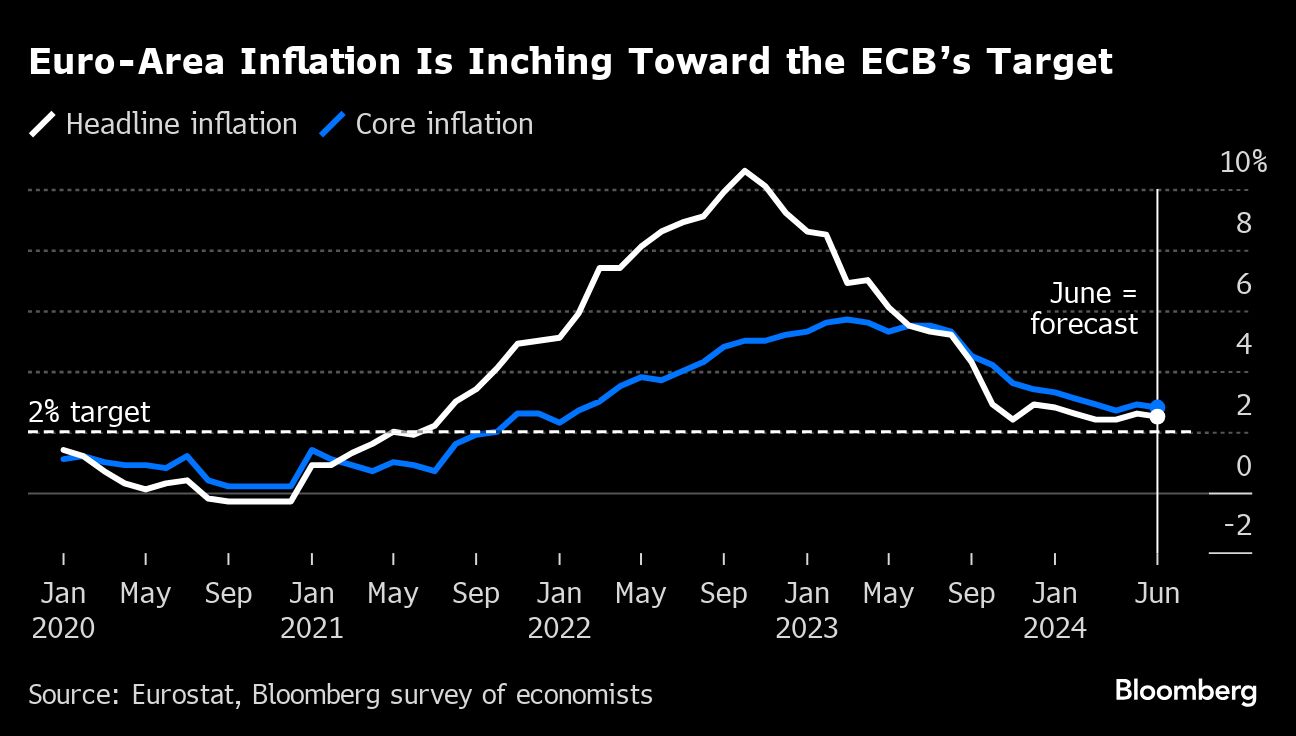
(Bloomberg) -- The European Central Bank doesn't yet have sufficient evidence that inflation threats have passed, President Christine Lagarde and her top economist said — feeding expectations that officials will take a break from cutting interest rates this month.
With the euro-zone job market robust, the ECB has time to assess incoming information, Lagarde said Monday in Sintra, Portugal, where she opened the ECB's annual central-banking forum. Speaking Tuesday to Bloomberg TV, Chief Economist Philip Lane said June's inflation reading won't be enough to fully evaluate closely watched services prices.
“We are still facing several uncertainties regarding future inflation, especially in terms of how the nexus of profits, wages and productivity will evolve and whether the economy will be hit by new supply-side shocks,” Lagarde said. “It will take time for us to gather sufficient data to be certain that the risks of above-target inflation have passed.”

The remarks suggest a preference for keeping borrowing costs unchanged when the ECB meets later this month. Since June's initial cut, investors have been looking to Lagarde for indications of how quickly rates will be lowered — and whether the political drama in her homeland will sway monetary policy in any way.
Monday's speech doesn't mention France — nor does it offer specific guidance on the ECB's path ahead, with Lagarde reiterating her commitment to making decisions as data arrive.
“The strong labor market means that we can take time to gather new information, but we also need to be mindful of the fact that the growth outlook remains uncertain,” she said. “All of this underpins our determination to be data-dependent and to take our policy decisions meeting by meeting.”

Read More on Sintra: ECB Gathers With France's Election Drama Overshadowing Rate Cuts
Lagarde said officials' assessment of the inflation outlook is “informed by, but not limited to, our projections” — pushing back against speculation among analysts that the ECB will only consider changing rates at the quarterly meetings when new forecasts are available.
She also stressed that policymakers won't be thrown off course by any one particular piece of information, having highlighted in the past that the road back to 2% will be bumpy and may include temporary setbacks.
“While the flow of new information constantly adds to and improves our picture of medium-term inflation, we are not pushed around by any specific data point,” Lagarde said. “Data dependence does not mean data-point dependence.”
What ECB Officials Are Saying at Sintra...
- Lithuania's Gediminas Simkus — click here for full interview
- “Expectations for two more cuts this year are in line with my own thinking, if data evolve as expected”
- Belgium's Pierre Wunsch — click here for full interview
- “The first two rate cuts are relatively easy as long as inflation hovers around 2.5% because we will still clearly be restrictive”
- Estonia's Madis Muller — click here for full interview
- “If the actual outcome ends up being close to our latest projections, then we most likely can further reduce the level of policy restrictiveness this year”
- Slovenia's Bostjan Vasle — click here for full interview
- “If everything will evolve as expected, we can continue to lower interest rates this year. But I wouldn't want to tie this to any date — it's linked to the data we'll receive”
On Tuesday, policymakers will receive an update on price pressures across the euro zone in June. That may show some small progress toward the 2% target, with economists estimating consumer-price growth moderated to 2.5% from 2.6%.
Against that backdrop, markets are betting on one or two more cuts this year — a scenario that Finland's Olli Rehn has described as “reasonable,” though he, too, said officials can't commit to a certain path.
The Bank for International Settlements warned Sunday that central banks should be cautious in lowering rates too rapidly, to avoid inflation flaring up again.
Lagarde agrees.
“Our work is not done,” she said. “We need to remain vigilant.”
--With assistance from Marilen Martin.
(Updates with quotes from ECB's Muller, Vasle.)
More stories like this are available on bloomberg.com
©2024 Bloomberg L.P.

-
Talking Points This Week: Tech Nerves, FII Buying, And A Faraway Banking Shock

The global markets are not shining this Diwali. The exception in the large markets is, India.
-
Midterm Rally Lasted A Day. The Hard Reality Of A Divided US May Last Two Years | Opinion
Between a contested AI boom, a debt ceiling that arrives in 2027 and a president with every incentive to act alone, the next two years may prove more volatile than the first day's rally suggests.
-
Blue Wave Will Derail the AI Trade but Won't Dismantle the AI Era | Unhedged Position
The Democrats' sweep of the US Congress will see politics collide with economic forces both over the long and short term.
-
It's Time To Take The GST Council's Bet On Trust Global
Payment records can prove India's services exports, and clear, proportionate rules can bring foreign digital sellers into the tax net.
-
Opinion | India at 38: From Innovation Overperformer to Innovation Powerhouse
India now has 453 VC-backed deep science startups, 18 of them late-stage, after 117 percent growth since 2020. Laurus Labs, at USD 9.3 billion, is the most valuable deep science company in any middle-income economy outside China.
-
Navigating Energy Crossroads: S Jaishankar's Call For Diversified Supply Chains At G20 Ministerial Meeting
As geopolitical fault lines continue to test maritime trade routes and commodity flows, Jaishankar's message remains pertinent: true economic resilience requires open markets, protected transit lines, and a genuine commitment to multilateral cooperation rather than coercion.
-
Indians Are Travelling, But Not Every Journey Is A Holiday | The Week In Whys
Pilgrims, patients and working women are the real travellers, and the system hasn't quite caught up with them.
-
Getting To Work Costs Women More | The Reason Why
It is not just about women paying more than men. It is about women paying much more in cities than in villages.
-
AI Bias In Investing Cannot Be Eliminated, But It Can Be Governed
Framing is a particularly important example as identical financial information presented in terms of gains rather than losses can lead an LLM to reach a different assessment.









