Jerome Powell, Mario Draghi, Haruhiko Kuroda And Philip Lowe - All On One Stage
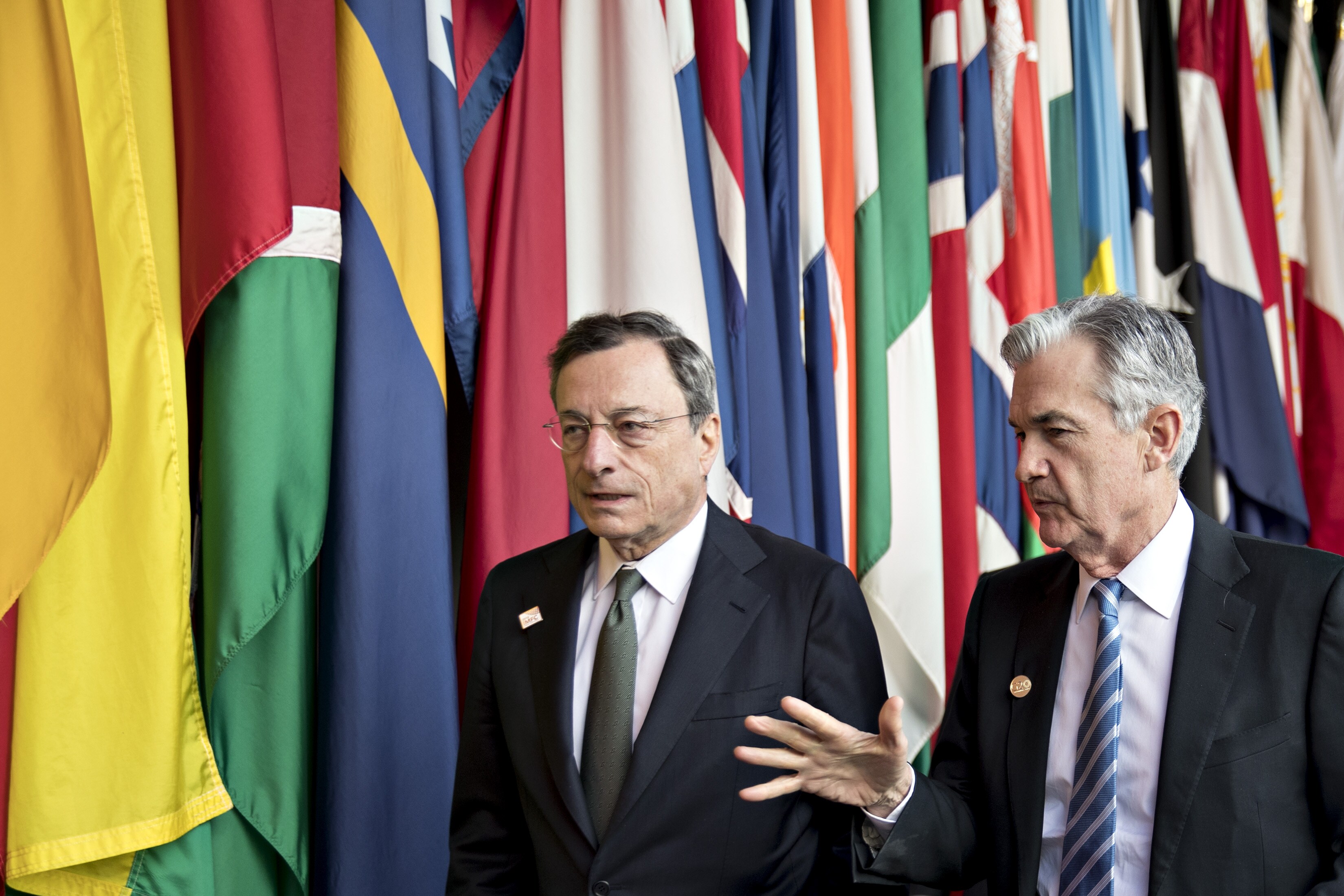
(Bloomberg) -- The world's most-powerful central bankers warned that escalating international trade tensions have started damaging confidence among companies, threatening the global economic expansion.
“Changes in trade policy could cause us to have to question the outlook,” Federal Reserve Chairman Jerome Powell said during a panel discussion at a European Central Bank conference in Sintra, Portugal. “For the first time, we're hearing about decisions to postpone investment, postpone hiring.”

His sentiment was echoed at Wednesday's event by Bank of Japan Governor Haruhiko Kuroda, ECB President Mario Draghi and Reserve Bank of Australia Governor Philip Lowe. Those four central banks set monetary policy for more than a third of the world's economy.
A trade war would be a headache for central banks given it would likely deal stagflationary blows to their economies by forcing consumer prices up and demand down. The policy makers would then be forced to decide whether to act to support growth or cap the inflationary pressures, for example by hiking interest rates.
U.S. President Donald Trump on Monday evening threatened to impose tariffs on another $200 billion of Chinese imports, prompting a response from Beijing warning of additional retaliation. The European Union also made good on a threat to hit American goods with retaliatory tariffs.
Draghi said it was still too early to measure a significant economic impact, but that he had begun worrying about an erosion of confidence, among both businesses and consumers.

“It's not yet time, in a sense, to see what the consequences on monetary policy of all this can be,” he said. “There's no ground to be optimistic on that.”
He added that there are lessons to be learned about trade conflict and protectionism from history, and “they're all very negative.” The burgeoning set of disputes was undermining “the multilateral framework that all of us have grown up with,” he said.
While Japan is not yet a target for new tariffs from the Trump administration, Kuroda said the indirect impact of the dispute could be to disrupt the network across East Asia that acts to supply Chinese industry.

“I really hope that this escalation could be rescinded, and a normal trading relationship between the U.S. and China would prevail,” he said. “This is a matter of great concern for Japan."
Australia's Lowe had, perhaps, the most dire warning. While trade tariffs alone probably wouldn't derail global growth, he said they could spark damaging market volatility and the postponement of business decisions.
.jpg "Philip Lowe, Governor, Reserve Bank of Australia. (Photographer: Sergio Dionisio/Bloomberg)")
“It wouldn't take that much for financial markets to combine with businesses that are waiting to turn this into a big global event,” he said. “I hope it has a low probability, but I'm very disturbed at what is happening.”
Australia is about to start free trade talks with the European Union, a sign that some economies are pushing for closer ties as the Trump administration pulls back.
“Can any of us think of a country that's made itself wealthier and boosted productivity growth by building walls? Probably not,” Lowe said. “I view what's happening as incredibly worrying.”
For now, market economists say the overall hit to economic growth from the trade dispute has been limited, though they caution that picture could change.
"So far, the economic damage is likely to be light," said Michael Every, head of financial markets research at Rabobank Group in Hong Kong. "Of course, it gets much worse if the trade war gets worse, but so far it's manageable."
Watch the conversation here.

-
Where You Live Shapes How You Get To Work | The Reason Why

Two-wheelers are the most popular way to get to work in India, accounting for nearly 43% of workplace commutes.
-
High US Salaries, No Green Card Certainty: The Financial Calculation Facing Indian H-1B Families
The suspension of PERM processing at eight technology employers does not cancel existing H-1B visas. What it does is force a question many Indian families have been avoiding: is the US salary worth tying your career and family plans to one employer?
-
Unhedged Position: Can India See An Indonesia-Style Time Correction?
The Nifty is trading below levels it first clocked in 2024. Is there, then, as I have suggested in the headline, potential that the current time correction drags on painfully for the next three-five, even ten years?
-
Navigating Friction And Energy Realities: An Analysis Of Marco Rubio's October Visit To India
Occurring at a critical juncture marked by stalled trade negotiations and escalating geopolitical pressures over global energy supplies, the visit offers a profound window into modern US-India relations.
-
India Exports Capital. Why Not Export Trusteeship?
The big question, then, is whether India can build an institution that global borrowers, investors, banks, and lawyers can trust, even without an Indian connection.
-
France's Economy & Politics Are In Crisis | The Reason Why
Let's look at how the French economy and politics evolved under Nicolas Sarkozy, Franois Hollande and Emmanuel Macron.
-
You May Inherit The Business. You Must Earn Its Credibility.
Succession tests the founder's ability to share authority as much as it tests the next generation's readiness to assume it.
-
Signing Deals Is One Thing; Making Them Work Is Another | The Week In Whys
Sometimes, things don't turn out as planned. Indian companies have lost some bids to rivals, some projects won't produce until 2030.
-
FOMC Wall, PERM Suspension, Hospital Stocks | Talking Points This Week
A PERM suspension would directly affect green-card sponsorship rather than H-1B visas, so the near-term earnings impact could remain relatively limited. The key question is whether this marks a new phase in US scrutiny of Indian IT.
-
Everything, Everywhere, All At Once: Dalal Street's Week To Forget | Joining The Dots
Visa curbs, a Starlink spat and cancer drug caps: what connects this week's shocks for Indian markets









