Japan’s Softer Economic Rebound Still Keeps BOJ Hike In Play

(Bloomberg) -- Japan's economy expanded in the second quarter at a pace slightly slower than the government's initial estimate, while still advancing enough to keep the Bank of Japan on track to raise interest rates later this year.
Japan's gross domestic product grew at an annualized pace of 2.9% in the three months through June compared with the previous quarter, the Cabinet Office said Monday. The result compared with a preliminary estimate of 3.1%. Private consumption and capital investment were both revised a tad lower.
In non-inflation adjusted terms, the economy advanced 1.8% from the previous quarter, and the data reaffirmed that the total value of the economy exceeded ¥600 trillion ($4.2 trillion) for the first time on record, a goal set a decade ago by policymakers in Japan.
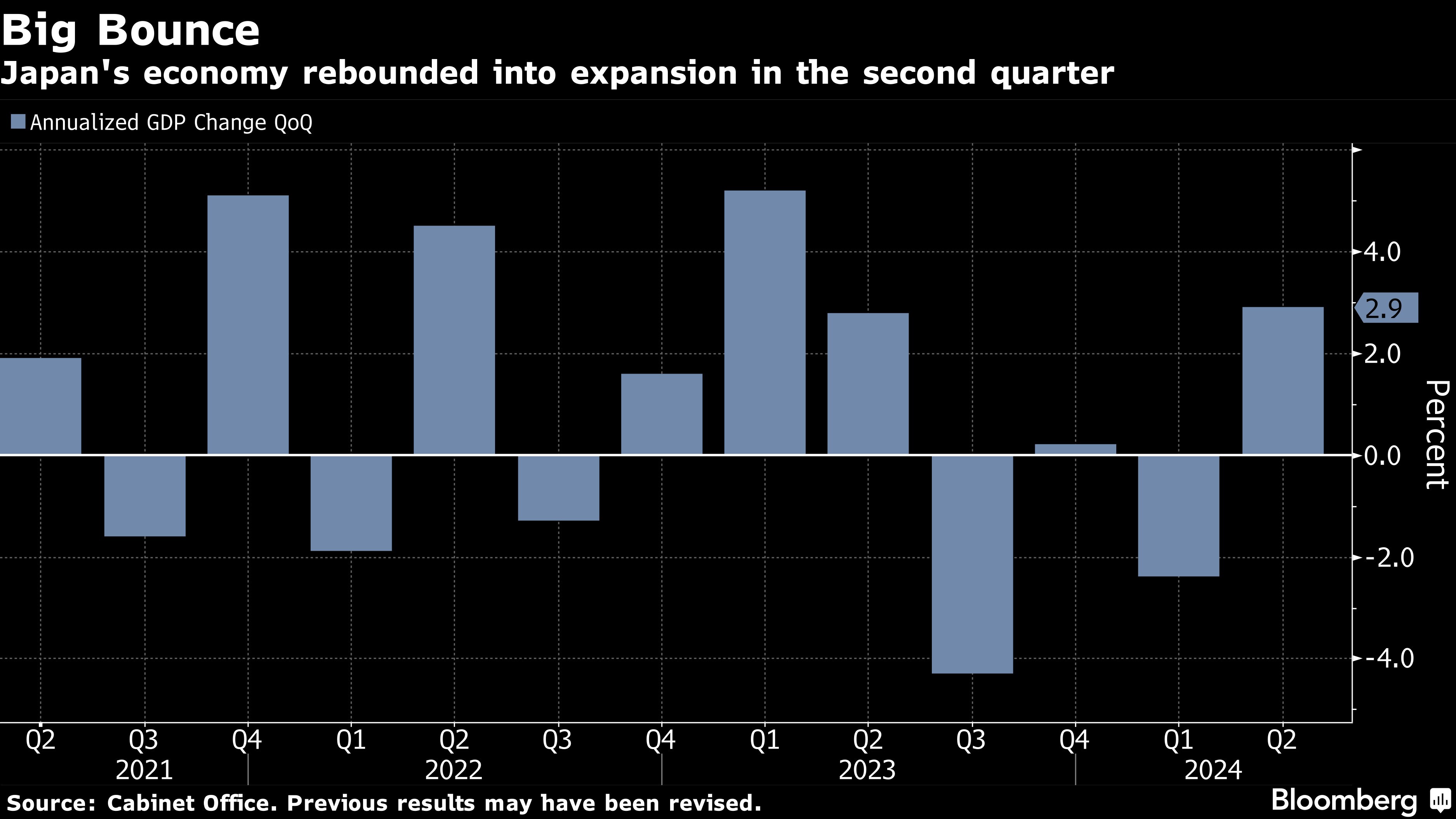
While the key domestic demand components were slightly downgraded, the overall results broadly support BOJ Governor Kazuo Ueda's view that a gradual recovery will continue. Almost no economists expect the central bank to adjust its benchmark rate when the policy board meets later this month, but many BOJ watchers forecast a rate move by January.
Monday's data confirmed that consumer spending grew 0.9% from the previous quarter in a sign of a recovery after it fell for four consecutive quarters through the end of March.
The revisions were largely within the margin for error and don't change the overall perception that the economy was in recovery last quarter, according to Takeshi Minami, chief economist at Norinchukin Research Institute.
“Today's data won't really affect the BOJ's policy stance,” Minami said. “They are unlikely to raise rates this month given unstable financial markets, but they have made it clear that a rate hike is in their mind so I think another hike within the year is possible.”
Still, some economists are skeptical about the resilience of consumer demand as households contend with persistent inflation for the first time in a generation. The key gauge of consumer inflation has stayed at or above the BOJ's 2% target for 28 months, with August data expected to extend that streak. While real wages have finally stopped falling after more than two years, consumer spending has stayed below pre-pandemic levels.
What Bloomberg Economics Says...
“Even with the downward revision to GDP, growth remained far above potential, which the Bank of Japan estimates at 0.6%. Along with hot inflation and strong pay growth, we keep our baseline forecast that the BOJ will look to hike rates again at its October meeting.”Taro Kimura, economist
The rebound in the economy was widely expected by economists after GDP contracted in the first three months of the year. Manufacturing during the period was undermined by a large earthquake northwest of Tokyo on New Year's Day and disruptions to auto output as a safety certification scandal forced some companies to temporarily shutter factory lines.
Concerns over cost of living and consumer demand will be on the minds of politicians vying to become Japan's next prime minister. The ruling Liberal Democratic Party's Sept. 27 leadership election is all but certain to determine Prime Minister Fumio Kishida's successor due to the party's dominance in parliament.
Toshimitsu Motegi, currently LDP secretary general and one of several candidates running in the party race, said last week he will compile an economic package if he wins the vote. Shinjiro Koizumi, one of the frontrunners in the leadership race, has also pledged to unveil a package should he become premier.
With the likelihood that demand from China and the US may cool as economic growth slows, Japan's consumer spending will be critical going forward, Minami said.
“Consumer spending may get stronger as wages are starting to rise,” he said. “At the same time, a recent rise in prices for rice and food may keep households in a saving mode.”
Japan's economy is expected to continue expanding this quarter, with economists looking for an annualized growth rate of 1.7%, according to the median estimate in a survey by Bloomberg last month. The pace would be well above the 1% that the central bank considers to be the top end of a range for the nation's potential growth rate. That indicates that economists expect inflationary pressure to persist as the BOJ keeps policy rates at the lowest level among major peers even after two rate hikes earlier this year.
The central bank will conclude its next policy meeting on Sept. 20, with the focus likely to fall on the prospects for another rate increase in October or December after the latest hike to 0.25% in July.
(Updates with economists' comments)

-
Love, Sex Aur Dhokha: The Audacious Plot To Spy On Jensen Huang

A Taipei dinner, a Singapore chip buyer and a suspected Chinese asset: inside the alleged spy operation that got close to NVIDIA's Jensen Huang.
-
Ten Things I Learnt This Samvat
Patience can be a trap. Cheap stocks can stay cheap. Leverage can wipe you out. What did Samvat 2082 teach us? Niraj Shah writes on 10 lessons from the year gone by.
-
Talking Points This Week: Tech Nerves, FII Buying, And A Faraway Banking Shock
The global markets are not shining this Diwali. The exception in the large markets is, India.
-
Midterm Rally Lasted A Day. The Hard Reality Of A Divided US May Last Two Years | Opinion
Between a contested AI boom, a debt ceiling that arrives in 2027 and a president with every incentive to act alone, the next two years may prove more volatile than the first day's rally suggests.
-
Blue Wave Will Derail the AI Trade but Won't Dismantle the AI Era | Unhedged Position
The Democrats' sweep of the US Congress will see politics collide with economic forces both over the long and short term.
-
It's Time To Take The GST Council's Bet On Trust Global
Payment records can prove India's services exports, and clear, proportionate rules can bring foreign digital sellers into the tax net.
-
Opinion | India at 38: From Innovation Overperformer to Innovation Powerhouse
India now has 453 VC-backed deep science startups, 18 of them late-stage, after 117 percent growth since 2020. Laurus Labs, at USD 9.3 billion, is the most valuable deep science company in any middle-income economy outside China.
-
Navigating Energy Crossroads: S Jaishankar's Call For Diversified Supply Chains At G20 Ministerial Meeting
As geopolitical fault lines continue to test maritime trade routes and commodity flows, Jaishankar's message remains pertinent: true economic resilience requires open markets, protected transit lines, and a genuine commitment to multilateral cooperation rather than coercion.
-
Indians Are Travelling, But Not Every Journey Is A Holiday | The Week In Whys
Pilgrims, patients and working women are the real travellers, and the system hasn't quite caught up with them.









