North Korea Fires Missile Over Japan For First Time Since 2017
(Bloomberg) -- North Korea fired a missile over Japan for the first time in five years, further ratcheting up tensions over Kim Jong Un's nuclear program and prompting a rare public safety warning to be issued by Tokyo.
The missile launched Tuesday splashed down in the Western Pacific about 3,200 kilometers east of Japan, officials in Tokyo said, adding there were no reports of damage. Japanese Prime Minister Fumio Kishida condemned the launch and South Korean President Yoon Suk Yeol warned of a “resolute response.”
The test represented the longest-range weapon fired by North Korea since May and hearkens back to the autumn of 2017 when Kim's regime unleashed its largest barrage of long-range rockets and detonated a nuclear bomb. That prompted then-US President Donald Trump to threaten to “totally destroy” North Korea and led the United Nations to impose some of its toughest sanctions to punish Kim.
North Korea launched the intermediate-range ballistic missile at 7:23 a.m. from Jagang province, South Korea's Joint Chiefs of Staff said Tuesday, adding that the rocket passed over Japan. It flew about 4,500 kilometers (2,800 miles) and reached an altitude of 970 kms, the JCS said. That's more than twice as high as the International Space Station.
“The United States strongly condemns the Democratic People's Republic of Korea's dangerous and reckless decision to launch a long-range ballistic missile over Japan,” US National Security Council spokesperson Adrienne Watson said in a statement, using North Korea's formal name. “This action is destabilizing and shows the DPRK's blatant disregard for United Nations Security Council resolutions and international safety norms.”
North Korea likely fired a Hwasong-12, Japanese Defense Minister Yasukazu Hamada said, referring to an intermediate-range missile with a range of about 4,500 kms. Joseph Dempsey, a weapons expert at the International Institute for Strategic Studies, said on Twitter that this was likely the missile's fifth successful test.
Asian defense-related companies gained in Tuesday trading in Tokyo and Seoul after the launch.
There may be further provocations to come amid warnings from the US, Japan and South Korea that Kim's regime is preparing to test a nuclear bomb. Kim has ignored US President Joe Biden's calls to return to stalled disarmament talks and has fired off ballistic missiles in defiance of a United Nations ban.
The provocations will likely add to global anxiety over nuclear saber-rattling as Russian President Vladimir Putin alludes to his atomic arsenal while attempting bolster his struggling invasion of Ukraine. The US's push to isolate Russia over the war -- coupled with increasing tensions between Washington and Beijing -- has allowed Kim to strengthen his nuclear deterrent without fear of new UN sanctions.
Russia or China vetoed a US-drafted sanctions resolution against North Korea at the UN Security Council in May and there's almost no chance of them supporting measures like they did in 2017. China fired its own ballistic missiles over Taiwan in August to protest US House Speaker Nancy Pelosi's visit to Taipei.

North Korea has not made any statements about its most recent tests in its official media, making it more difficult for the outside world to glean the intentions of the reclusive state. Kim has also been out of the public eye for more than three weeks.
The country's latest launches coincided with a visit to Japan and South Korea by US Vice President Kamala Harris in late September, as well as the arrival of the USS Ronald Reagan aircraft carrier group to South Korea for joint drills. These included an anti-submarine drill among the US, Japan and South Korea.
North Korea has bristled for decades at joint military exercises, calling them a prelude to an invasion.
“Given the US-Japan-ROK joint naval drills that took place last week, Pyongyang cannot help but to give a nod to Tokyo by firing a missile towards Japan as a warning that it's not only the US and South Korea at target, but Japan, as well,” said Soo Kim, a policy analyst with the Rand Corp. who previously worked at the Central Intelligence Agency.
South Korea's president said North Korea's nuclear and missile provocations would only further strengthen security cooperation in and outside the region, Yoon's office said in a statement. Seoul was also seeking “corresponding measures” to the launch, it said.
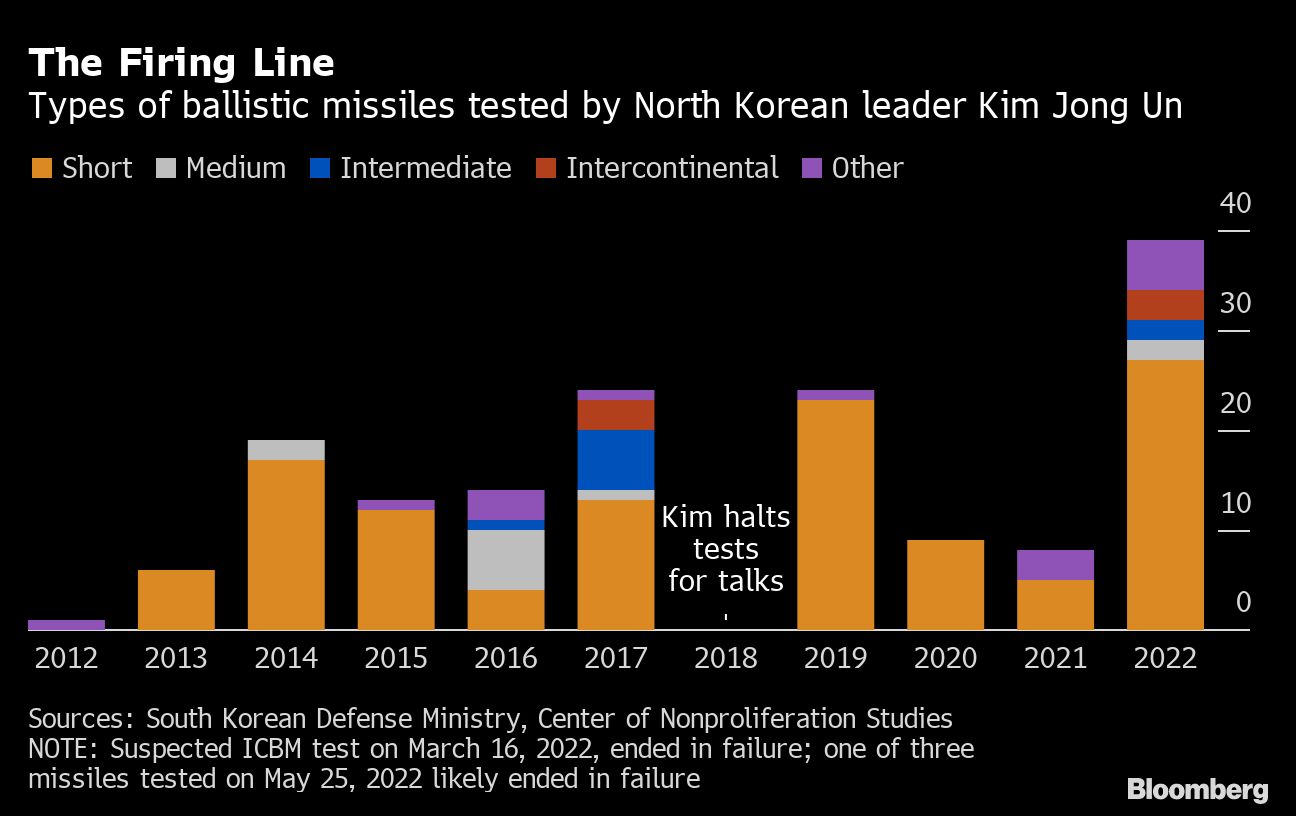
Kim Jong Un has fired off more ballistic missiles in 2022 than in any of his years in power. Pyongyang has been busy rolling out newer missile systems designed to use high speed and maneuverability to evade US-operated interceptors and carry a warhead to the US mainland, as well as to its bases in Asia.
Shortly after the latest launch, the Japanese government broadcast a notice to the public that a North Korean missile was heading toward the northern part of the country.
“A missile has been launched, a missile has been launched,” were among some of the warnings read by broadcasters with television screens showing stark white text on a black background. It warned residents of less populated areas of some remote islands -- part of Tokyo as well as Hokkaido and Aomori prefectures -- to take shelter from a missile fired from North Korea.
(Updates with US response in fifth paragraph.)
More stories like this are available on bloomberg.com
©2022 Bloomberg L.P.

-
Love, Sex Aur Dhokha: The Audacious Plot To Spy On Jensen Huang

A Taipei dinner, a Singapore chip buyer and a suspected Chinese asset: inside the alleged spy operation that got close to NVIDIA's Jensen Huang.
-
Ten Things I Learnt This Samvat
Patience can be a trap. Cheap stocks can stay cheap. Leverage can wipe you out. What did Samvat 2082 teach us? Niraj Shah writes on 10 lessons from the year gone by.
-
Talking Points This Week: Tech Nerves, FII Buying, And A Faraway Banking Shock
The global markets are not shining this Diwali. The exception in the large markets is, India.
-
Midterm Rally Lasted A Day. The Hard Reality Of A Divided US May Last Two Years | Opinion
Between a contested AI boom, a debt ceiling that arrives in 2027 and a president with every incentive to act alone, the next two years may prove more volatile than the first day's rally suggests.
-
Blue Wave Will Derail the AI Trade but Won't Dismantle the AI Era | Unhedged Position
The Democrats' sweep of the US Congress will see politics collide with economic forces both over the long and short term.
-
It's Time To Take The GST Council's Bet On Trust Global
Payment records can prove India's services exports, and clear, proportionate rules can bring foreign digital sellers into the tax net.
-
Opinion | India at 38: From Innovation Overperformer to Innovation Powerhouse
India now has 453 VC-backed deep science startups, 18 of them late-stage, after 117 percent growth since 2020. Laurus Labs, at USD 9.3 billion, is the most valuable deep science company in any middle-income economy outside China.
-
Navigating Energy Crossroads: S Jaishankar's Call For Diversified Supply Chains At G20 Ministerial Meeting
As geopolitical fault lines continue to test maritime trade routes and commodity flows, Jaishankar's message remains pertinent: true economic resilience requires open markets, protected transit lines, and a genuine commitment to multilateral cooperation rather than coercion.
-
Indians Are Travelling, But Not Every Journey Is A Holiday | The Week In Whys
Pilgrims, patients and working women are the real travellers, and the system hasn't quite caught up with them.









