Jaishankar Says US' Move Towards Multipolarity Suits India’s Interests
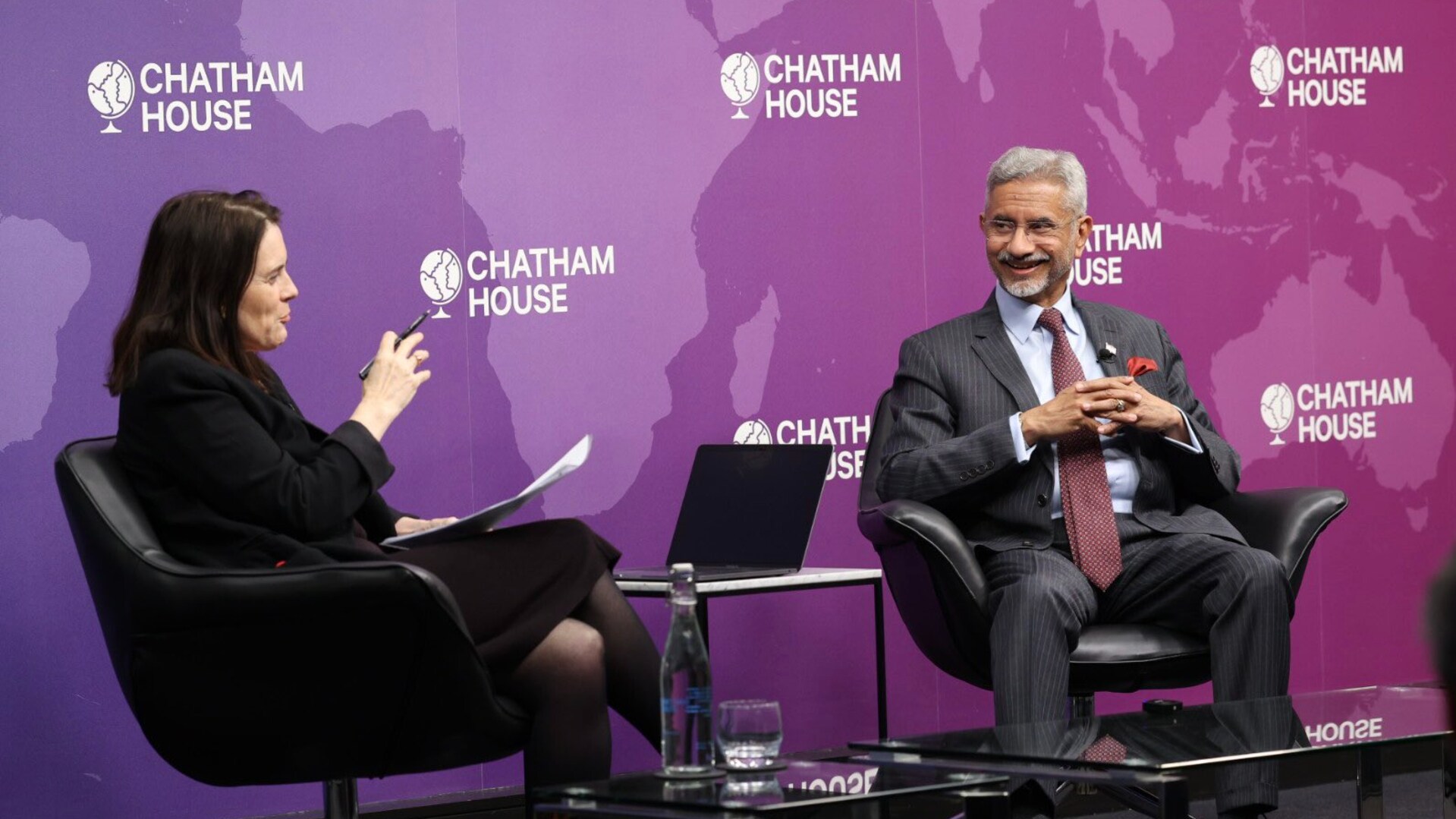
External Affairs Minister S Jaishankar said that the US under President Donald Trump is moving towards multipolarity and this suits India's interests.
Jaishankar, who is on a six-day visit to the UK and Ireland, was speaking at a session titled ‘India's rise and role in the world' at the Chatham House think-tank in London on Wednesday evening.
The various foreign policy topics that he discussed at the event included India's role in the ongoing Russia-Ukraine conflict, the trajectory of the BRICS grouping of nations and relations with China.
“We have been one of the few countries who have been regularly talking to both Moscow and Kyiv at various levels… Wherever there's been a sense that India can do something, we have always been open-minded about it. Our consistent position has been that they need to do direct negotiations,” he said.
On his thoughts about the first few weeks of the new US government, Jaishankar said, “We see a president and an administration which, in our parlance, is moving towards multipolarity and that is something that suits India.”
He added, “From President Trump's perspective, the one big shared enterprise that we have is the Quad, which is an understanding where everybody pays their fair share… There are no free riders involved. So that's a good model which works.”
The Quad alliance consists of the US, India, Australia and Japan.
On the specific issue of tariffs, the minister pointed that Commerce and Industry Minister Piyush Goyal is currently in Washington to discuss a bilateral trade pact, following discussions between Prime Minister Narendra Modi and President Trump at the White House last month.
“We had a very open conversation about it (tariffs) and the result of that conversation was that we agreed on the need for a bilateral trade agreement,” he said.
During the exchange with Chatham House Director Bronwen Maddox, he covered a broad spectrum of issues, including his “cautious optimism” over the India-UK free trade agreement negotiations after his ministerial discussions over the past few days.
“It's a very complicated process. So, given the complexity, it's natural that it would take time,” he said, adding, “From my discussions with Prime Minister (Keir) Starmer, Foreign Secretary David Lammy and (Business) Secretary Jonathan Reynolds, I got a consistent message that the British side is also interested in moving forward.”
While a “cautiously optimistic” Jaishankar hoped that the agreement doesn't take too long, he said that he has conveyed a few points “on behalf of my concerned colleagues as well”.
On China, the minister noted that there has been some positive developments since October 2024. This includes the opening of the Mount Kailash pilgrimage route in Tibet.
“We have a very, very unique relationship with China as the only 2 billion plus populated countries in the world,” he added. “We want a relationship where our interests are respected, sensitivities are recognised and works for both of us.”
When it came to an audience question on “solving” issues in Kashmir, Jaishankar stated, “On Kashmir, actually we have done, I think, a good job solving most of it.”
He said, “Removing Article 370 was step number one, restoring growth and economic activity and social justice in Kashmir was step number two, and holding elections with a very high turnout was step number three.”
Jaishankar added, “I think the part we are waiting for is the return of the stolen part of Kashmir which is under illegal Pakistani occupation; when that is done, I assure you Kashmir will be solved.”
—With PTI inputs

-
High US Salaries, No Green Card Certainty: The Financial Calculation Facing Indian H-1B Families

The suspension of PERM processing at eight technology employers does not cancel existing H-1B visas. What it does is force a question many Indian families have been avoiding: is the US salary worth tying your career and family plans to one employer?
-
Unhedged Position: Can India See An Indonesia-Style Time Correction?
The Nifty is trading below levels it first clocked in 2024. Is there, then, as I have suggested in the headline, potential that the current time correction drags on painfully for the next three-five, even ten years?
-
Navigating Friction And Energy Realities: An Analysis Of Marco Rubio's October Visit To India
Occurring at a critical juncture marked by stalled trade negotiations and escalating geopolitical pressures over global energy supplies, the visit offers a profound window into modern US-India relations.
-
India Exports Capital. Why Not Export Trusteeship?
The big question, then, is whether India can build an institution that global borrowers, investors, banks, and lawyers can trust, even without an Indian connection.
-
France's Economy & Politics Are In Crisis | The Reason Why
Let's look at how the French economy and politics evolved under Nicolas Sarkozy, Franois Hollande and Emmanuel Macron.
-
You May Inherit The Business. You Must Earn Its Credibility.
Succession tests the founder's ability to share authority as much as it tests the next generation's readiness to assume it.
-
Signing Deals Is One Thing; Making Them Work Is Another | The Week In Whys
Sometimes, things don't turn out as planned. Indian companies have lost some bids to rivals, some projects won't produce until 2030.
-
FOMC Wall, PERM Suspension, Hospital Stocks | Talking Points This Week
A PERM suspension would directly affect green-card sponsorship rather than H-1B visas, so the near-term earnings impact could remain relatively limited. The key question is whether this marks a new phase in US scrutiny of Indian IT.
-
Everything, Everywhere, All At Once: Dalal Street's Week To Forget | Joining The Dots
Visa curbs, a Starlink spat and cancer drug caps: what connects this week's shocks for Indian markets
-
India Is Going Abroad For Critical Minerals. But It May Take Years To Pay Off | The Reason Why
Although India's steps are in the right direction, they remain modest compared with India's growing dependence.









