India Progressed On One Of The Six World Bank Governance Indicators From 2007-2016

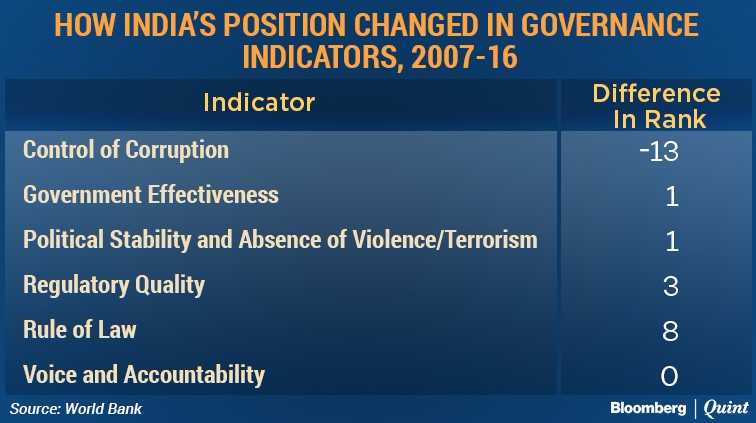
Except corruption, India's position on the World Bank's global governance indicators either worsened or remained unchanged in the 10 years leading to 2016, according to World Bank data.
India improved its ranking by 13 positions over the decade to 2016, moving to 111 from 124 among 214 regions on the World Bank's corruption indicator, released once every two years beginning 1996 and every year since 2003; fell by one position each on government effectiveness (to 90 from 89) and political stability (to 181 from 180), by eight positions on rule of law (to 100 from 92) and three positions on regulatory quality, and remained where it was on accountability of public institutions.
The six indicators are “strongly positively correlated” and “should not be thought of as being somehow independent of one another”, according to Daniel Kaufmann (president of Natural Resources Governance Institute, a global advocacy) and Aart Kraay and Massimo Mastruzzi (economists at World Bank), the researchers who put together the index.
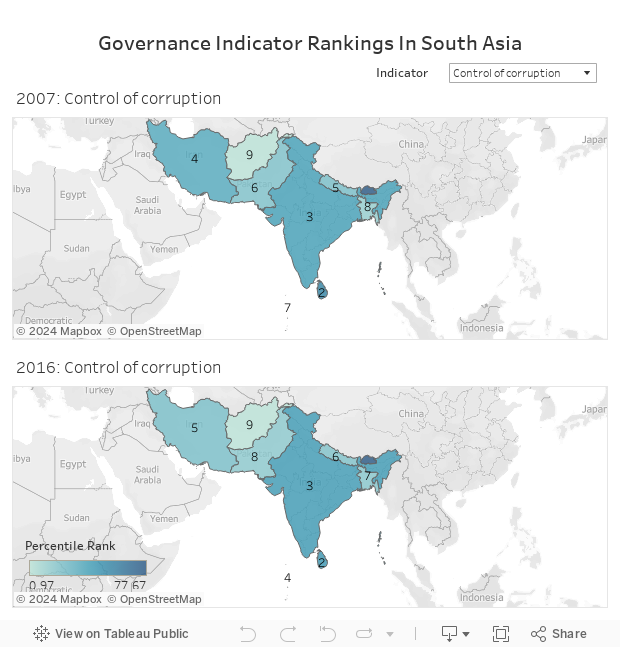
In south Asia, India fell by two positions on political stability from four to six among nine nations that included Afghanistan, Bangladesh, Bhutan, Iran, Maldives, Nepal, Pakistan and Sri Lanka.
India remained among the top three on all other indicators in the decade to 2016, remaining the best on accountability.
The World Bank's worldwide governance indicators report, beginning 1996, aggregate individual governance indicators for over 214 regions on six dimensions.
Control of corruption captures perceptions of the extent to which public power is exercised for private gain as well as “capture” of the state by elites and private interests.
Government effectiveness reflects perceptions of the quality of public services, the quality of the civil service and the degree of its independence from political pressures, the quality of policy formulation and implementation, and the credibility of the government's commitment to such policies.
Political stability and absence of violence measures perceptions of the likelihood of political instability and/or politically motivated violence, including terrorism.
Voice and accountability assesses perceptions of the extent to which a region's citizens are able to participate in selecting their government, as well as freedom of expression, freedom of association and a free media.
Regulatory quality captures perceptions of the ability of the government to formulate and implement sound policies and regulations that permit and promote private sector development.
Rule of law is concerned with perceptions of the extent to which agents have confidence in and abide by the rules of society, and in particular the quality of contract enforcement, property rights, the police, and the courts, as well as the likelihood of crime and violence.
This copy has been published in arrangement with IndiaSpend.

-
Navigating Friction And Energy Realities: An Analysis Of Marco Rubio's October Visit To India

Occurring at a critical juncture marked by stalled trade negotiations and escalating geopolitical pressures over global energy supplies, the visit offers a profound window into modern US-India relations.
-
India Exports Capital. Why Not Export Trusteeship?
The big question, then, is whether India can build an institution that global borrowers, investors, banks, and lawyers can trust, even without an Indian connection.
-
France's Economy & Politics Are In Crisis | The Reason Why
Let's look at how the French economy and politics evolved under Nicolas Sarkozy, Franois Hollande and Emmanuel Macron.
-
You May Inherit The Business. You Must Earn Its Credibility.
Succession tests the founder's ability to share authority as much as it tests the next generation's readiness to assume it.
-
Signing Deals Is One Thing; Making Them Work Is Another | The Week In Whys
Sometimes, things don't turn out as planned. Indian companies have lost some bids to rivals, some projects won't produce until 2030.
-
FOMC Wall, PERM Suspension, Hospital Stocks | Talking Points This Week
A PERM suspension would directly affect green-card sponsorship rather than H-1B visas, so the near-term earnings impact could remain relatively limited. The key question is whether this marks a new phase in US scrutiny of Indian IT.
-
Everything, Everywhere, All At Once: Dalal Street's Week To Forget | Joining The Dots
Visa curbs, a Starlink spat and cancer drug caps: what connects this week's shocks for Indian markets
-
India Is Going Abroad For Critical Minerals. But It May Take Years To Pay Off | The Reason Why
Although India's steps are in the right direction, they remain modest compared with India's growing dependence.
-
When Everyone Has AI, What Gives You An Edge?
India's young workforce is entering an uncertain world of work where powerful AI tools are becoming widely accessible. The advantage will belong to those who combine deep expertise with digital fluency, and the distinctly human capabilities that technology cannot manufacture.
-
Wrong Labels, High Pesticide Residues Holding Back Agri Exports | The Reason Why
India needs stronger domestic food-safety and labelling standards, with best practices becoming part of everyday business for farmers, traders and food companies.










