India Jumps Most In Global Competitiveness Ranking In 2016
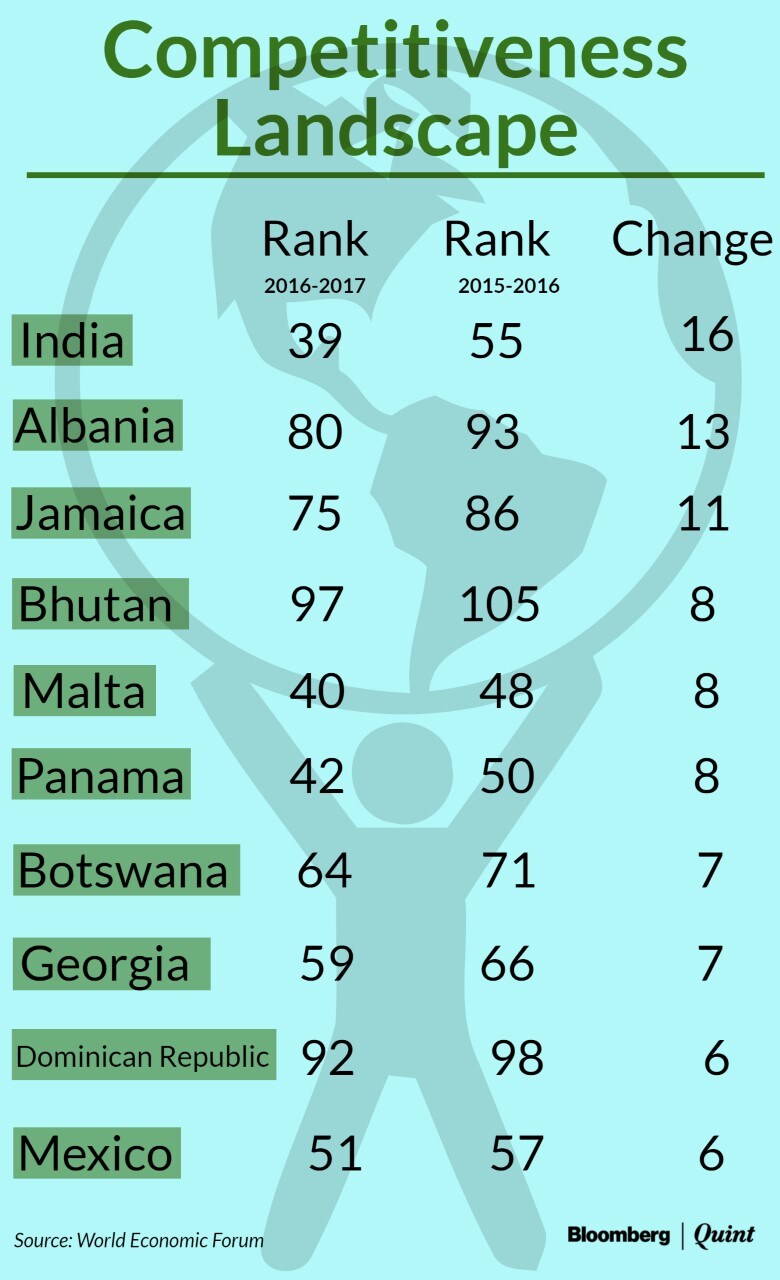
India climbed 16 notches for the second straight year to the 39th spot in a global index of the world's most competitive economies, where Switzerland remains on top. This is the biggest improvement by any country this year on the Global Competitiveness Index of the World Economic Forum (WEF).
The jump in India's ranking is reflective of “improved monetary and fiscal policies as well as lower oil prices” as a result of which the Indian economy has stabilised and now boasts the highest growth among G20 countries, the World Economic Forum said in its latest report.
India's competitiveness has improved across the board, in particular in goods market efficiency, business sophistication, and innovation.World Economic Forum's Global Competitiveness Report
The index was led by Switzerland, followed by Singapore, United States, Netherlands, and Germany.
India's performance on the index was in contrast to the world economy, where declining openness to international trade in goods and services is threatening growth and prosperity, the World Economic Forum said in a separate news release.
Declining openness in the global economy is harming competitiveness and making it harder for leaders to drive sustainable, inclusive growth,Klaus Schwab, Founder and Executive Chairman, World Economic Forum
Hits And Misses
Competitiveness is defined by the WEF as “the set of institutions, policies, and factors that determine the level of productivity of a country.” The concept has emerged in the recent years as a new model to measure economic development. WEF identifies twelve pillars or factors, that determine overall competitiveness.
India's ranking on public institutions saw an improvement of 18 notches this year, thanks to the government's efforts to add more transparency. India's public institutions were ranked at 42 with a score of 4.4 out of 7 from a list of 138 countries.
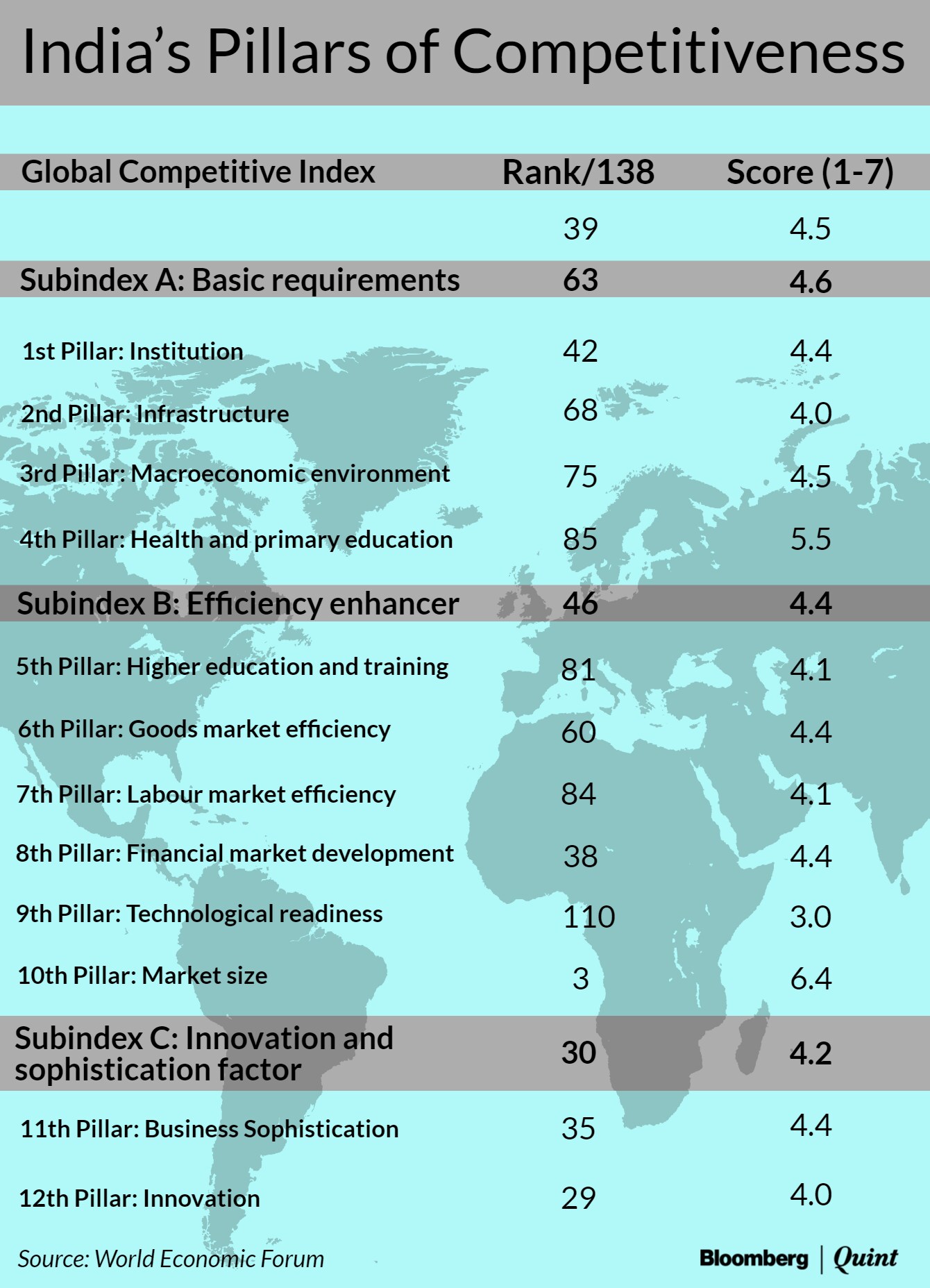
The most prominent improvement was seen in goods market efficiency where India's rank went up 31 places to 60th with a score of 4.4 out of 7, thanks to robust demand in the Indian market and competitive pricing by businesses.
On labour market efficiency, India ranked 84th among 138 countries, despite climbing 19 places on the index. The country's labour market is segmented between workers protected by rigid regulations and centralised wage determination, especially in the manufacturing sector, and millions of unprotected and informal workers, the report pointed out.
India's financial markets developed significantly, propelling the country about 15 places to the 38th spot on that index, with a score of 4.4. However, the market is still vulnerable to the growing concern of non-performing loans, which spiked for most banks in the country due to the Reserve Bank of India's new strategic debt restructuring mechanism.
India's position on the index of health and primary education fell a notch to 85th spot despite an improved score of 5.5 out of 7. Although life expectancy has increased it is still low by global standards, with India ranking only 106th in the world. India almost halved infant mortality but other countries did even better.
India faces challenges in two key areas – infrastructure and technological readiness. The country lagged at the 68th position despite jumping 13 places on the index as rural areas remained under-connected due to lack of necessary infrastructure. India was one of the worst ranked countries in terms of technological readiness. It was ranked at 110th with a score of 3.0 out of 7 due to delayed availability of latest technologies, slow internet bandwidths and low density of internet users as compared to the total population. Fewer than one in five Indians access the Internet on a regular basis, and fewer than two in five are estimated to own even a basic cell phone, the World Economic Forum said.
India's Biggest Headwinds
.png)
Tax regulations – especially the different levels of value added taxes – emerged as the biggest challenge to the efficiency of the domestic market, in an Executive Opinion Survey conducted by the WEF in which respondents were asked to select the five more problematic factors for doing business in the country.
The Goods and Services Tax regime, that is currently in the works, however, aims to do away with value-added taxes completely.
Large publicly-owned enterprises, especially in the utility and financial sectors, also deteriorate efficiency, respondents to the survey said.
Corruption, which was the most problematic factor for businesses in India last year, took second place in 2016.
Other issues that posed a challenge for business included high tax rates, poor public health, high inflation, and insufficient capacity for innovation.

-
High US Salaries, No Green Card Certainty: The Financial Calculation Facing Indian H-1B Families

The suspension of PERM processing at eight technology employers does not cancel existing H-1B visas. What it does is force a question many Indian families have been avoiding: is the US salary worth tying your career and family plans to one employer?
-
Unhedged Position: Can India See An Indonesia-Style Time Correction?
The Nifty is trading below levels it first clocked in 2024. Is there, then, as I have suggested in the headline, potential that the current time correction drags on painfully for the next three-five, even ten years?
-
Navigating Friction And Energy Realities: An Analysis Of Marco Rubio's October Visit To India
Occurring at a critical juncture marked by stalled trade negotiations and escalating geopolitical pressures over global energy supplies, the visit offers a profound window into modern US-India relations.
-
India Exports Capital. Why Not Export Trusteeship?
The big question, then, is whether India can build an institution that global borrowers, investors, banks, and lawyers can trust, even without an Indian connection.
-
France's Economy & Politics Are In Crisis | The Reason Why
Let's look at how the French economy and politics evolved under Nicolas Sarkozy, Franois Hollande and Emmanuel Macron.
-
You May Inherit The Business. You Must Earn Its Credibility.
Succession tests the founder's ability to share authority as much as it tests the next generation's readiness to assume it.
-
Signing Deals Is One Thing; Making Them Work Is Another | The Week In Whys
Sometimes, things don't turn out as planned. Indian companies have lost some bids to rivals, some projects won't produce until 2030.
-
FOMC Wall, PERM Suspension, Hospital Stocks | Talking Points This Week
A PERM suspension would directly affect green-card sponsorship rather than H-1B visas, so the near-term earnings impact could remain relatively limited. The key question is whether this marks a new phase in US scrutiny of Indian IT.
-
Everything, Everywhere, All At Once: Dalal Street's Week To Forget | Joining The Dots
Visa curbs, a Starlink spat and cancer drug caps: what connects this week's shocks for Indian markets
-
India Is Going Abroad For Critical Minerals. But It May Take Years To Pay Off | The Reason Why
Although India's steps are in the right direction, they remain modest compared with India's growing dependence.









