Davos 2024: IMF’s Gopinath Says Market Bets On Rate Cuts Are ‘Premature’
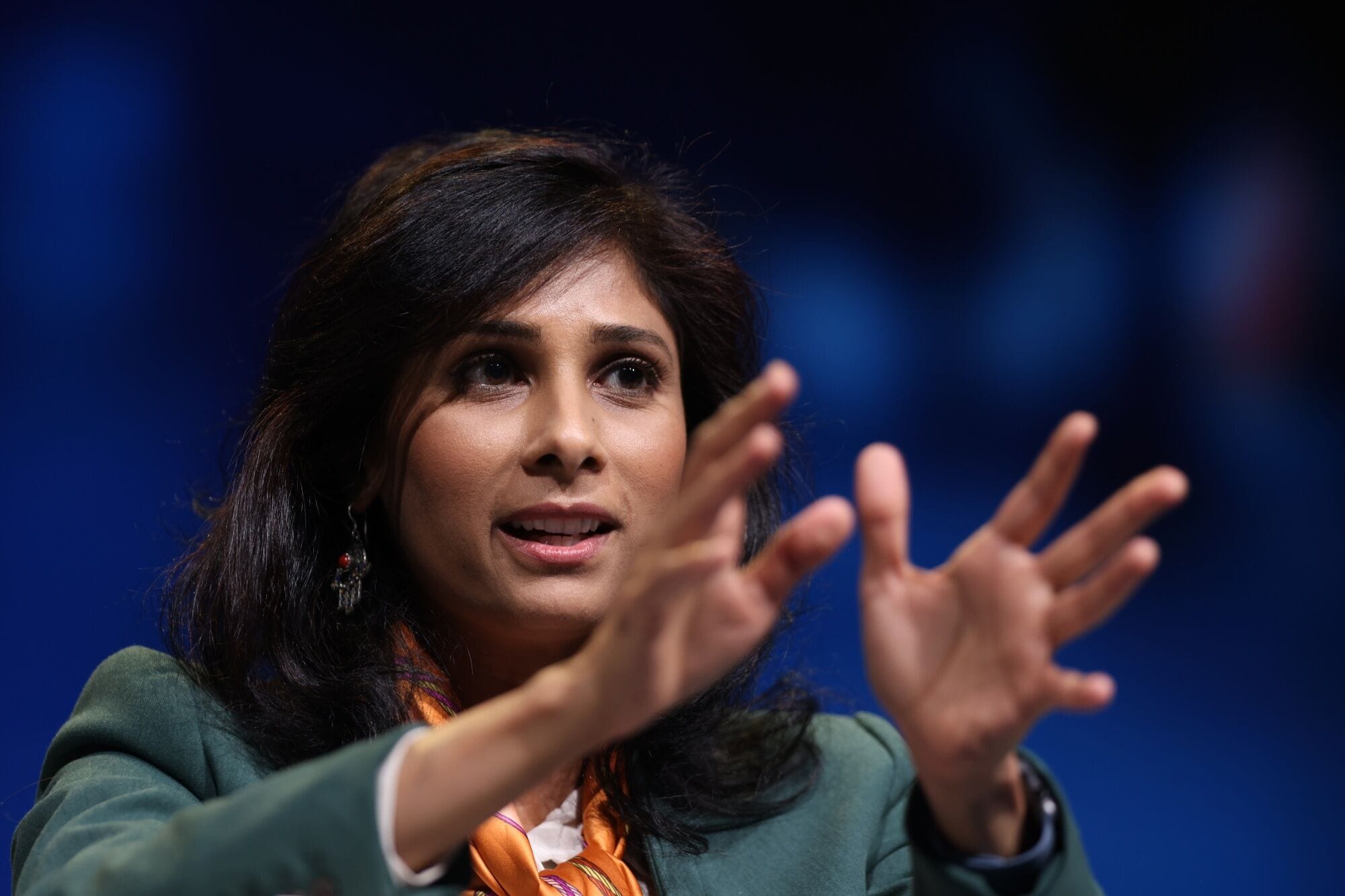
(Bloomberg) -- Market expectations for rapid interest-rate cuts are a bit premature because the battle against inflation isn't yet over, International Monetary Fund official Gita Gopinath said.
Speaking at the World Economic Forum in Davos, the fund's first deputy managing director said that even after sharp hikes in borrowing costs in the last two years, the job is still not done as labor markets remain tight on both sides of the Atlantic.
“The markets are expecting central banks to cut rates pretty aggressively — I think that's a bit premature to make that conclusion,” she said. “We should expect rates to come down some time this year, but based on the data we see right now, we expect this to be more likely in the second half of this year.”
Her remarks chime with those of global monetary officials who have pushed back on investor expectations for aggressive cuts in borrowing costs. Gopinath observed that economies are holding up in the face of tight conditions, making the chances of a deep recession less likely.
“We have households and corporations with stronger balance sheets and we've seen effects but we've also seen resilience; Labor markets are slowing but at a much more gradual pace,” she said. “We feel like a soft landing scenario — the probabilities have gone up quite a bit because we've had inflation come down without needing that much of a loss in terms of economic activity.”
In the longer term, Gopinath said policy rates will be on average higher than in the period after the global financial crisis, when central banks were trying to boost inflation.
Speaking on the same panel, European Central Bank Governing Council member Francois Villeroy de Galhau said economic transformations including the fight against climate change will mean higher rates in the longer term. He said the ECB's rates could be at a “new normal” around 2% on average through the cycle.
Villeroy refused to be drawn on when exactly the ECB will cut borrowing costs, after saying in recent weeks the first reductions in borrowing costs should come this year.
“It's too early to declare victory, I completely agree with Gita that the job is not yet done,” Villeroy said. Rates “shouldn't be higher than today and barring major surprises — we look at the Middle East — our next move will be a cut probably this year.”
He also agreed with Gopinath on the prospects for economic growth.
“What we can see on both sides of the Atlantic is something like a soft landing,” Villeroy said.
(Updates with soft landing comments in fifth paragraph)
More stories like this are available on bloomberg.com
©2024 Bloomberg L.P.

-
Midterm Rally Lasted A Day. The Hard Reality Of A Divided US May Last Two Years | Opinion

Between a contested AI boom, a debt ceiling that arrives in 2027 and a president with every incentive to act alone, the next two years may prove more volatile than the first day's rally suggests.
-
Blue Wave Will Derail the AI Trade but Won't Dismantle the AI Era | Unhedged Position
The Democrats' sweep of the US Congress will see politics collide with economic forces both over the long and short term.
-
It's Time To Take The GST Council's Bet On Trust Global
Payment records can prove India's services exports, and clear, proportionate rules can bring foreign digital sellers into the tax net.
-
Opinion | India at 38: From Innovation Overperformer to Innovation Powerhouse
India now has 453 VC-backed deep science startups, 18 of them late-stage, after 117 percent growth since 2020. Laurus Labs, at USD 9.3 billion, is the most valuable deep science company in any middle-income economy outside China.
-
Navigating Energy Crossroads: S Jaishankar's Call For Diversified Supply Chains At G20 Ministerial Meeting
As geopolitical fault lines continue to test maritime trade routes and commodity flows, Jaishankar's message remains pertinent: true economic resilience requires open markets, protected transit lines, and a genuine commitment to multilateral cooperation rather than coercion.
-
Indians Are Travelling, But Not Every Journey Is A Holiday | The Week In Whys
Pilgrims, patients and working women are the real travellers, and the system hasn't quite caught up with them.
-
Getting To Work Costs Women More | The Reason Why
It is not just about women paying more than men. It is about women paying much more in cities than in villages.
-
AI Bias In Investing Cannot Be Eliminated, But It Can Be Governed
Framing is a particularly important example as identical financial information presented in terms of gains rather than losses can lead an LLM to reach a different assessment.
-
Joining The Dots | Dark Skies, Steady Diya: Why Hope Holds This Diwali
With war, a weak rupee and foreign outflows weighing on sentiment, policymakers at the NDTV World Summit and market veterans at NDTV Profit Ignite: Diwali Edition offered the same advice: stay invested and filter out the noise.









