How The ECB Plans To Keep Markets In Check As It Hikes Rates

(Bloomberg) -- Less than three weeks before embarking on a series of interest-rate increases, the European Central Bank is honing its plans to keep government-bond markets from panicking as it does so.
A first line of defense against a sovereign-debt crisis akin to the one that struck the euro zone last decade became active on Friday. A new instrument to avoid so-called fragmentation — unwarranted blowouts in member states' yields — is due soon to enable the ECB to respond to record inflation.
Here's what we know about the central bank's two-pronged strategy:
Reinvesting Pandemic-Era Bond Holdings
Goal
- The ECB is determined to convince investors before rate hikes start that it's serious about ensuring an orderly normalization of monetary policy
How it will work
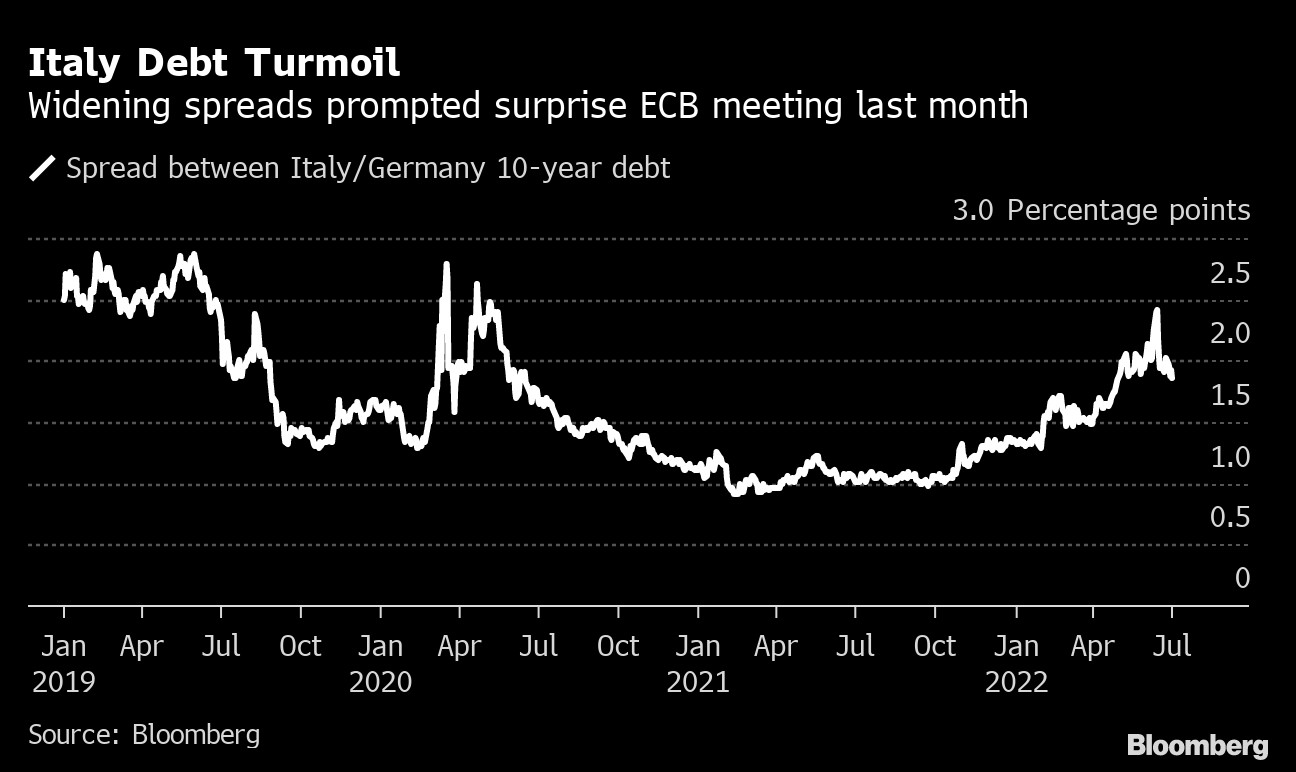
- The ECB will redirect the proceeds of maturing debt from the 1.7 trillion-euro ($1.8 trillion) portfolio it accumulated during the Covid-19 crisis to vulnerable countries like Italy, where yields surged last month
Size
- An average of 17 billion euros of bonds from the Pandemic Emergency Purchase Program expires each month. About 12 billion euros is from stronger nations and can be used to help struggling ones
Allocation
- The ECB is so far allowing wide leeway in deploying the funds. It's said to have divided countries into — including Germany, France and the Netherlands, — consisting of Italy, Greece, Spain and Portugal, and
- Stricter rules on who gets what may yet follow, determined by the size and speed of any shifts in yields. Greece, whose debt doesn't qualify for the regular quantitative-easing program, may get an outsized share if needed
Time frame
- PEPP reinvestments are scheduled to run until 2024, though that deadline can be extended. Front-loading — allocating funds before securities have matured — isn't being allowed for now
Anti-Fragmentation Instrument
Goal
- The tool will offer a more permanent solution allowing the ECB to raise rates as needed in a monetary union where fiscal policies diverge. “We will ensure that the orderly transmission of our policy stance throughout the euro area is preserved,” President Christine Lagarde said in June
How it will work
- Government bonds will be purchased when the yields of member-states are deemed to have risen in a way that isn't justified by their economic fundamentals
Timing
- Proposals are being drawn up for the Governing Council to “consider” at the July 20-21 meeting. The wording leaves open the option to postpone a decision if action isn't considered urgent or more work is required
Size
- Officials want a backstop with maximum potency — so it may never be used, like the program created alongside former ECB President Mario Draghi's 2012 pledge to do “whatever it takes” to save the euro. The upshot could be a plan that's unlimited in size
- The now defunct 2010 Securities Markets Program failed to rein in the region's debt crisis — partly because it had limits
Balance-sheet impact
- With other monetary stimulus now being removed, the ECB wants to avoid swelling the money supply with its latest initiative
- It could do so either through so-called liquidity-absorbing operations — where banks receive interest for parking money at the central bank for a set period of time; or, by selling other bonds in its portfolio — such as those of core countries like Germany
Conditionality
- There are likely to be strings attached to avoid accusations the ECB is financing governments outright, though they'll probably be less stringent than in Draghi's 2012 Outright Monetary Transactions plan, which required bailout programs no government was willing to request
- Conditions could include meeting targets and milestones set out in the European Union's pandemic recovery plan, adhering to certain fiscal rules, or both. The complication here is that the bloc's thresholds are currently suspended and some ECB officials are wary of having to judge national fiscal policy
Legal Issues Affecting Both
Faced with law suits on earlier ECB programs, asset purchases were ruled to be within the central bank's remit partly because they were evenly distributed across the region — something that wouldn't be the case here
Policy makers have already stressed that whatever they'll decide will be proportionate, focusing on a term Germany's constitutional court used when it challenged the ECB's 2015 QE plan
- That means any defense will probably be built around the argument that bond-buying is necessary for the ECB to fulfill its primary objective — preserving price stability across the euro zone
Read more...
ECB's High-Wire Act to Deliver Rate Liftoff Enters Final Stretch
Lagarde's Moment of ECB Crisis Reckoning, in a London Basement
Why the ECB Needs New Tools for Bond ‘Fragmentation': QuickTake
ECB's Panetta Says Beating Fragmentation Key for ‘All Euro Area'
More stories like this are available on bloomberg.com
©2022 Bloomberg L.P.

-
A New Samvat Wishlist: Inclusive Prosperity And Human Development

India has strengthened its economic foundations through infrastructure, digital access and enterprise. Its next growth chapter must deepen productivity, create better livelihoods and widen participation in prosperity.
-
Love, Sex Aur Dhokha: The Audacious Plot To Spy On Jensen Huang
A Taipei dinner, a Singapore chip buyer and a suspected Chinese asset: inside the alleged spy operation that got close to NVIDIA's Jensen Huang.
-
Ten Things I Learnt This Samvat
Patience can be a trap. Cheap stocks can stay cheap. Leverage can wipe you out. What did Samvat 2082 teach us? Niraj Shah writes on 10 lessons from the year gone by.
-
Talking Points This Week: Tech Nerves, FII Buying, And A Faraway Banking Shock
The global markets are not shining this Diwali. The exception in the large markets is, India.
-
Midterm Rally Lasted A Day. The Hard Reality Of A Divided US May Last Two Years | Opinion
Between a contested AI boom, a debt ceiling that arrives in 2027 and a president with every incentive to act alone, the next two years may prove more volatile than the first day's rally suggests.
-
Blue Wave Will Derail the AI Trade but Won't Dismantle the AI Era | Unhedged Position
The Democrats' sweep of the US Congress will see politics collide with economic forces both over the long and short term.
-
It's Time To Take The GST Council's Bet On Trust Global
Payment records can prove India's services exports, and clear, proportionate rules can bring foreign digital sellers into the tax net.
-
Opinion | India at 38: From Innovation Overperformer to Innovation Powerhouse
India now has 453 VC-backed deep science startups, 18 of them late-stage, after 117 percent growth since 2020. Laurus Labs, at USD 9.3 billion, is the most valuable deep science company in any middle-income economy outside China.
-
Navigating Energy Crossroads: S Jaishankar's Call For Diversified Supply Chains At G20 Ministerial Meeting
As geopolitical fault lines continue to test maritime trade routes and commodity flows, Jaishankar's message remains pertinent: true economic resilience requires open markets, protected transit lines, and a genuine commitment to multilateral cooperation rather than coercion.









