How Much Has The Rupee Really Depreciated?

The fall in the Indian currency has been the subject of much debate this year. The depreciation, the response to it and its implications have been discussed threadbare.
But economists, including those on India's monetary policy committee, still differ on the best benchmark to use to understand the depreciation in the rupee and, consequently, the appropriate policy response to it.
The Spot Rate
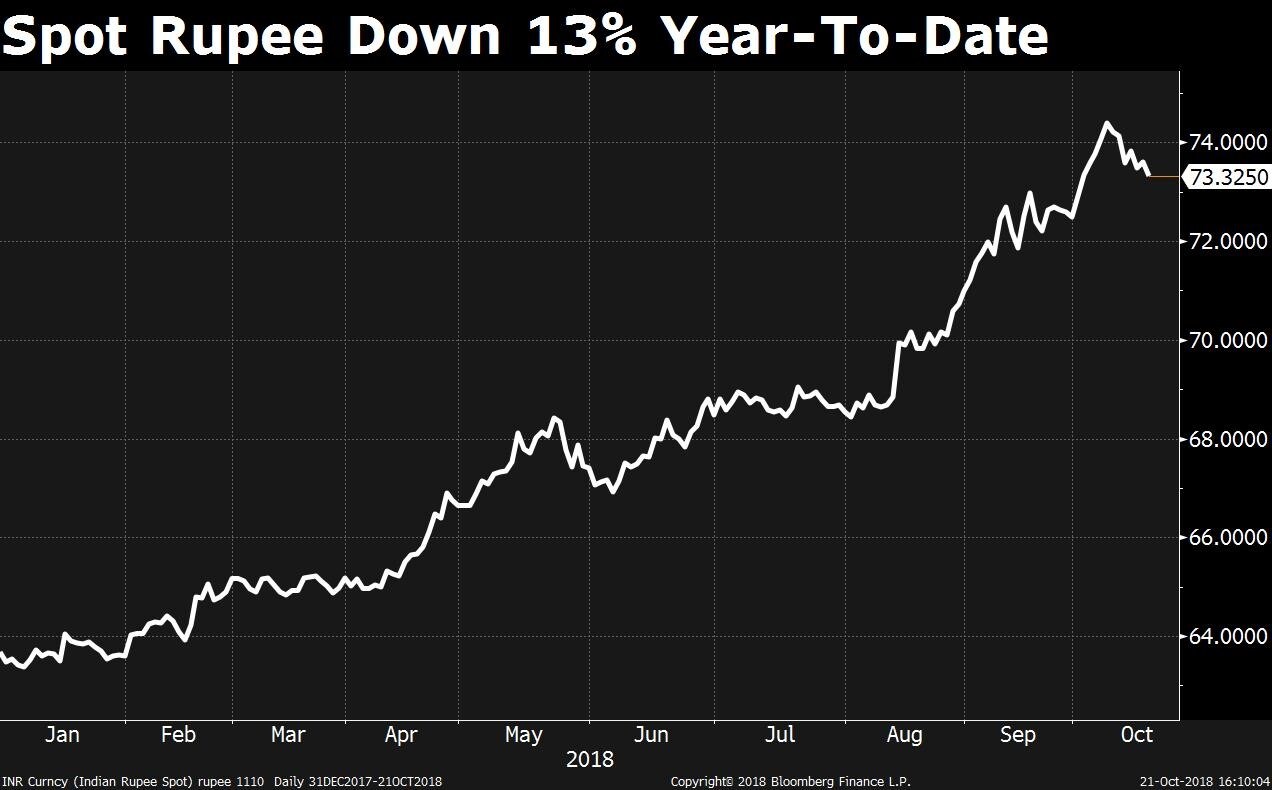
The most commonly used measure is the spot rate for the rupee. It trades every day. Everyone can see how much the rupee gains or falls. Reactions follow.
For the year-to-date, the rupee has fallen 13 percent, in response to higher oil prices and foreign portfolio outflows.
This fall, one of the steepest seen in recent years, has prompted fears of inflation risks, among other things.
MPC member Chetan Ghate flagged off this fall as one of the upside risks to inflation. Citing already rising inflation expectations, Ghate said this, together with a weaker rupee and higher oil prices, could lead to unhinging inflationary expectations.
What makes these cumulative increases in inflationary expectations salient, is that they risk being unanchored by both the 7 percent nominal depreciation in the INR and the $13 a barrel increase in the price of oil, since the August 2018 policy.Chetan Ghate, Member, Monetary Policy Committee
The MPC, in its October policy, chose to keep interest rates unchanged despite calls for higher rates as a way to narrow the current account deficit and protect the rupee fall. By raising rates, the MPC can curtail aggregate demand, which in turn can help reduce imports and narrow the current account gap.
Along with keeping rates unchanged, RBI Deputy Governor Viral Acharya also suggested that the central bank was not particularly uncomfortable with the fall in the rupee. “...exchange rate adjustment is an important part of how your economy adjusts to trade shocks,” Acharya said in the post-policy press conference on October 5.
The Nominal Effective Exchange Rate
One reason why some policymakers are comfortable with the fall in the rupee is that its fall is not isolated.
Sure, the rupee is the worst performing currency in Asia this year but other emerging market currencies have also fallen. The steeper fall in the rupee may be partly an adjustment for the relatively stable exchange rate over the last few years.
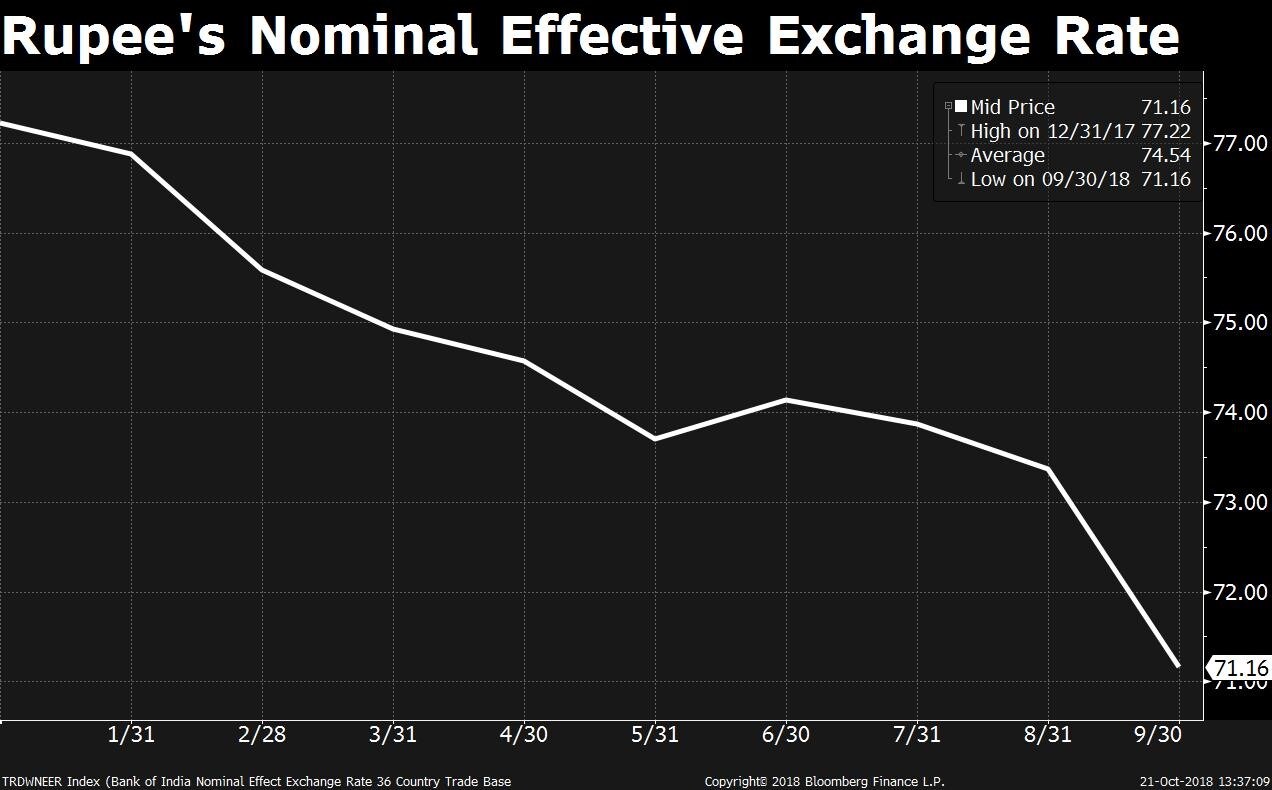
MPC member Ravindra Dholakia said that a better way to look at the rupee depreciation is to look at Nominal Effective Exchange Rate against a basket of currencies of India's trade partners.
The 36-country NEER index of the RBI shows a roughly 8 percent decline so far this year, according to Bloomberg data.
While there is a considerable depreciation of Indian Rupee against U.S. Dollar recently, the rate of depreciation is substantially lower in terms of trade-weighted Nominal Effective Exchange Rate, because other currencies have also depreciated against U.S. Dollar. It is the depreciation in NEER that affects headline inflation. As a result, its impact on inflation is not likely to be very substantial.Ravindra Dholakia, Member, Monetary Policy Committee
The Real Effective Exchange Rate
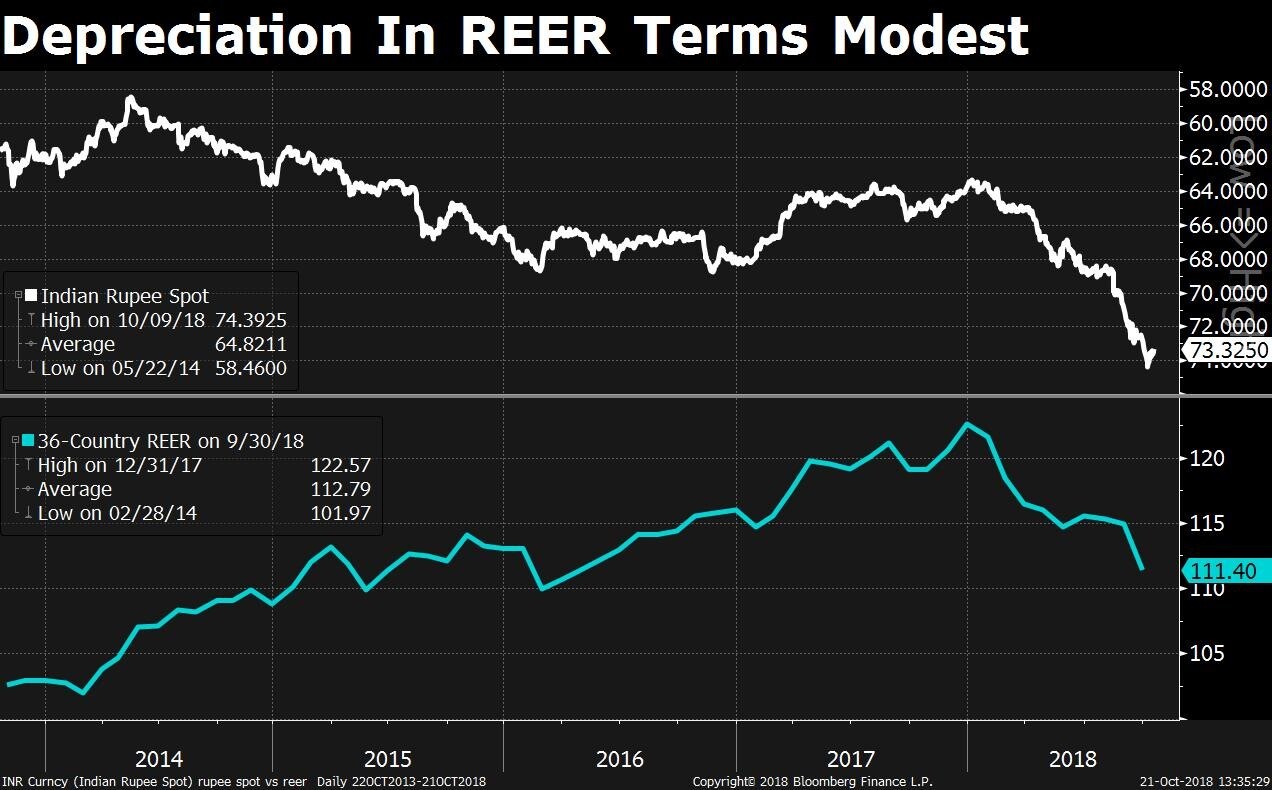
A third way to look at the rupee depreciation is the real effective exchange rate. The REER index takes the Nominal Effective Exchange Rate and adjusts it for inflation.
The 36-country REER index shows that the rupee, by this measure, has depreciated about 9 percent.
Citing the relatively lower depreciation in the REER when compared to spot exchange rate, brokerage house CLSA said that further depreciation in the spot exchange rate can't be ruled out just yet.
Some economists believe that, in the present context of a widening current account deficit, a fall in the REER would be important to boost export competitiveness.
“All else being constant, a close to 12 percent depreciation in the real effective exchange rate can indeed stabilise the current account deficit,” said Pranjul Bhandari, chief India economist at HSBC in a report analysing India's balance of payments released earlier this month.
The Right Policy Response
The measure of currency depreciation used by the RBI would be important in determining its response. Should the central bank feel that the depreciation in the NEER is not significant, it may limit its response to intervention via its foreign exchange reserves. That has been the preferred response so far.
In the post-policy press conference, RBI Governor Urjit Patel highlighted that the depreciation in the Indian currency is in line with the trend across emerging markets.
However, should markets overextend and the fall in the REER and NEER start looking excessive, the RBI may consider other options such as an NRI bond or a foreign currency deposit scheme.

-
Talking Points This Week: Tech Nerves, FII Buying, And A Faraway Banking Shock

The global markets are not shining this Diwali. The exception in the large markets is, India.
-
Midterm Rally Lasted A Day. The Hard Reality Of A Divided US May Last Two Years | Opinion
Between a contested AI boom, a debt ceiling that arrives in 2027 and a president with every incentive to act alone, the next two years may prove more volatile than the first day's rally suggests.
-
Blue Wave Will Derail the AI Trade but Won't Dismantle the AI Era | Unhedged Position
The Democrats' sweep of the US Congress will see politics collide with economic forces both over the long and short term.
-
It's Time To Take The GST Council's Bet On Trust Global
Payment records can prove India's services exports, and clear, proportionate rules can bring foreign digital sellers into the tax net.
-
Opinion | India at 38: From Innovation Overperformer to Innovation Powerhouse
India now has 453 VC-backed deep science startups, 18 of them late-stage, after 117 percent growth since 2020. Laurus Labs, at USD 9.3 billion, is the most valuable deep science company in any middle-income economy outside China.
-
Navigating Energy Crossroads: S Jaishankar's Call For Diversified Supply Chains At G20 Ministerial Meeting
As geopolitical fault lines continue to test maritime trade routes and commodity flows, Jaishankar's message remains pertinent: true economic resilience requires open markets, protected transit lines, and a genuine commitment to multilateral cooperation rather than coercion.
-
Indians Are Travelling, But Not Every Journey Is A Holiday | The Week In Whys
Pilgrims, patients and working women are the real travellers, and the system hasn't quite caught up with them.
-
Getting To Work Costs Women More | The Reason Why
It is not just about women paying more than men. It is about women paying much more in cities than in villages.
-
AI Bias In Investing Cannot Be Eliminated, But It Can Be Governed
Framing is a particularly important example as identical financial information presented in terms of gains rather than losses can lead an LLM to reach a different assessment.









