Saola Departs Hong Kong After Bringing Destructive Winds
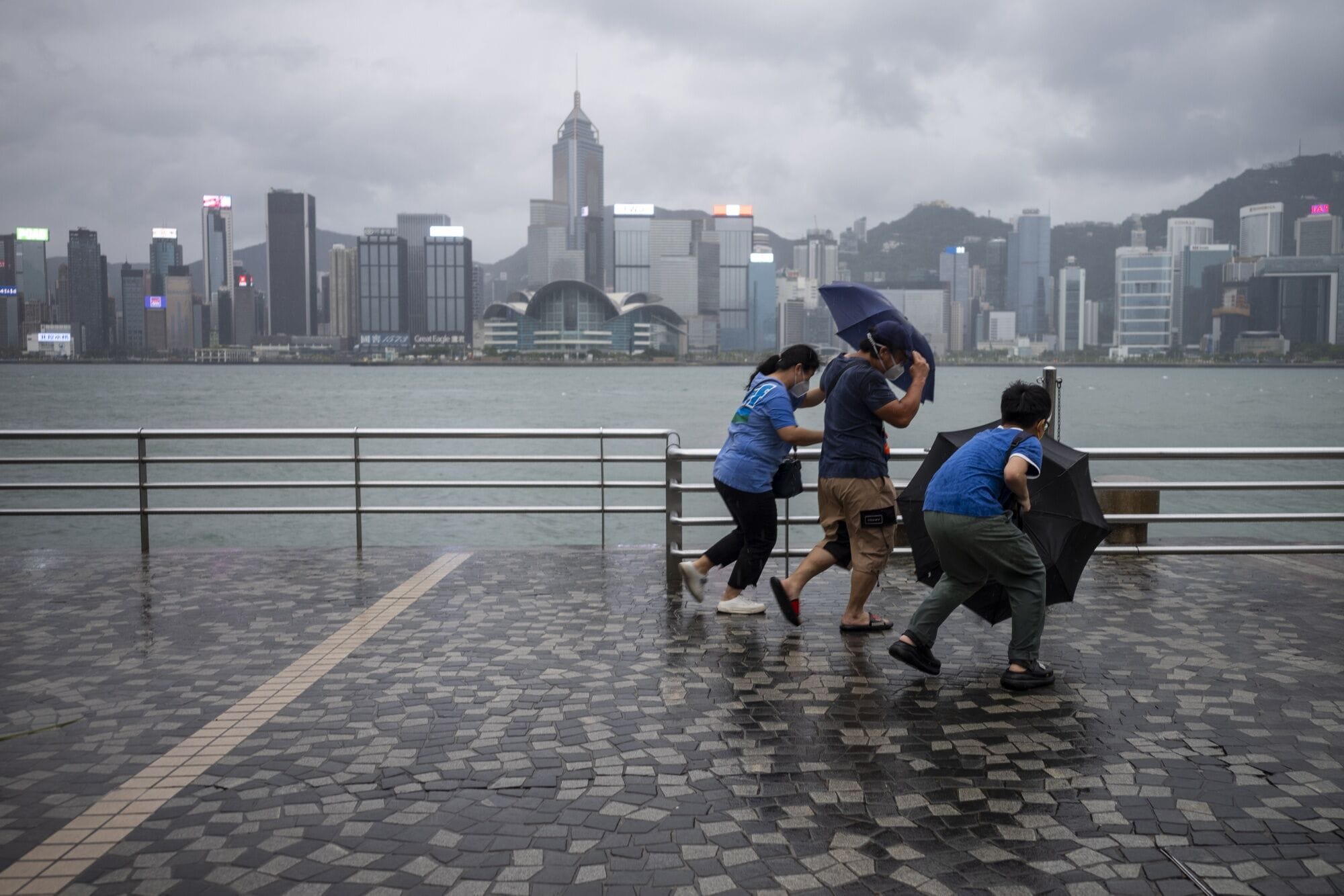
(Bloomberg) -- Severe Typhoon Saola began to weaken and gradually depart Hong Kong, after bringing hurricane-force winds and heavy rain to the territory.
The Hong Kong Observatory lowered its storm warning from the highest No. 10 level to the No. 8 signal at 3:40 a.m. Saturday, according to its latest bulletin. Authorities expect to maintain the current storm signal until at least 12 p.m., warning that gales force winds are still affecting many places and that seas will still be very rough with swells.

The stock market was closed Friday in advance of the storm's arrival and school was suspended through Saturday. Most public transportation was grounded. The government said it received dozens of reports of downed trees and 12 confirmed reports of flooding, while 55 people sought treatment at public hospitals during the typhoon.
Maximum sustained winds reached 99 kilometers per hour (62 mph) in some areas during the past hour, according to the local observatory's latest bulletin. Saola earlier sustained winds of 210 km/h near the center, as strong as a Category 4 hurricane on the Saffir-Simpson wind scale.
The storm, the strongest to affect Hong Kong since at least Mangkhut in 2018, is a major test for Chief Executive John Lee's government. Mangkhut provoked public criticism after roads remained blocked for days by some of the tens of thousands of trees toppled by the typhoon and people struggled to get to work.
As of about 7 a.m., Saola was centered about 140 km west-southwest of Hong Kong, after earlier reaching as close as 30 kilometers south-southwest, the observatory said. Mangkhut was 100 kilometers away from the city at its closest point.
In nearby Macau, a Chinese-speaking island that is the world's biggest gambling hub, the government ordered all casinos to shut after raising its storm warning level to T10. The city's casinos are generally open 24 hours a day and previously were shut at the height of the Covid pandemic and in 2018 when Mangkhut hit. The storm signal was subsequently lowered to No. 8 at 6 a.m., the local Meteorological and Geophysical Bureau said.
Hong Kong Chief Secretary Chan Kwok-ki, who is leading the government's task force to deal with the storm, warned residents to stay indoors.
“This can be a very destructive typhoon,” he said Thursday. “We hope to minimize the damage.”
Read more: Only Plane Flying to Hong Kong Lands in Middle of Super Typhoon
In the past 40 years, only five storms have prompted the raising of the highest signal in Hong Kong, according to observatory data. The No. 10 signal means hurricane force winds reaching a sustained speed of at least 118 km/h.
A total of 460 flights out of 850 passenger flights to and from Hong Kong were canceled Friday, according to the local airport authority. Cathay Pacific Airways Ltd., the city's flag carrier, halted all Hong Kong flights until 10 a.m. Saturday.
Inner-harbor and outlying islands ferry services were suspended, along with all bus services.
Nearby Shenzhen airport halted all flights from noon, the airport operator said. Businesses closed from 4 p.m., while transport would stop three hours later, the government said. Trains traveling to and from Guangdong province would be halted from 8 p.m. Friday until Saturday evening.
Read more: How Hurricanes Are Categorized on an Imperfect Scale: QuickTake
The Hong Kong exchange halted stock trading, which is required when Signal No. 8 or above is in place. Trading halts due to severe weather are seen as increasingly antiquated given that the global finance industry adjusted to remote working during the pandemic.
With most orders now received and executed electronically, the case is growing for Hong Kong to ensure continuous trading in bad weather. Financial Secretary Paul Chan said earlier this year that the city will explore arrangements to allow stock trading under severe weather.
China's national weather authorities reiterated their highest alert for the typhoon on Friday morning. They warned of severe weather in the coastal provinces of Fujian and Guangdong, and urged local officials to be ready for flash flooding.
China dealt with several bouts of extreme weather this summer, with dozens of deaths in northern areas including Beijing that were caused by flooding from Typhoon Doksuri.
Another storm is expected to affect Taiwan and eastern China in the coming days. Severe tropical storm Haikui has now intensified into a typhoon and is moving west from Okinawa in Japan and is expected to move close to northern Taiwan on Saturday evening or Sunday morning before making landfall in mainland China near Fuzhou.
Currency and fixed income markets in the Philippines were closed on Friday after government offices including the central bank were shut due to monsoon rains enhanced by Saola and other storms.
--With assistance from Dominic Lau, Olivia Tam, Alfred Liu, K. Oanh Ha, Jing Li, Philip Glamann, Filipe Pacheco, Lin Cheng, Jacob Gu, Danny Lee and Luz Ding.
(Updates with new details on flooding and people seeking medical treatment)
More stories like this are available on bloomberg.com
©2023 Bloomberg L.P.

-
Navigating Energy Crossroads: S Jaishankar's Call For Diversified Supply Chains At G20 Ministerial Meeting

As geopolitical fault lines continue to test maritime trade routes and commodity flows, Jaishankar's message remains pertinent: true economic resilience requires open markets, protected transit lines, and a genuine commitment to multilateral cooperation rather than coercion.
-
Indians Are Travelling, But Not Every Journey Is A Holiday | The Week In Whys
Pilgrims, patients and working women are the real travellers, and the system hasn't quite caught up with them.
-
Getting To Work Costs Women More | The Reason Why
It is not just about women paying more than men. It is about women paying much more in cities than in villages.
-
AI Bias In Investing Cannot Be Eliminated, But It Can Be Governed
Framing is a particularly important example as identical financial information presented in terms of gains rather than losses can lead an LLM to reach a different assessment.
-
Joining The Dots | Dark Skies, Steady Diya: Why Hope Holds This Diwali
With war, a weak rupee and foreign outflows weighing on sentiment, policymakers at the NDTV World Summit and market veterans at NDTV Profit Ignite: Diwali Edition offered the same advice: stay invested and filter out the noise.
-
The Curious Case of Equitas Small Finance Bank And A CEO Who Quit For Stock
PN Vasudevan believes persistent investor concerns over a perceived conflict of interest had become a governance overhang on Equitas Small Finance Bank's stock, even as the lender improved profitability and asset quality.
-
Talking Points This Week: AI Cash Burn, A Tiger Comeback And An India That Still Finds Its Own Path
India is not immune to higher oil or tighter global liquidity, yet its earnings base is broader, its domestic policy levers are still available.
-
Foreign Investors Own Half Of HDFC Bank and ICICI Bank. An LTCG Cut Could Matter Most Here
Foreign portfolio investors have US$115 billion parked in HDFC Bank, ICICI Bank. If the government cuts long-term capital gains tax, Jefferies says returning foreign money could land here first.
-
'Never Seen This Level Of Negativity': Sandeep Tandon Says The Next Rally May Be Closer Than You Think
Veteran investor Sandeep Tandon says foreign selling is easing, large-caps are due a comeback and mid-caps are crowded, while he turns positive on gold, power and pharma this Diwali.
-
Indians Stay With Family, Not In Hotels | The Reason Why
India still lacks enough clean, reliable and affordable hotels for budget-conscious travellers.










