Hong Kong Shuts Stock Market, Schools As Super Typhoon Nears
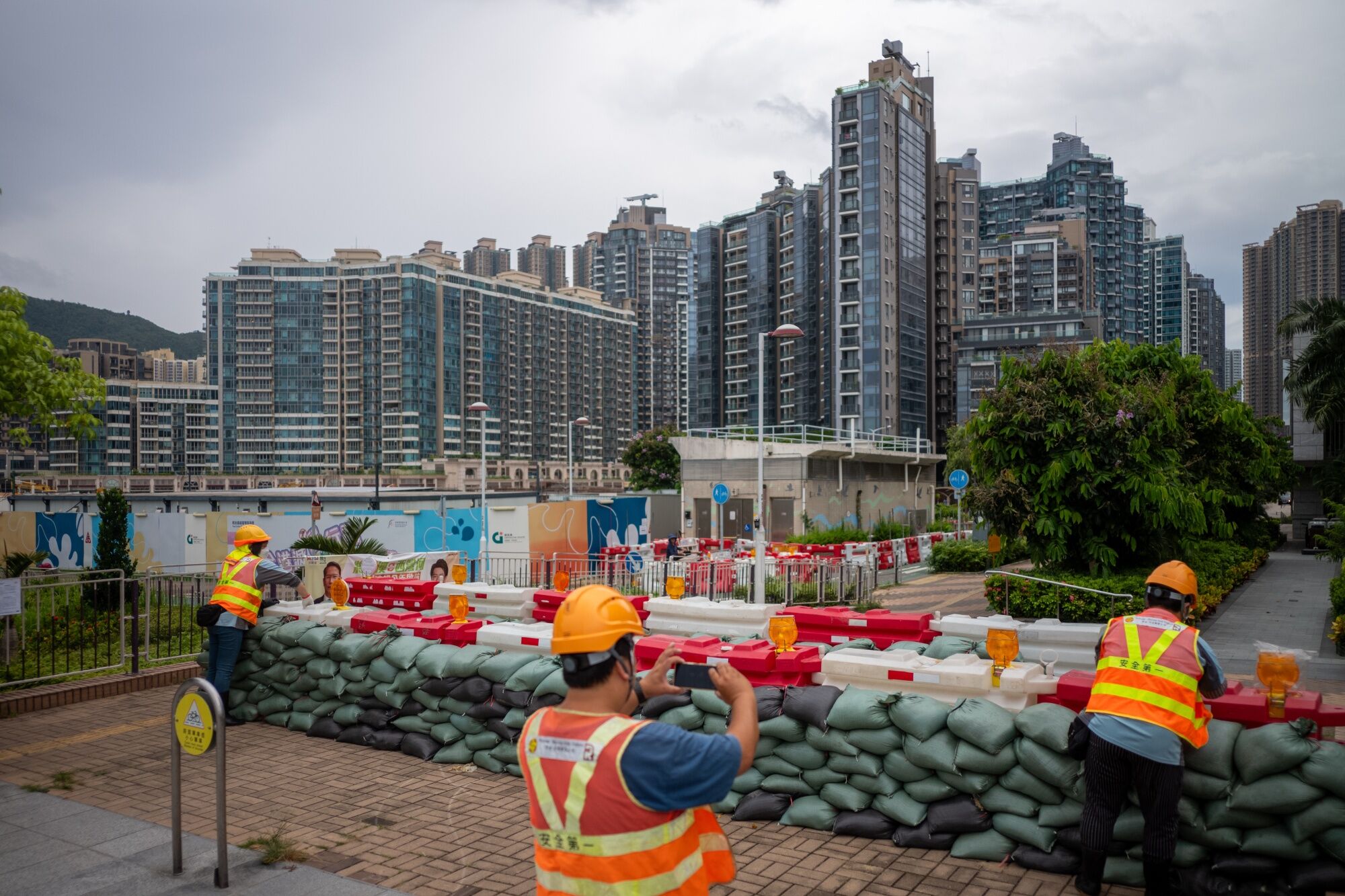
(Bloomberg) -- Hong Kong is bracing for what may be the strongest storm to hit the city in at least five years as Super Typhoon Saola heads straight toward the financial hub.
The local observatory issued the No. 8 storm signal, its third-highest warning, at 2:40 a.m. Friday and plans to keep it at that level for most of the day. That means Hong Kong's $5 trillion stock market will be shut, schools won't open and most public transportation will be grounded. Many flights will be canceled.
Chief Secretary Chan Kwok-ki, leading a government task force to deal with the storm, warned residents to stay indoors, while the head of local observatory warned that the signal may even be raised to the highest level — no. 10.
Saola, which skirted past the Philippines and Taiwan, has the potential to be the most powerful typhoon to hit Hong Kong since Mangkhut battered the city in 2018. That storm left roads blocked, buildings damaged and low-lying areas flooded. The latest forecast track has the eye of the typhoon passing over the southern part of the city either late Friday or early Saturday.
“This can be a very destructive typhoon,” the chief secretary said Thursday, flanked by heads of various government departments. “We hope to minimize the damage.”
As of 7 a.m., Saola was centered about 240 kilometers (149 miles) east-southeast of Hong Kong and is expected to be closest to Hong Kong between Friday night and Saturday morning, skirting within 100 kilometers south of the city, according to the observatory.
All inner harbor and outlying islands ferry services have been suspended, while the MTR, the city's subway and railroad operator, halted bus services.
Cathay Pacific Airways Ltd., the city's flag carrier, said it will halt all Hong Kong flights from 2 p.m. Friday until 10 a.m. Saturday. The airline expects significant disruptions at Hong Kong International Airport and is working to keep aircraft out of the city for a period of time, according to information seen by Bloomberg.
Hong Kong is typically affected by about six typhoons annually, usually from June to October, but only a fraction of those result in market or school closures. The last time was in July because of typhoon Talim.
A direct hit is rare. There have only been 16 maximum-level storms in Hong Kong since records began in 1946, including Hato in 2017 and Mangkhut the following year. Both of those were at least 60 km away from the finance hub at their closest, according to observatory data.
Read more: How Hurricanes Are Categorized on an Imperfect Scale: QuickTake
The No. 10 signal means hurricane force winds reaching a sustained speed of 118 km an hour are affecting the city.
According to Steven Lam, insurance analyst at Bloomberg Intelligence in Hong Kong, Saola's speed and trajectory indicate that the storm may be as destructive as some of Hong Kong's worst typhoons in recent times, such as Mangkhut and Hato.
“Saola's damage could be comparable to Mangkhut and Hato, because it could be closer to the city and with slower movement than the prior two,” Lam said.
China is also set to be affected by another typhoon nearer Shanghai, called Haikui.
“Typhoon Saola and Haikui could bring insurance claims exceeding $1 billion,” Bloomberg Intelligence's Lam said.
China has been hit by bouts of extreme weather this summer which have caused flooding in the north that left dozens dead.
More stories like this are available on bloomberg.com
©2023 Bloomberg L.P.

-
Navigating Energy Crossroads: S Jaishankar's Call For Diversified Supply Chains At G20 Ministerial Meeting

As geopolitical fault lines continue to test maritime trade routes and commodity flows, Jaishankar's message remains pertinent: true economic resilience requires open markets, protected transit lines, and a genuine commitment to multilateral cooperation rather than coercion.
-
Indians Are Travelling, But Not Every Journey Is A Holiday | The Week In Whys
Pilgrims, patients and working women are the real travellers, and the system hasn't quite caught up with them.
-
Getting To Work Costs Women More | The Reason Why
It is not just about women paying more than men. It is about women paying much more in cities than in villages.
-
AI Bias In Investing Cannot Be Eliminated, But It Can Be Governed
Framing is a particularly important example as identical financial information presented in terms of gains rather than losses can lead an LLM to reach a different assessment.
-
Joining The Dots | Dark Skies, Steady Diya: Why Hope Holds This Diwali
With war, a weak rupee and foreign outflows weighing on sentiment, policymakers at the NDTV World Summit and market veterans at NDTV Profit Ignite: Diwali Edition offered the same advice: stay invested and filter out the noise.
-
The Curious Case of Equitas Small Finance Bank And A CEO Who Quit For Stock
PN Vasudevan believes persistent investor concerns over a perceived conflict of interest had become a governance overhang on Equitas Small Finance Bank's stock, even as the lender improved profitability and asset quality.
-
Talking Points This Week: AI Cash Burn, A Tiger Comeback And An India That Still Finds Its Own Path
India is not immune to higher oil or tighter global liquidity, yet its earnings base is broader, its domestic policy levers are still available.
-
Foreign Investors Own Half Of HDFC Bank and ICICI Bank. An LTCG Cut Could Matter Most Here
Foreign portfolio investors have US$115 billion parked in HDFC Bank, ICICI Bank. If the government cuts long-term capital gains tax, Jefferies says returning foreign money could land here first.
-
'Never Seen This Level Of Negativity': Sandeep Tandon Says The Next Rally May Be Closer Than You Think
Veteran investor Sandeep Tandon says foreign selling is easing, large-caps are due a comeback and mid-caps are crowded, while he turns positive on gold, power and pharma this Diwali.
-
Indians Stay With Family, Not In Hotels | The Reason Why
India still lacks enough clean, reliable and affordable hotels for budget-conscious travellers.










