Global Oil Surplus To Persist In 2026 As Demand Sags, IEA Says

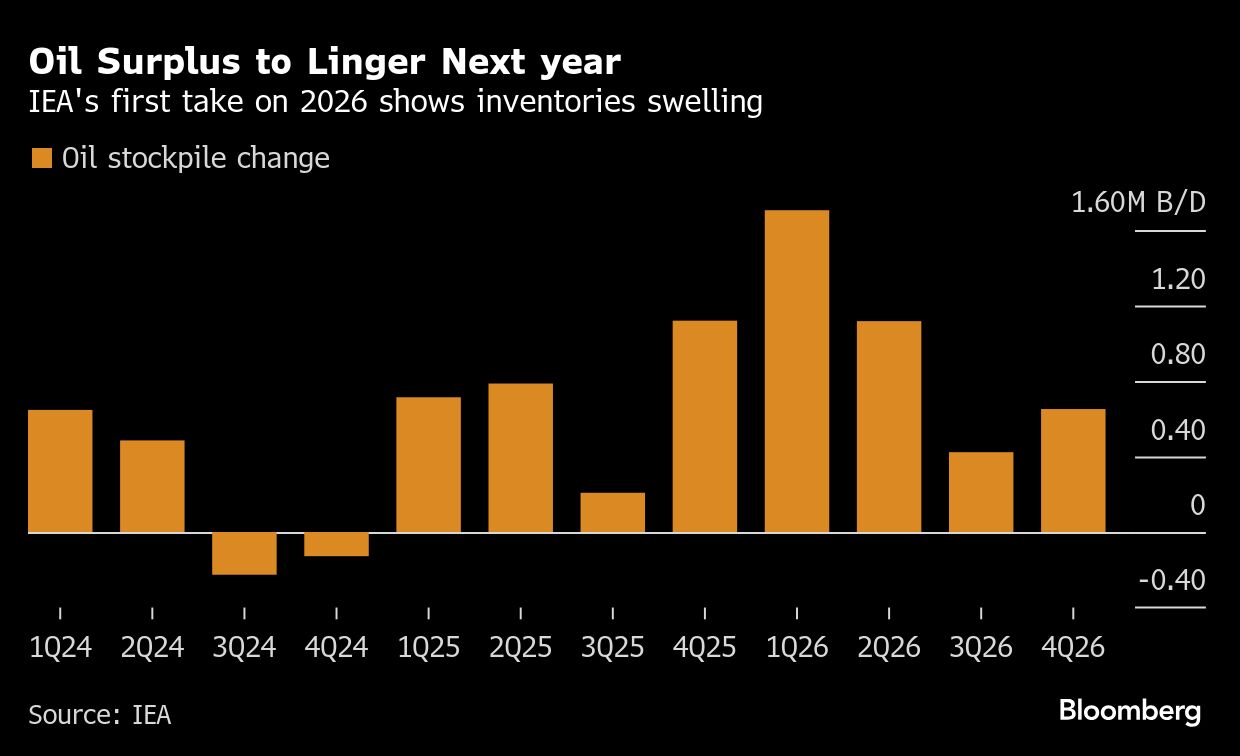
The International Energy Agency slashed forecasts for global oil demand this year amid the brewing trade war, and in its first detailed assessment of 2026 predicted a persistent supply surplus.
The adviser to major economies chopped projections for 2025 demand growth by a hefty 300,000 barrels a day — or almost a third — to 730,000 barrels a day, according to a monthly report on Tuesday. Half of the reduction was concentrated in the US and China, which are engaged in a full-blown trade war.
Consumption growth will be even slower in 2026, at 690,000 barrels a day, due to “a fragile macroeconomic environment” and the rising popularity of electric vehicles, the Paris-based agency said.
“The deteriorating outlook for the global economy amid the sudden sharp escalation in trade tensions in early April has prompted a downgrade to our forecast,” IEA analysts wrote.
The downgrade follow a slump in oil prices to a four-year low below $60 a barrel in London last week, after US President Donald Trump announced a slew of punitive trade tariffs. Brent futures have since recovered a little, trading near $65 on Tuesday.
Trump's move, coupled with a surprise decision by OPEC+ producers to accelerate production increases next month, spurred a series of oil-price revisions from Wall Street giants including Goldman Sachs Group Inc. and JPMorgan Chase & Co.
As the market slump takes a toll on US drillers, the IEA also lowered estimates for new supplies outside the Organization of the Petroleum Exporting Countries this year by 200,000 barrels a day to 1.3 million barrels a day.
These supply additions will still be more than enough to satisfy the subdued rate of demand, both this year and next. In 2026, production outside OPEC+ will expand by a “robust” 920,000 barrels a day, with growth still dominated by the US, Brazil, Canada and Guyana. The global overhang will balloon to 1.7 million barrels a day during the first quarter of next year, according to the agency's data.
Amid the gloom, the report showed some lingering signs of strength in the oil market. Demand growth during the first quarter was at its strongest since 2023, and world oil inventories are hovering “near the bottom of the five-year range.”
Yet the overall outlook is bearish. Even OPEC's secretariat — typically more bullish than other forecasters — has acknowledged the deteriorating picture, trimming oil demand projections in its latest monthly report on Monday. Its estimates remain considerably higher than the IEA's and Wall Street's.
OPEC leader Saudi Arabia has surprisingly appeared to encourage the market downturn, steering the group to bolster output by three times the scheduled amount in May in a bid to compel fellow members to abide by their output limits. It may be a strategy only for the short term.
For the IEA, the slowdown in growth from the recent average of around 1 million barrels a day fits with its broader outlook that oil consumption will stop growing this decade as the transition from fossil fuels to renewable energy gathers momentum.

-
Talking Points This Week: Tech Nerves, FII Buying, And A Faraway Banking Shock

The global markets are not shining this Diwali. The exception in the large markets is, India.
-
Midterm Rally Lasted A Day. The Hard Reality Of A Divided US May Last Two Years | Opinion
Between a contested AI boom, a debt ceiling that arrives in 2027 and a president with every incentive to act alone, the next two years may prove more volatile than the first day's rally suggests.
-
Blue Wave Will Derail the AI Trade but Won't Dismantle the AI Era | Unhedged Position
The Democrats' sweep of the US Congress will see politics collide with economic forces both over the long and short term.
-
It's Time To Take The GST Council's Bet On Trust Global
Payment records can prove India's services exports, and clear, proportionate rules can bring foreign digital sellers into the tax net.
-
Opinion | India at 38: From Innovation Overperformer to Innovation Powerhouse
India now has 453 VC-backed deep science startups, 18 of them late-stage, after 117 percent growth since 2020. Laurus Labs, at USD 9.3 billion, is the most valuable deep science company in any middle-income economy outside China.
-
Navigating Energy Crossroads: S Jaishankar's Call For Diversified Supply Chains At G20 Ministerial Meeting
As geopolitical fault lines continue to test maritime trade routes and commodity flows, Jaishankar's message remains pertinent: true economic resilience requires open markets, protected transit lines, and a genuine commitment to multilateral cooperation rather than coercion.
-
Indians Are Travelling, But Not Every Journey Is A Holiday | The Week In Whys
Pilgrims, patients and working women are the real travellers, and the system hasn't quite caught up with them.
-
Getting To Work Costs Women More | The Reason Why
It is not just about women paying more than men. It is about women paying much more in cities than in villages.
-
AI Bias In Investing Cannot Be Eliminated, But It Can Be Governed
Framing is a particularly important example as identical financial information presented in terms of gains rather than losses can lead an LLM to reach a different assessment.









