Global Economy Could Lose $4 Trillion In Output, IMF Chief Warns
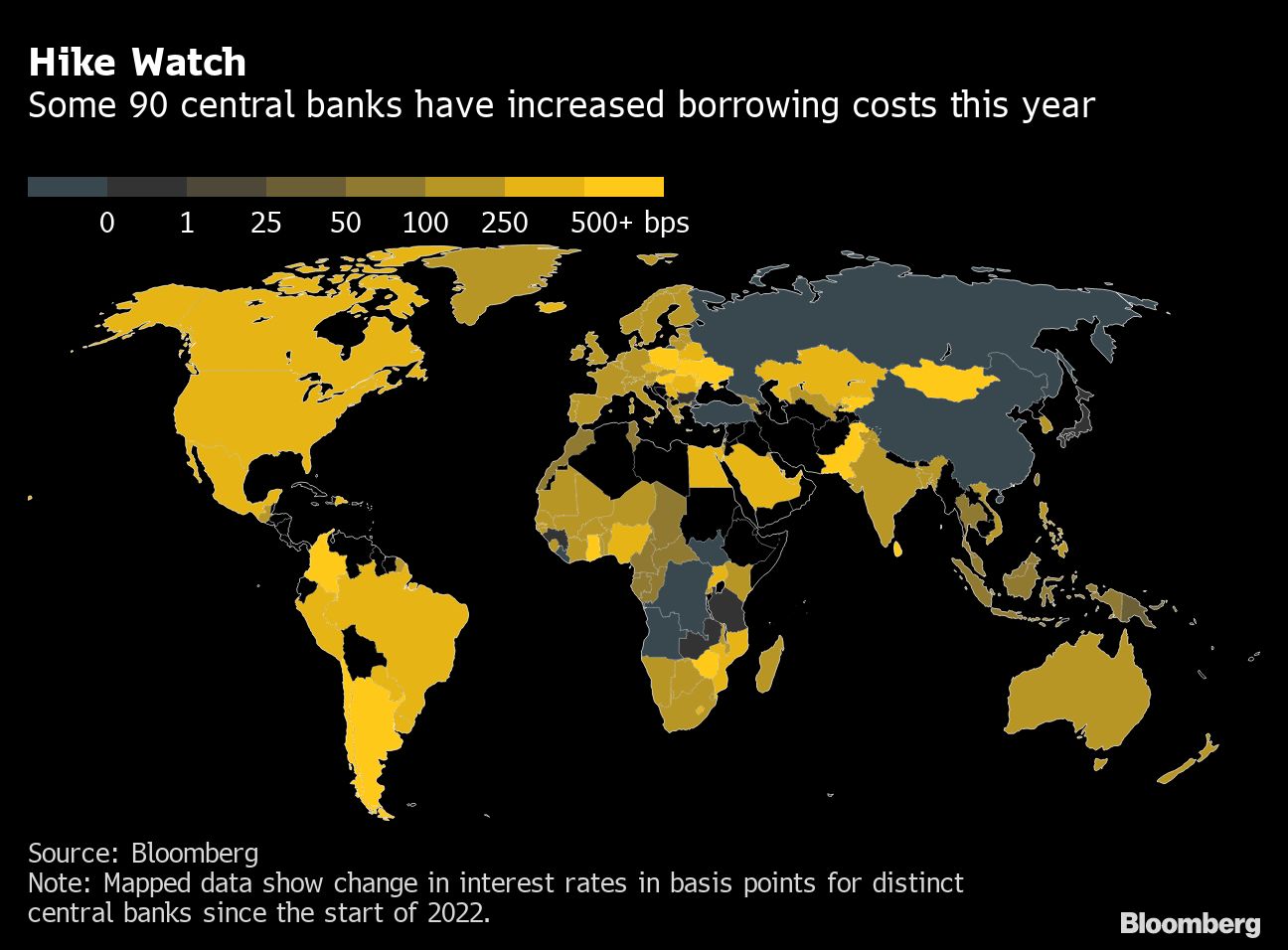
(Bloomberg) -- The global economy is at increasing risk of recession and it could lose $4 trillion in output through 2026, a “massive setback” roughly equivalent to the size of Germany's economy, the International Monetary Fund's top official said.
The situation is “more likely to get worse than to get better,” Managing Director Kristalina Georgieva said in prepared remarks for an IMF event Thursday in Washington. She cited uncertainty that remains “extremely high” after Russia's invasion of Ukraine and the pandemic, and warned that “there could be even more economic shocks.”

The head of the lender of last resort spoke ahead of its annual meetings next week, when finance ministers and central bankers will converge on the US capital to seek solutions for global challenges such as persistent inflation, record debt that emerging developing nations are struggling to service, climate change and food security.
The IMF estimates countries accounting for about a third of the global economy will experience at least two consecutive quarters of contraction this or next year, Georgieva said.
“Even when growth is positive, it will feel like a recession because of shrinking real incomes and rising prices,” she added.
The IMF currently projects global economic growth of just 3.2% in 2022 and 2.9% in 2023. Georgieva said the latter estimate will be lowered next week.
Georgieva called on policymakers to “stay the course” to bring down inflation as a means of stabilizing economies.
“As painful as that may be this is the right thing to do. Even if the economy slows down as a result,” she said.

She also warned that the cost of a policy misstep will be high.
“Not tightening enough would cause inflation to become deanchored and entrenched -- which would require future interest rates to be much higher and more sustained, causing massive harm on growth and massive harm on people,” she said. “On the other hand, tightening monetary policy too much and too fast -- and doing so in a synchronized manner across countries -- could push many economies into prolonged recession.”
The combination of a strong dollar and higher interest rates is hitting emerging-market economies with weak fundamentals, making it more expensive for them to service their debt, Georgieva said.
Speaking in a separate interview on CNBC, Georgieva reiterated calls for creditors to restructure the debt of vulnerable nations and that China -- the world's largest bilateral lender -- participate in these processes.
”It's in their interest that we prevent a wave of defaults,” the IMF chief said.
Other priorities include deploying “temporary” and “targeted” fiscal measures focused on lower-income households, and supporting emerging markets, the IMF chief said at the Georgetown event.
Georgieva also cautioned against “fragmentation” and urged stronger international cooperation, particularly in addressing issues of food insecurity and climate change.
(Updates with comment from Georgieva in eighth paragraph.)
More stories like this are available on bloomberg.com
©2022 Bloomberg L.P.

-
Love, Sex Aur Dhokha: The Audacious Plot To Spy On Jensen Huang

A Taipei dinner, a Singapore chip buyer and a suspected Chinese asset: inside the alleged spy operation that got close to NVIDIA's Jensen Huang.
-
Ten Things I Learnt This Samvat
Patience can be a trap. Cheap stocks can stay cheap. Leverage can wipe you out. What did Samvat 2082 teach us? Niraj Shah writes on 10 lessons from the year gone by.
-
Talking Points This Week: Tech Nerves, FII Buying, And A Faraway Banking Shock
The global markets are not shining this Diwali. The exception in the large markets is, India.
-
Midterm Rally Lasted A Day. The Hard Reality Of A Divided US May Last Two Years | Opinion
Between a contested AI boom, a debt ceiling that arrives in 2027 and a president with every incentive to act alone, the next two years may prove more volatile than the first day's rally suggests.
-
Blue Wave Will Derail the AI Trade but Won't Dismantle the AI Era | Unhedged Position
The Democrats' sweep of the US Congress will see politics collide with economic forces both over the long and short term.
-
It's Time To Take The GST Council's Bet On Trust Global
Payment records can prove India's services exports, and clear, proportionate rules can bring foreign digital sellers into the tax net.
-
Opinion | India at 38: From Innovation Overperformer to Innovation Powerhouse
India now has 453 VC-backed deep science startups, 18 of them late-stage, after 117 percent growth since 2020. Laurus Labs, at USD 9.3 billion, is the most valuable deep science company in any middle-income economy outside China.
-
Navigating Energy Crossroads: S Jaishankar's Call For Diversified Supply Chains At G20 Ministerial Meeting
As geopolitical fault lines continue to test maritime trade routes and commodity flows, Jaishankar's message remains pertinent: true economic resilience requires open markets, protected transit lines, and a genuine commitment to multilateral cooperation rather than coercion.
-
Indians Are Travelling, But Not Every Journey Is A Holiday | The Week In Whys
Pilgrims, patients and working women are the real travellers, and the system hasn't quite caught up with them.









